

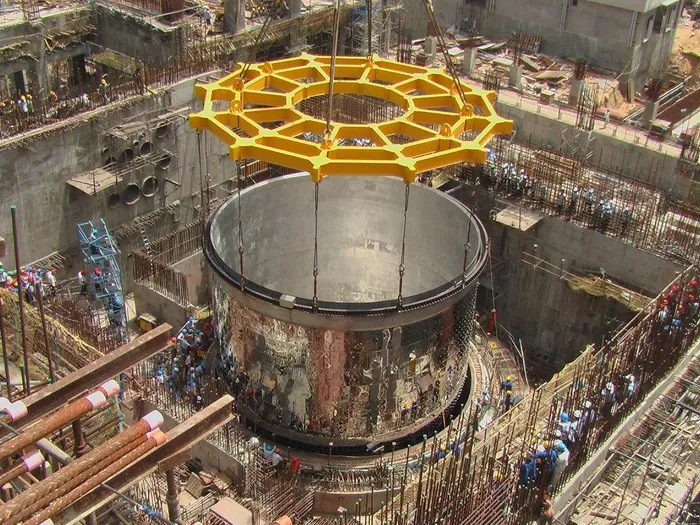
Prototype Fast Breeder Reactor.
Image: X
At a time when global discourse has been dominated by conflict, shifting alliances, and competing geopolitical narratives, a quieter transformation has been underway - one that carries far greater long-term consequences. India chose to build.
In 2026, India’s indigenously developed Prototype Fast Breeder Reactor (PFBR) at Kalpakkam achieved criticality, marking a decisive milestone in its three-stage nuclear energy programme and its pursuit of long-term energy sovereignty. There were no dramatic announcements and no geopolitical signaling - only capability built patiently over decades.
This achievement is deeply rooted in the vision of Homi Jehangir Bhabha, widely regarded as the architect of India’s nuclear programme. Decades ago, Bhabha laid out a long-term three-stage strategy designed not merely to generate power, but to secure energy independence through the effective use of India’s limited uranium and abundant thorium reserves.
The PFBR represents the realisation of that vision - a system where fuel is not only consumed but created, enabling a sustainable and self-reliant nuclear future. On this milestone, Indian Prime Minister Narendra Modi emphasised that India’s progress in advanced nuclear technology reflects the country’s commitment to self-reliance, clean energy, and scientific excellence, noting that such achievements are the result of decades of dedication by Indian scientists and engineers.
The PFBR project, initiated in 2004, took over 20 years to reach criticality. The project was developed by BHAVINI (Bharatiya Nabhikiya Vidyut Nigam Ltd) with 200 Indian industries participated, making it one of the most extensive examples of coordinated industrial and scientific collaboration in the Global South.
PFBR was developed indigenously, representing a key milestone under the Aatmanirbhar Bharat (Self-reliant India) initiative This was not just a reactor; it was an ecosystem. The technical barriers were formidable, including the mastery of liquid sodium cooling technology, the safe handling of plutonium-based Mixed Oxide fuel, the development of a closed fuel cycle, and the establishment of stringent safety and regulatory benchmarks.
According to the World Nuclear Association, fast breeder reactors represent one of the most complex nuclear technologies, with only a handful of countries achieving operational success. Yet India persisted, guided by long-term policy consistency rather than short-term outcomes, reinforcing the principle that energy security is ultimately built on domestic technological capability.
Unlike conventional nuclear reactors, the PFBR is designed to produce more fuel than it consumes, fundamentally changing the economics and sustainability of nuclear power. It operates using plutonium-239 and uranium-238 in the form of Mixed Oxide fuel, employs fast neutrons to sustain the chain reaction, and converts fertile material into fissile fuel.
The reactor uses liquid sodium for efficient heat transfer and enables reprocessing of spent fuel within a closed cycle. The defining outcome is a breeding ratio greater than one, positioning nuclear energy not just as a power source but as a self-sustaining system. The reactor, which can produce more fuel than it consumes, highlights India's technological advancement, placing it as the second country after Russia with a commercial fast breeder reactor.
Globally, fast breeder reactor technology remains limited to a few nations. Russia has demonstrated long-term operational maturity, while India represents a strategic evolution of the technology. According to the International Atomic Energy Agency, fast reactors and closed fuel cycle systems are essential for reducing long-lived nuclear waste, improving fuel efficiency, and enabling sustainable nuclear expansion.
For BRICS nations, particularly South Africa, India’s achievement carries immediate and practical relevance. South Africa remains the only African country operating a commercial nuclear power plant, the Koeberg Nuclear Power Station, with an installed capacity of approximately 1,860 megawatts, contributing roughly four to five percent of national electricity supply. However, the broader energy system remains heavily constrained by structural dependence on coal and a centralized utility model dominated by Eskom.
Coal continues to define South Africa’s energy reality, accounting for roughly 70–75% of electricity generation and an even higher share of the broader energy mix. This dependence, combined with aging infrastructure, has resulted in recurring load shedding and reliability challenges that have constrained economic growth and industrial productivity. While operational improvements have provided temporary relief, the structural challenge remains unresolved.
Recognising this, South Africa has begun transitioning toward a more diversified energy mix. Renewable energy is expanding, and nuclear remains part of long-term planning. However, an equally important development is emerging in the gas sector through Transnet. Transnet is positioning itself as a key enabler of the country’s energy transition through the development of liquefied natural gas infrastructure, including the Zululand Energy Terminal at Richards Bay, which is expected to become South Africa’s first LNG import terminal. This initiative is designed to address future gas supply gaps, support industrial demand, and enable gas-to-power projects that can complement renewable energy.
In parallel, Transnet is planning to repurpose existing pipeline infrastructure to transport regasified LNG from coastal terminals to inland economic hubs, reflecting a strategic shift toward integrated energy logistics. While LNG offers a critical transition pathway away from coal, it also introduces considerations of import dependence and price volatility, reinforcing the importance of balancing short-term flexibility with long-term energy sovereignty.
In this context, India’s PFBR offers a powerful lesson. It demonstrates not only technological achievement but the ability to build, sustain, and execute complex national programmes over decades. It reflects a transition from dependence to capability - something that South Africa, and indeed many BRICS nations, are still striving to achieve.
The broader implication for BRICS is clear. Collectively, these nations possess vast natural resources, growing energy demand, and significant industrial potential. What is required is alignment - where technological capability, industrial participation, and long-term policy converge. India contributes indigenous reactor design and a future-ready thorium strategy, Russia provides decades of operational expertise in advanced nuclear systems, and South Africa brings strategic geography, logistics infrastructure, and emerging gas sector development.
The implications extend far beyond electricity generation. They encompass energy security, industrial development, technological sovereignty, and climate resilience. Nuclear energy, alongside transitional fuels such as LNG, forms a critical part of a balanced and resilient energy strategy. According to the International Energy Agency, nuclear power remains one of the most reliable sources of low-carbon electricity and is essential for achieving stable and sustainable energy systems.
While much of the world debated power, India chose to create it—not through rhetoric, but through engineering, not through dependency, but through capability. It built systems, skills, and sovereignty.
Power is not claimed in headlines. It is created through sustained effort.
The enduring relationship between India and South Africa finds one of its strongest foundations in the legacy of Nelson Mandela, who, soon after his release from prison, chose India as one of his early international engagements. This symbolic gesture reflected deep historical solidarity and a shared vision for development and self-reliance.
Over time, this relationship has evolved into practical collaboration, particularly in the energy sector. Eskom has strengthened ties with Indian partners through technical cooperation and knowledge exchange, including a formal collaboration with NTPC focused on operational excellence, training, and best practices in power generation. Indian companies such as Adani Group have also shown strategic interest in South Africa’s energy infrastructure, while Eskom engineers have benefited from specialised training programmes in India. This builds on a long-standing relationship, as Eskom had previously contributed to transmission projects in India, reflecting a two-way exchange of expertise.
Building on this foundation, deeper collaboration in advanced energy technologies presents a significant opportunity. If South Africa decides to develop complex systems such as advanced nuclear reactors, it could unlock participation for more than 200 direct companies across engineering, manufacturing, and construction, while enabling thousands of subcontractors across the supply chain.
Such an initiative would not only support job creation but also stimulate industrial growth, enhance local technical capability, and strengthen long-term energy independence. Within the BRICS framework, this represents a natural progression - from historical solidarity to strategic co-development - where shared expertise between India and South Africa can translate into tangible economic and technological advancement.
For BRICS nations, the message is both clear and urgent. The future will not belong to those who merely possess resources, but to those who can transform them into enduring capability.
Amit More
Image: Facebook
Amit More is an Exco Member of the India South Africa Chamber of Commerce.
** The views expressed do not necessarily reflect the views of IOL or Independent Media.