

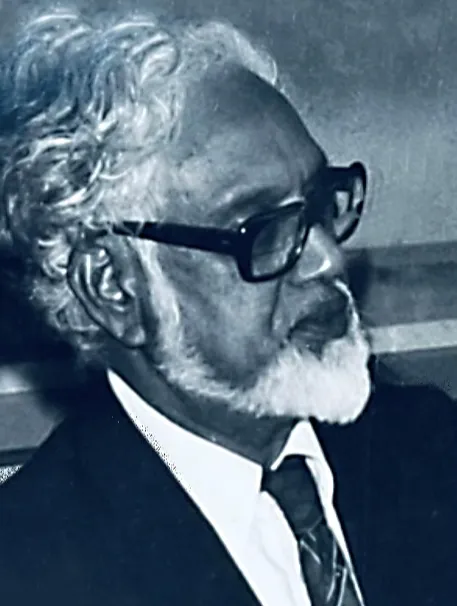
RS Nowbath
Image: Supplied
In a dim garage at 25 Daintree Avenue, Asherville, Durban, a dozen cardboard boxes sat in quiet anonymity.
Yet inside them lay treasures more precious than gold bars: thousands of yellowing pages, meticulously struck on to paper by hand-operated keys, carrying the weight of a history too often ignored.
An extraordinary accomplishment, these manuscripts chronicled the epic dispersal of Indians to several countries across the globe, uprooted to serve the insatiable demands of Britain’s sugar empire.
Every page revealed the political machinations that underpinned indenture – the cynical bargains struck in colonial offices, the trials endured by labourers in the cane fields, and the cruel irony of a system that mimicked slavery long after slavery itself had been abolished.
What appeared to be mere records were, in truth, indictments: a well-crafted testament to how exploitation was repackaged, legitimised, and sustained under the banner of empire.
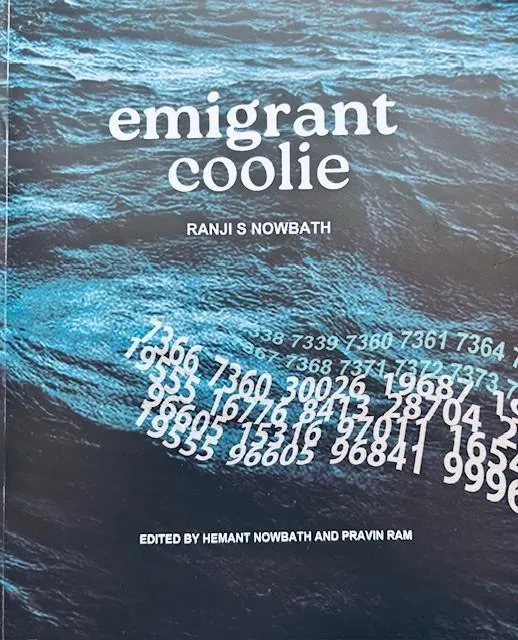
Nowbath's book, Emigrant Coolie
Image: Supplied
Stacked in silence, those boxes held not just documents but voices – resilient, wounded, defiant – preserved in typewriter ink and paper, waiting to remind the world that dignity, though suppressed, can never be erased.
More than seven decades earlier, an erudite Durban scholar of political philosophy, economics, psychology, sociology and law, Ranji Seetharam Nowbath, then 27 in 1949, embarked on a three-year research project at Banaras Hindu University and the University of Calcutta.
Awarded a Government of India Cultural Relations scholarship, he traced the history of coolie emigration from India and titled his writings Emigrant Coolie. It was these scripts that were collecting dust in the nondescript garage in Asherville.
Five years ago, his son Dr Hemant Nowbath, a psychiatrist, and Pravin Ram, a retired history curriculum specialist, rolled up their sleeves and collated the manuscripts into a 400-page book. With the help of publisher Anivesh Singh, Emigrant Coolie was launched a fortnight ago, fulfilling the wish of the author who had passed away almost 30 years earlier, on July 25, 1996.
Born in Newcastle in 1921, RS Nowbath attended Sastri College in Durban. He worked at The Leader newspaper from 1941 to 1945, selling advertising space, reporting, and editing alongside founder Dhanee Bramdaw. Later, after returning from India, he taught at schools, edited The Graphic, studied law part-time, and was admitted to the Bar in 1971.
I first met him in 1977, when I was a university drop-out with no clear career path, nudged by my father into a temporary advertising salesman job at The Graphic, earning the princely sum of R75 per month. “Temporary” became a lifelong passion for the media and a soul-satisfying career.
The editor at The Graphic, Ticks Chetty, had just left to join the Sunday Tribune as a reporter. Nowbath was appointed as part-time editor of The Graphic. Selling ad space was not appealing for me. I began helping with some news writing, without any formal training, though. That was when I encountered Nowbath closely – his peculiar habits, his frugality, his discipline.
Right from the outset, we became friends. During long late-night sessions at the old-club-style The Exchange bar at the Royal Hotel, I noticed he was his own man. He neither sought approval nor bent to convention. He did what he believed was right, and what worked for him.
His habits were peculiar, yet purposeful. Returning from India, he never reset his wristwatch to South African time. It remained three-and-a-half hours ahead, ticking to India’s rhythm. With a glance and a quick calculation, he always knew the local hour. I emulated this peculiar habit and for many years my watch also ran to India time.
Nowbath drove an old Volkswagen Beetle, content to leave it baking in the street rather than pay for a parking garage. Prestige was irrelevant; practicality was king. Paper was treated with the same ruthless logic. If he typed notes or stories, he used the back of a page – crossing out the front with a pen before repurposing it. His clerks were expected to follow suit. For him, frugality was a discipline, not a deprivation. And here lies the distinction: a frugal man trims excess with purpose, while a miser starves himself of utility. Frugality is efficiency; miserliness is fear.
He taught his legal clerks to care for their tools. Typewriters were cleaned meticulously, keys polished so that the hollow of an O, B, or D remained clear, unspoiled by ink or dust. In his world, even the smallest detail mattered.
When he arrived from Newcastle to attend Sastri College, he boarded with a South Indian Tamil family in Mount Vernon, Hillary. Their vegetarian fast during Puratassi became his own. What began as courtesy became conviction: for years thereafter, he kept the Puratassi fast with quiet discipline, never mind that he had “roti” heritage.
Yet he was no orthodox believer. He was an agnostic, candid in his uncertainty. He often said he was not sure if there was a God. The irony was delicious: part of his name, Seetharam, was stitched from the Ramayana’s protagonists, Sita and Rama. But names are inheritance; belief is choice.
Still, he understood the cultural necessity of faith. Religion, he believed, was not about personal piety, but about communal continuity. Hinduism, in his view, had to be sustained in South Africa –not as dogma, but as heritage. For many years, he served as secretary of the South African Hindu Maha Sabha, ensuring that the rituals, festivals and institutions of Hindu life endured.
Nowbath was a paradox in motion: sceptical yet devout in practice, frugal yet generous with knowledge, eccentric yet exacting. He lived by his own measure, but always with an eye to the larger fabric of community. In a world obsessed with appearances, he was proof that substance – however peculiar – still mattered.
Nowbath wrote Talk of the Bazaar in The Leader under the nom de plume The Faquir. His counterpart at The Graphic, Pat Poovalingam, offered a satirical counterpoint with Tales from Gondwanaland, signed as Sadiq Ali.
It was never enough for Nowbath and Poovalingam to be lawyers, journalists and community leaders. No, they had to be gladiators of intellect, sparring not with swords but with syllables. Behind each column lay a secret jealousy: who was cleverer, who more intelligent?
If Nowbath’s column was a diesel-powered Mercedes-Benz – solid, unostentatious, reliable, trustworthy; Poovalingam’s was a Lamborghini – loud, angular, designed to turn heads. He wrote while quaffing single malt whiskey, fingers tapping to the mellifluous strains of Carnatic legend MS Subbulakshmi. His prose thrived on spectacle, drama and flamboyant, risqué turns of phrase – accuracy optional, but impact guaranteed.
And perhaps that is the essence of Nowbath’s legacy: a man who could park his Beetle in the sun, scribble on the back of a page, and still remind us that heritage, like ink in the hollow of an O, must be kept clear lest it fade into dust.
Nowbath was an outstanding writer with a keenly analytical mind; he was an outspoken critic of government policies that bore down on people of colour.
In a preface to Emigrant Coolie, he wrote: “The Indians emigrating to the colonies have exhibited remarkable moral strength. They survived the rigours of the indenture days and the heritage of slavery to which they had succeeded and, despite the devil in the white man, they have made tremendous headway socially and economically.
“They must, indeed, have been a strong people. There must have been a streak of good running through their fibres so that not only have they triumphed over their hazards of the indenture system but are, in some of the countries in which they live, regarded as a threat to European welfare and so are denied what should be fair reward for the suffering of their forebears. Out of miserable, half-starved coolies who went abroad have risen the Indian populations of Mauritius, the West Indies, Natal, Fiji, Reunion and Surinam.”
Hemant and Pravin deserve commendation for breathing life into Nowbath’s manuscripts. Their work adds richly to the study of the girmitiyas – the indentured servants whose stories shaped a chapter of history too often overlooked.
In the end, those boxes in Asherville were more than dusty archives. They became a mirror, reflecting a life of substance, a history of resilience, and a reminder that even in the dimmest garage, dignity waits patiently to be rediscovered – and retold.
*** For copies of Emigrant Coolie, contact Micromega Publications: [email protected] or 083 778 1991.
** The views expressed do not necessarily reflect the views of IOL or Independent Media.