

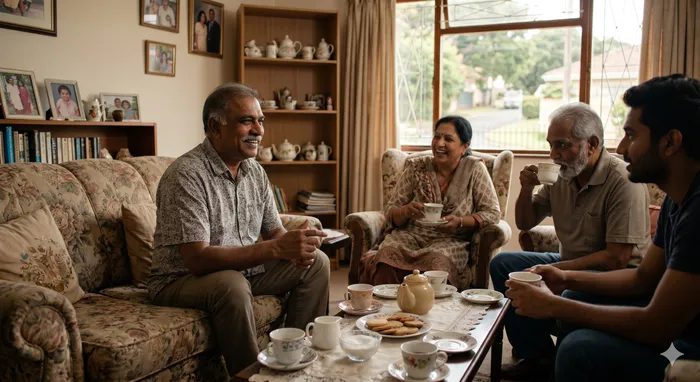
We are more prosperous than our parents were. More mobile. More connected. And somehow, in acquiring all of that, we have misplaced the single most human instinct they carried with them everywhere they went: the instinct to show up for one another with something in hand.
Image: Google Gemini
Stop. Before you read another word, close whatever tab is open besides this one, put down your phone for a moment, and come with me. Not forward – backward.
Forty, maybe 50 years. Back to a small wood-and-iron house in Nonoti, Chatsworth, Phoenix, Merebank or Isipingo or even Darnall, where the front door was never really locked, where the neighbours knew your grandmother’s name, and where the sound of a knock at the door on a Sunday afternoon was enough to make every child in the house sit up straight. Because company was coming. And company – in our world, in that time – came with something in their hands.
It did not matter how much or how little they had. It was not about abundance. It was about the act. A packet of Bakers Blue Label Marie biscuits, placed on the kitchen counter with the quiet dignity of someone who understood, without being told, that you did not arrive at another person’s home empty-handed. If they were slightly better off that week, it was a box of Choice Assorted – and every child in the house knew that a Choice Assorted meant negotiations, politics, and the occasional injustice of watching your favourite biscuit disappear into someone else’s hand.
The Lemon Creams went first. Always. The Tennis Biscuits had their loyal constituency. The Eat Sum Mores were underestimated, which made them available for the patient and the strategic. And there was one biscuit in that box that was yours. Your siblings knew it. And they respected it – or there were consequences that no parent could fully arbitrate.
But the adults – they had already moved on. They were at the table, or in the lounge, and someone had put the kettle on. And here is where you need to pay attention, because this detail matters more than it seems: it was not just any tea. It was Joko or Five Roses. Not because they were fashionable. Not because anyone had done a taste test. Because they were affordable. Because when you were raising a family on a budget that left no room for error, you bought what worked and what cost what you could manage.
Joko and Five Roses became the unofficial teas of an entire community – brewed strong, poured into mismatched cups, and served alongside those biscuits that had just arrived at the door. Generations of Indian South Africans grew up with that smell: tea steeping, biscuits open on the counter, voices layered over one another in the warmth of a small house that somehow always had room for one more.
“They did not have much. But they never arrived empty-handed. That was not poverty – that was dignity. That was who we were.”
And then there was the mindrel. If you did not grow up Indian in South Africa in the 1970s, you may know it by its formal name – Creme Soda. That pale green, impossibly sweet carbonated drink that seemed to flow through every Indian household gathering like a second river. But we never called it Creme Soda. We called it mindrel. Why? Because that is what it was to us – ours, renamed, claimed, absorbed into the vocabulary of a community that made everything it touched, its own.
The mindrel was the official cool drink of the Indian South African household not because of preference, but because of price. It was among the cheapest on the shelf, and at most times on special. And so, it became the drink you poured for visitors, the drink the children fought over, the drink that sat in a row of bottles in the kitchen on the days when the house was full.
Today, Creme Soda is a premium product, a retro novelty, a nostalgia purchase at a non-nostalgic price. And those of us who remember it as the most ordinary thing in the world – as common and expected as Joko in the pot – find ourselves paying a premium to remember who we were. This is the great inversion of our times: every marker of our modesty has become expensive. The Marie biscuit – once the most economical biscuit on any shelf, produced in Durban from as far back as the 1890s, and chosen precisely because it asked very little of the buyer – now sits at the top of the price index, carried there by the loyalty of a generation which will not stop buying it regardless of cost.
The Eat Sum More, which my colleague’s mother still firmly believes is cheaper than Romany Creams, is not. It has not been for some time. When he broke that news to her, she sat in a silence that was not about biscuits at all. It was about a world that had shifted under her feet without asking her permission. The manufacturers know what they are doing. They know that nostalgia is a captive market. They know that we will pay. What is harder to answer is what we ourselves have lost in the process – not to pricing, but to something quieter and more corrosive. Because here is what is true: today, nine out of 10 people arrive at someone’s home with nothing. Not a packet of biscuits. Not a bottle of mindrel. Not even the thought of it.
We are more prosperous than our parents were. More mobile. More connected. And somehow, in acquiring all of that, we have misplaced the single most human instinct they carried with them everywhere they went: the instinct to show up for one another with something in hand. We have dressed this up in the language of informality – “oh, they don’t expect anything”, “it’s not really done any more”. But what we are really saying, if we are honest, is that we stopped thinking about it. We stopped thinking of them before we walked through their door. And that is a loss that no amount of prosperity can paper over.
“The mindrel is now a premium. The Marie is now expensive. The Eat Sum More costs more than the Romany Cream. Everything humble has been made costly – except our values. Those we gave away for free.”
And then there is the samoosa. Let me tell you about the samoosa, because this is where everything lives – the whole unspoken truth of who our parents were and what they gave us without ever naming it. Every Indian household of that era knew the frying afternoon.
The oil heating, the carefully sealed triangles going in one by one, and inevitably – because perfection was never guaranteed – some breaking open, some catching the heat a moment too long, some coming out golden-edged and imperfect, and quietly disqualified from the plate that would go to the family. Who ate those? The mother. The father. Without a word. Without ceremony. Without any expectation that anyone would notice or say thank you.
They took the broken ones and gave their children the best of what there was. Not as performance. Not as sacrifice declared aloud. Simply as love, expressed in the only language that mattered: action.
That image – a mother in a kitchen eating the burnt samoosa so that her child could have the perfect one – is the most complete portrait I can offer of the generation that built us. They did not have a word for self-sacrifice because to them it was not sacrifice. It was simply the order of things. You gave the best to those you loved. You took the broken ones yourself. You arrived at someone’s door with a packet of Maries or a box of Choice Assorted, you made Joko tea and poured mindrel for the children, and you sat together in a small tin house, and you were, in every way that counted, wealthy.
We were not poor. We were not rich. We were something more durable than either: we were a community. And a community is not a place or a demographic. It is a set of habits practised daily – the habit of showing up, the habit of bringing something, the habit of giving the best to those around you, and eating the broken ones yourself. Those habits were passed to us. We received them. And somewhere in the years of accumulating comfort and convenience, too many of us have let them quietly lapse.
This column is not a rebuke. It is a mirror. Tear it out if you have to. Paste it somewhere you will see it. Because this is you – or it was, and it can be again. The blue packet on the counter. The mindrel poured cold into a glass. The Joko tea strong in the pot. The broken samoosa eaten in the kitchen without complaint. These were not small things dressed up as large ones. They were large things that arrived in small packages – and they told you, every single time, exactly who the people around you were. The question is whether you still are.