

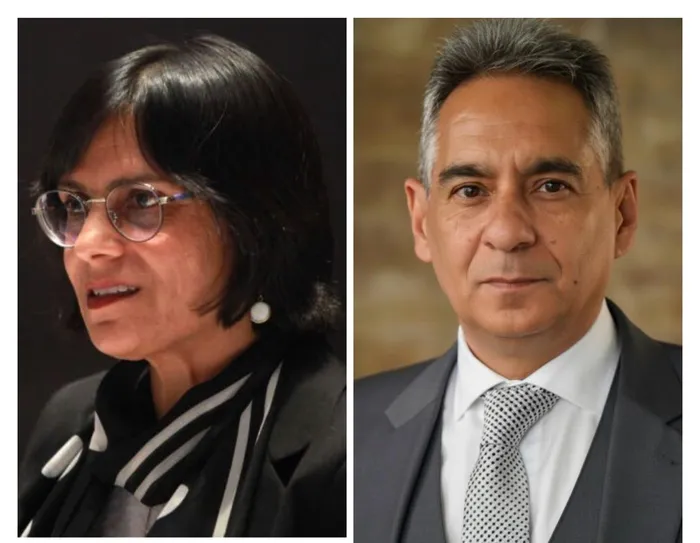
Judge Mas-udah Pangarker and acting Judge Igshaan Higgins a both of whom are Muslim, have made a groundbreaking ruling which has set a precedent for South African family law and Muslims around the country.
Image: Supplied
Judge Masudah Pangarker and acting Judge Igshaan Higgins both of whom are Muslim, have made a pioneering ruling which has set a precedent for South African family law and Muslims around the country.
The Western Cape High Court has once again in a series of two months delivered rulings which impact the Muslim community both in implicitly recognising the proprietary consequences of Islamic marriages and has last week delivered a landmark ruling establishing that nafaqah which is the technical term referencing the Islamic religious duty of a husband to provide financial maintenance - can serve as the basis for civil reimbursement claims between divorced Muslim spouses.
The appeal, Y.M v S.P (Appeal) (A146/2025), involved a Cape Town woman seeking to reclaim funds she spent on essential living expenses during her marriage. The court ordered the ex-husband to repay approximately R96,780 to his former wife.
It was essentially an appeal against the whole judgment and order of the Magistrates Court for the District of Wynberg, in which the appellant’s claim was dismissed with costs after conclusion of a trial. The central issue before the Court was whether the appellant’s payments were voluntary gifts or whether they gave rise to a legally enforceable obligation to be reimbursed by the respondent once he regained financial strength, arising either from an agreement between the parties (express or tacit), the principles of Islamic law (nafaqah), or unjustified enrichment.
The parties were both Muslim professionals residing in the Western Cape, rekindled a prior relationship in March 2020. The appellant is an attorney who ran her own legal practice. The respondent was employed in the NGO sector but, crucially, was under debt review and had a duty to support his mother. His financial position was therefore constrained.
The judges found that while nafaqah is a religious doctrine, it provides a “normative backdrop” to understand the financial conduct of the couple.
Under Islamic law, if a husband fails to provide maintenance and the wife pays for essentials, it is presumed to be a loan (Qard) unless she explicitly waives her right to repayment. In this case there was no such waiver.
The judges noted that “The Islamic legal context thus provides the normative backdrop against which the parties; conduct must be understood.
It explains why the respondent approached the appellant’s father first to seek permission to marry the appellant. It also explains why the appellant would have expected to be reimbursed for the sums of money she spent during the marriage, as described in the pleadings and during the trial. In addition, it demonstrates that her payments for rent, food and essential medical care were not voluntary benevolence, but a step-in to satisfy the respondent’s own primary obligation as a Muslim husband. To hold otherwise would thus be to permit the respondent to be unjustly enriched at the appellant’s expense.”
This aspect is significant because this landmark ruling significantly shifts the legal terrain by moving beyond merely recognizing Muslim marriages to integrating Islamic financial principles into civil law, preventing the exploitation of legal loopholes.
The ruling noted that because of the Divorce Amendment Act 1 of 2024, courts are now legally obligated to consider the specific context of spouses in an Islamic marriage rather than applying a “strictly civil law outlook”.
The court must be commended for detailing a ruling on its own terms and in particular even going so far as citing the following in its judgment- “The Holy Quran explicitly imposes a duty of maintenance on the husband as follows ‘Let the man of means spend according to his means, and the man whose resources are restricted, let him spend according to what God has given him.’ (Chapter 65 verse 7).”
Effectively the principles the Qur’an introduces as a catalyst for social transformation all work to establish balance and bring about greater justice and equity in human behaviour, both at a basic level between spouses and broadly at a global level.
There are certain fundamentals that have been emerging from such judgments.
Maintenance for women which is intrinsic to the Qur’an is now a legal precedent in South Africa. It is the first reported High Court decision to explicitly use the Islamic obligation and an Islamic principle of nafaqah to support a civil claim for monetary reimbursement between divorced Muslim spouses. In this case and possibly many others that have arisen over the years, the ruling effectively demolished the common legal defence used by ex-husbands that a wife’s financial contributions during a marriage were merely “voluntary gifts”. Many husbands were getting away with such by falsely alluding to the fact that they were gifts effectively creating loopholes have been exploited on a regular basis by all and indeed bolstered by unscrupulous attorneys who were only interested in pecuniary benefits for themselves by manufacturing such defences.
The judgment also sends a rigorous message to magistrates who on many occasions adopt a superficial, literalistic and narrow approach when faced with various factual scenarios. When the court amalgamates religious legal norms with civil law, claims can no longer be dismissed simply because they arise from an Islamic marriage or rely on Jurisprudential principles like nafaqah.
The court effectively adopted an Islamic obligation and made it a legal obligation based on that very Islamic principle. Gone are the days when only western legal frameworks from Roman-Dutch law formed the fabric of South African society. Besides that, it now has set a precedent for how Muslim women can claim repayment for household expenses (rent, groceries, debts) borne during the marriage by providing a practical and an actionable remedy for financial recovery, breaking down barriers to the inequality in the South African legal system that have existed for far too long.