

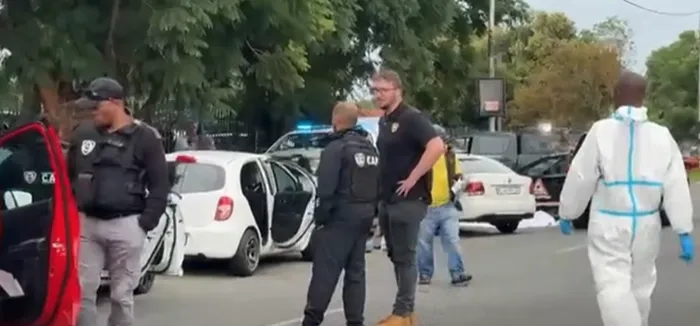
What has happened to the humanity in man? Increasingly, when tragedy strikes -when someone is shot dead, lies dying, or is seriously wounded - onlookers do not rush to render assistance. Instead, they raise their mobile phones, point their cameras, and click away as if there was a prize for the first Instagram post.
Image: eNCA
A MINOR road accident in Emmarentia, Johannesburg spiralled into a deadly shooting on Sunday, leaving a husband dead, his wife critically wounded, and their young children scarred for life.
What began as a quarrel over a bumper tap ended in gunfire and what followed was even more chilling: videos of the tragedy shared online within hours, exposing the children’s grief not to protect them, but to feed social media’s appetite for spectacle.
Anti-crime activist Yusuf Abramjee condemned the circulation of these clips, warning that such sharing is “deeply irresponsible and harmful”.
He is right. These images retraumatise families, violate private grief, and transform tragedy into grotesque entertainment.
What has happened to the humanity in man? Increasingly, when tragedy strikes -when someone is shot dead, lies dying, or is seriously wounded - onlookers do not rush to render assistance. Instead, they raise their mobile phones, point their cameras, and click away as if there was a prize for the first Instagram post.
This chilling trend raises a profound question: have we become so cold, callous, and inconsiderate that another’s suffering is reduced to mere content?
Horrifying footage showing innocent children forced to watch their parents being shot has no place in a civilised society. Such images circulate not to protect or comfort, but to gratify the voracious appetite of online platforms. They are more than distressing; they are an assault on dignity itself.
The ethical responsibilities of bystanders and social media users cannot be ignored.
We must ask ourselves: is our first instinct to help, or to record? To console, or to broadcast?
The answer to these questions will define the moral fabric of our society. Public safety is not only about policing and protection; it is about the collective conscience of ordinary citizens.
When compassion dies in the crowd, when empathy is replaced by voyeurism, humanity itself is diminished.
We must urgently reclaim our sense of responsibility. The well-being of victims and their families must come first. Their suffering should never be exploited for clicks, likes, or views.
Instead of filming, we should be calling for help, offering comfort, shielding children from trauma, and standing as human beings in solidarity with those in pain.
This is a strong appeal to the public: let us become more considerate, more caring, more human. Let us remember that dignity is not a commodity, and tragedy is not entertainment.
The next time we witness suffering, may our instinct be to help, not to record. For in that choice lies the measure of our humanity.
When tragedy strikes, let us put down the camera and pick up our conscience.