

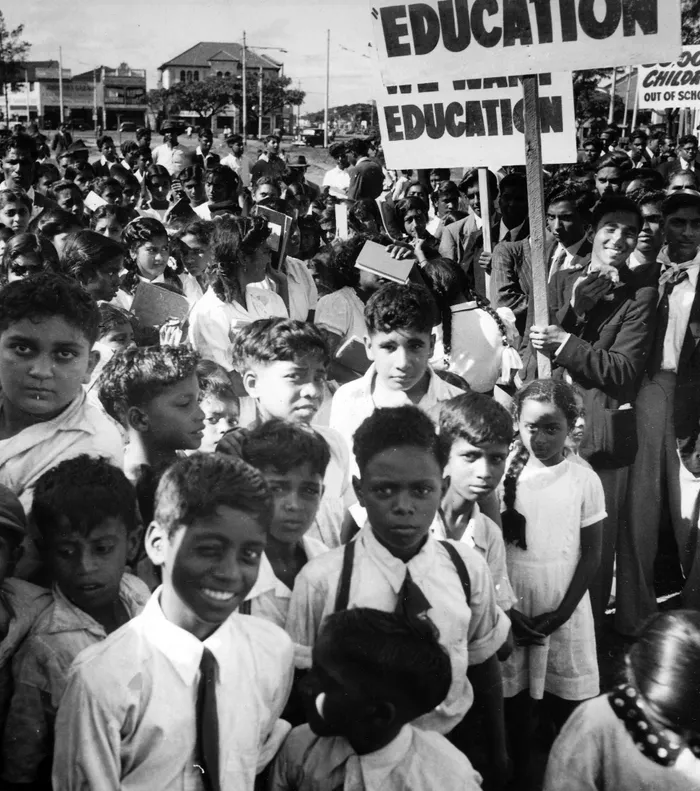
Natal Indian Congress protest for a quality public education in 1945.
Image: 1860 Heritage Centre
IN SOUTH Africa, education is fundamentally linked to freedom, transitioning from an apartheid-era tool of oppression to a constitutional right designed for liberation and equality. While democracy has brought free, universal, and equal education, significant challenges remain, with deep-seated inequalities and a poor-quality schooling system limiting true educational freedoms for many.
As we commemorate Freedom Day this week, a significant point of conversation has centred on the revisions to the curriculum, assessment and policy statements for the Department of Basic Education.
In changing the curriculum, some changes are generally welcomed, specifically the Further Education and Training phase curriculum revisions that finally centre African history, its kingdoms and agency. It is a major contribution to transforming education from a colonial tool into a process of reclaiming cultural heritage, and fostering critical thought and analysis.
In terms of methodology, the use of oral testimony and other more engaging methods of enquiry is encouraging and welcome. In most instances, understanding the struggle for quality public education places us in a better position to understand the changes to the curriculum within the context of people of indentured origins and their descendants. Providing this "free" quality education remains a huge challenge for the government of South Africa.
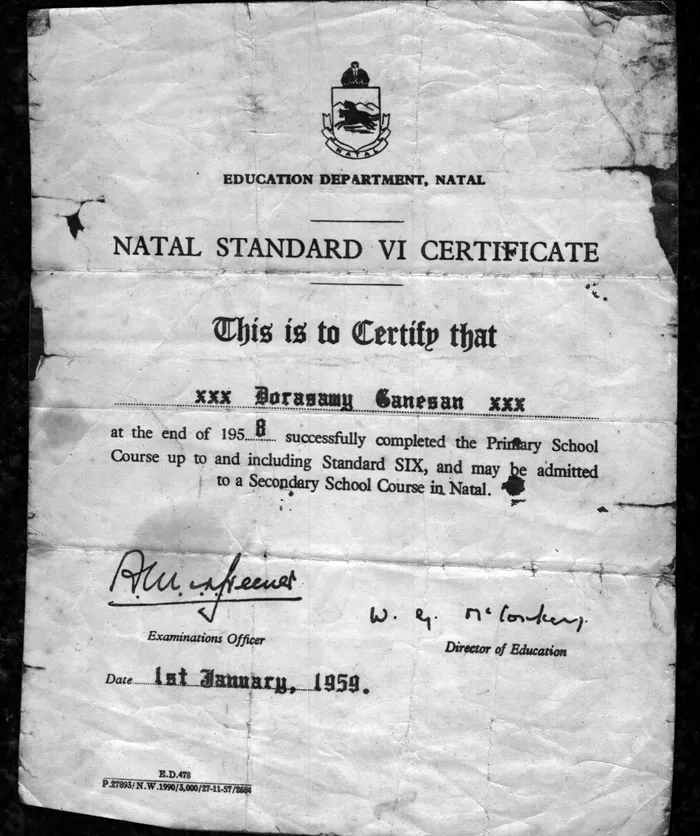
Most Indians could only get to a Standard 6 pass in 1959.
Image: 1860 Heritage Centre
Historically, the provision of "free" quality education for our indentured immigrants to Natal remained a paltry affair for 30 years, from 1869 up to 1899, with only primary school education being offered. The census of 1904 shows that only 5,211 (5%) of 100,918 of the Natal Indians were literate in English. In the same year, there were only 40 Indian schools in Natal, 10 were privately-run Muslim schools, and one private Tamil school.
The other 29 were predominantly missionary establishments, most of them community-driven and without any support from the government. These schools had very poor educational facilities. Most parents could not afford to send their children to school. Children were required to contribute to the family income either by working or by taking care of their households.
In 1927, the Cape Town Agreement threatened Indian people without educational qualifications with repatriation to India. To fast-track educational advancement, the building of schools had to be subsidised (with the aid of the government) by members of the South African Indian community. Schooling for Indians was inadequate, with a few state-aided schools, offering up to Standard 6 (Grade 8) passes. The need to educate KwaZulu-Natal’s Indian community by 1929 became a priority to break the cycle of poverty, and most importantly, to also remain in the country of their birth.
By the 1940s, the struggle to provide quality free public education continued unabated when frustrated people protested in a march that was led by the Natal Indian Congress in 1945. Schools in the 1940s were grossly overcrowded, with only a handful of secondary schools. The depression of the post-war years, together with a crippled economy, saw an Indian minority focus exclusively on survival, with 64% of the population living below the "bread line".
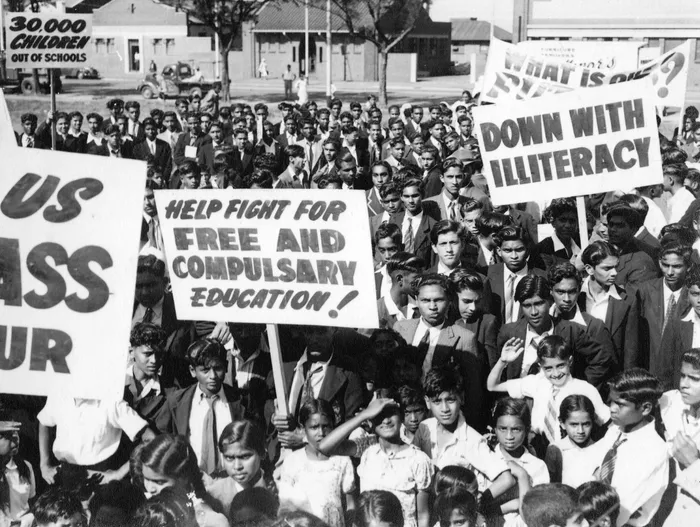
Children take to the street with the Natal Indian Congress to protest for a quality public education in 1945.
Image: 1860 Heritage Centre
By the 1960s, the high number of children wanting to go to school meant that three to four township schools were built within a walking radius of less than 10km of one another. Each school then had an occupancy of up to 1,000 pupils in some instances. The huge enrolment meant that teachers worked under a platoon system until 1983. This saw classrooms working in shifts with different sets of children starting school at different times of the day. Within this context of the struggle for a quality pubic education, the following curriculum revisions are critical in providing meaningful change to an overtly dominant colonial agency foregrounding.
For the Grade 10 CAPS document, the exclusive focus on one ancient African civilisation is too narrow, not allowing learning to understand African civilisation in comparison to ancient civilisations that flourished at the same time. A focus that will include the ancient Indus Valley Civilisation (also known as the Harappan or Sindhu-Sarasvati civilisation), one of the world's oldest urban cultures, flourishing around 3300 – 1300 BCE, and Keezhadi, a significant 2,600-year-old (circa 6th century BCE) urban civilisation discovered near the Vaigai River in Tamil Nadu, India, would add gravitas in better understanding African civilisations.
The Indian civilisation is far more extensive than focusing on the Mughal Empire. The exclusive focus of the Mughal Empire paints a narrow worldview of India from 1526 to 1858. Further suggestions recommend including the history of India from 1526 to 1858, which includes the Vijayanagara Empire, the Nayaka Kingdoms from the 16th to 18th Century, and the Maratha Confederacy, where Shivaji Maharaj became the dominant power in India during the 18th century, challenging Mughal authority.
For Grade 11, VOC, Dutch East India Company, slavery in the Indian Ocean, and Indian indenture history must receive more emphasis. For South Africans, Indian Ocean slavery has to be included to make it relevant. More that 50% of slaves came from South Asia, Madagascar, Mozambique, and India. Our CAPS history focus should include Indian Ocean slavery and not only Atlantic in the Grade 11 syllabus as a measure of including previously-marginalised histories and the descendants of these peoples in the curriculum. Both Indian Ocean slavery and Indian indenture are better understood within the context of Atlantic, transatlantic slavery.
The CAPS must consider the inclusion of the critical differences and similarities between slavery and Indian indenture, and the cultural resistance of the Minstrel Carnival and the development of Kaaps, which allow for a diversification of our history, in allowing all our people to claim a place at the table of telling a complete history of South Africa. South African children are better served when they can understand Atlantic and Indian Ocean slavery as a cohesive area of study and enquiry.
The Grade 12 syllabus revisions have critical periods of colonial and South African liberation history that need to be included, with a focus on the following areas:
* Nelson Mandela is mentioned twice, while PW Botha is mentioned 12 times.
* Displacement of the African majority by colonial oppression through the hut tax and the creation of reserves.
* Trade union history and its development in the shaping of worker resistance to understand the formation of the ANC and Communist Party.
* Greater emphasis on the Freedom Charter, adopted on June 26, 1955, in Kliptown, as a foundational document articulating the anti-apartheid alliance's vision for a democratic, non-racial South Africa seen in the context of developing of the Constitution.
* A much greater emphasis on the role of women in the freedom Struggle, with a focus on the Women’s March of 1956.
* The inclusion and emphasis of the Doctors Pact of 1947, the Defiance Campaign of 1952, the 1956 Treason Trial, the Cato Manor Beer Hall Riots, and the Sharpeville massacre.
* A history of banning, liberation-era sabotage of the apartheid state, 1980s school boycotts, political executions, Matola Raid, Maseru Massacre and 1984 Consulate 6.
* There should also be more on the UDF and political executions: Cradock 4, Matola Raid, Maseru Massacre, Ruth First, Dulcie September, Ashley Kriel, Lenny Naidu and the Release Mandela Campaign.
Beyond the history of colonial and liberation politics, there is also room for the inclusion of social, cultural and educational development in South Africa. If allowed, identity can become a divisive subject for any curriculum revisions. As Indian Africans, we claim our space as being born of the soil that allows our history to be told on the pages of history, and not in the margins.
In South Africa, race, class and ethnicity have defined power, privilege and the periphery for over 350 years. The freedom Struggle presented a powerful platform for South Africans of diverse origins to work together in pursuit of a just society. While not everybody embraced that journey in all its facets, the destination was a free society now enjoyed by all. That sentiment is eloquently told in the preamble of our democratic Constitution:
We, the people of South Africa,
Recognise the injustices of our past;
Honour those who suffered for justice and freedom in our land;
Respect those who have worked to build and develop our country; and
Believe that South Africa belongs to all who live in it, united in our diversity
A redesigned curriculum, designed to reflect on Indian Ocean slavery and Indian indenture in South Africa, allows the telling of that story within the richer tapestry of deepening non-racialism, and highlighting the collective contribution of our various communities in the building of our country. The challenge from the activist photographer, archivist and artist, Omar Badsha, to look at this history through African lenses, is critical to the philosophical underpinning of the revised history curriculum.
The ability to remember, reflect and rebuild is key to unifying our country. The recovery, documentation and affirmation of marginalised histories are crucial to the forging of a collective national consciousness. Constant re-interpretations of history provide opportunities to break away from the shackles that keep our society fractured. Many of those fissures centre around nationhood, which must allow all of us to see ourselves on the pages of history.
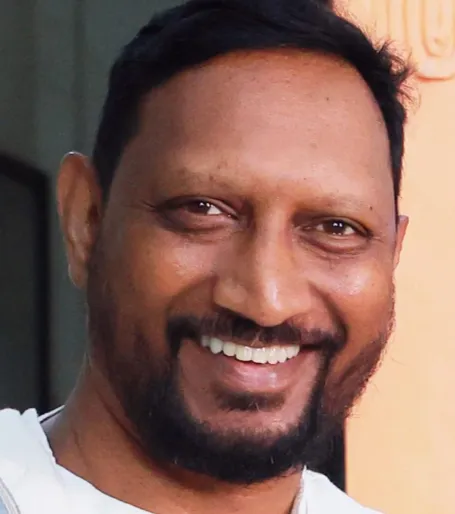
Selvan Naidoo
Image: File
Selvan Naidoo is the maternal great-grandson of Camachee, indentured number 3297, and paternal great-grandson of Karpayamma, indentured number 96575, and director of the 1860 Heritage Centre.