

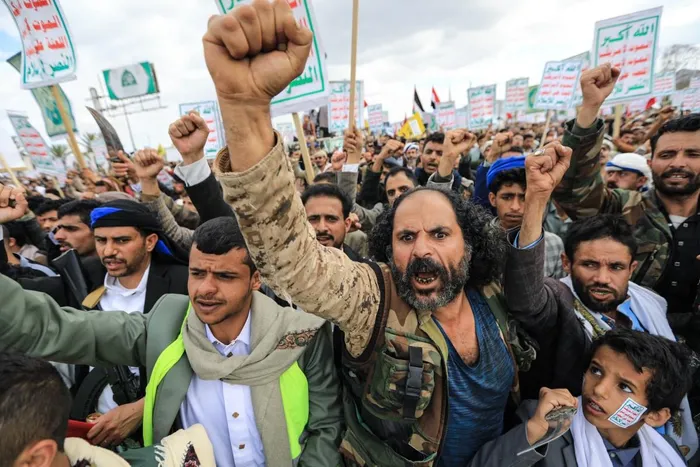
Supporters of the Iran-backed Houthi movement brandish their weapons as they rally in solidarity with Iran and Lebanon amid the Middle East war, in the capital Sanaa.
Image: MOHAMMED HUWAIS / AFP
AS THE final days of April tick down, the illusion of a swift, decisive victory in the Middle East has collapsed into fragile ceasefires and the steady act of Israeli expansion. More than two months into the conflict, what began as a co-ordinated US-Israeli blitzkrieg against Iran has turned into a grinding stalemate, exposing the desperation of American leadership, the isolation of a once-unshakable Israeli state, and a new regional order where Western alliances no longer hold.
After 40 days of war, including the assassination of Iran’s supreme leader, and heavy losses for Iran, Israel and the US, Tehran and Washington agreed to a fragile two-week ceasefire brokered by Pakistan, the first face-to-face talks between Iranian and American officials since 1979. The ceasefire is set to expire on April 22. On the northern front, a separate 10-day truce between Israel and Lebanon is also holding by a thread.
The Strait of Hormuz, that narrow chokepoint through which a fifth of the world's oil flows, refused to co-operate. Iran shut it down. Global oil prices soared past $120 a barrel. Gas at American pumps crossed $4 a gallon. Suddenly, President Donald Trump's "victory" began to look like a trap.
Now Trump has pivoted. He says the US will exit the Middle East in two to three weeks – whether a deal is reached or not. In a prime-time address, he declared a "swift, decisive and overwhelming" victory while simultaneously vowing to strike Iran "extremely hard" over the next two to three weeks. The contradictions are dizzying. His threat to wipe out Iran as a civilisation was met with shock as human rights activists lamented a war crime in the making. This is not a president ending a war on his terms. Trump is trying to flee a quagmire before the midterm elections – while pretending he won.
On April 15, 40 of the Senate's 47 Democrats voted to halt the transfer of offensive weapons to Israel. Seven of 10 Jewish senators joined them. The erosion of automatic American support for Israel is no longer gradual; it is accelerating in full view. The America First isolationism that defines Trump's base is colliding head-on with the old neoconservative consensus that demanded unconditional support for Israel.
Meanwhile, the International Court of Justice has become a diplomatic battlefield. South Africa's genocide case against Israel, filed in late 2023, has attracted a growing list of Western intervenors. Last month, the Netherlands and Iceland formally joined the case under Article 63 of the Genocide Convention. More than a dozen countries have now aligned themselves with South Africa's position. The legal walls are closing in.
While the world focuses on ceasefires and negotiations, Israel is quietly, and not so quietly, redrawing its borders. Israeli officials have confirmed the creation of buffer zones in Gaza, Syria and Lebanon, a strategic shift that one analyst described as a "forever war" against adversaries that cannot be eliminated.
In Lebanon, Israeli ground forces pushed toward the Litani River, clearing a strip 5km to 10km beyond the border, and destroying homes in Shia villages. In Syria, Israel has refused to withdraw from strategic areas in the Quneitra governorate, appearing to lay the groundwork for long-term annexation. In Gaza, Israeli forces effectively control half the Strip's territory, expanding their footprint even as ceasefire talks continue.
Turkish Foreign Minister Hakan Fidan warned that Israel was seeking to expand into Lebanon and Syria under flimsy security pretexts, declaring that Israel "cannot be integrated into the region while it is based on expansion and oppression". This is not speculation. This is a policy that contradicts Israeli claims of its right to exist. This right is fundamental to all countries, provided they exist within defined borders. Israel wants to expand to claim the Middle East from the river to the sea, and as yet it cannot define its borders. Other countries in the region challenge the illegal expansion. Not Israel's right to exist.
As April draws to a close, the picture is clear. Trump is scrambling for an exit, any exit, that allows him to claim victory, even as his "victory" rings hollow. Israel is winning tactical battles in Lebanon, but losing the war for international legitimacy, its traditional Western support base fracturing by the week. The old Middle East – where the US and Israel dictated terms, and the West looked the other way – is gone. What is emerging in its place is something far more dangerous, far more unpredictable, and far more honest about the brutal realities of power, expansion, and the desperate theatre of false victory. Parts of Israel look like a broken Gaza, and the myth of Israeli and American invincibility has been seriously tested by Iran's cheap, but re-engineered Russian missile technology that has shocked the world.
As all this unravels, in South Africa, the mighty Helen Godzille, as narcissistic as Trump, denies genocide and aligns with the white supremacy of Trump and the AfriForum doctrine of keeping power white, and firmly in the hands of the West. China emerges as the superpower in waiting, accumulating the biggest win without firing a bullet. The petrodollar is in decline as BRICS oil sales are mainly in the currency of the Chinese yuan. Russia sanctions are lifted by Trump as an emergency measure of the global crisis, and the high prices of diesel leave Russia with a windfall that will benefit its war with Ukraine. By far, China and Russia emerge as the winners in this reckless war engineered by Israel, while capturing the US into a maze of deceit.
The peace talks led by US Vice President JD Vance were making excellent progress before Israel Prime Minister Benjamin Netanyahu intervened to sabotage them. Trump placed new conditions at the 11th hour of the talks, which he knew Iran would not accept. The murderous hand of Netanyahu was exposed by Netanyahu himself, when he claimed that Vance reported to him. The American blocking of the blockade led to widespread condemnation and hilarious contempt as the world economy moved toward collapse.
Perhaps there is a method to the madness of Netanyahu and Trump. Is it possible that they are pressing for a total economic global collapse to create the conditions to launch a nuclear attack on Iran? Trump's AI projection of himself as Jesus and then a doctor presented the world with morbid humour at best, and blasphemy at worst. His attacks on the pontiff were extraordinary, simply for the pontiff's calling for peace. His continuous insults highlight the higher purpose presented by the pontiff, whose message of peace and a call for friendship between Muslim and Christian resonates.
Prophetically, an American pope rises to fight the Antichrist that emerges from America.
Father Neil Frank, OMI, the Catholic Bishop in South Africa, cuts through the noise. He says that the only way to fight global wars is for every human being to open their hearts for a global campaign for peace, spoken in the universal language of love.
He is not asking for poetry. He is asking for action. Just as South Africa waged a diplomatic war through sanctions and isolation against the apartheid regime, our South African bishop, in tandem with our President Cyril Ramaphosa, calls for a campaign of peace by holding Israel and Trump to account through collective international strategies to bring peace to the Middle East and indeed to the world.
** The views expressed do not necessarily reflect the views of IOL or Independent Media.