

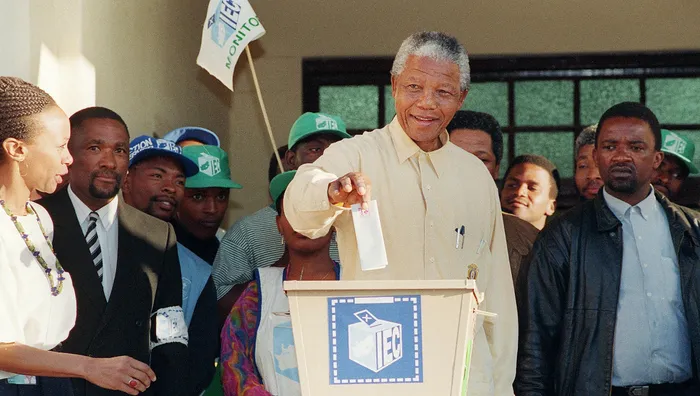
Nelson Mandela casts his vote at the John Langalibalele Dube’s Ohlange High School in Inanda, near Durban, on April 27, 1994. This is the uncomfortable truth of 2026: South Africa has achieved political freedom, but not yet freedom that feeds, protects and dignifies.
Image: AFP
AS SOUTH Africa enters mid-2026, our democracy has reached an age that should signal maturity. Thirty-two years after 1994, the promise of freedom ought to feel settled and secure. Instead, it feels unresolved – less like a completed project and more like a draft still being contested by lived reality.
This is the uncomfortable truth of 2026: South Africa has achieved political freedom, but not yet freedom that feeds, protects and dignifies. For millions, the right to vote has not translated into the right to thrive.
Recent data from the Human Sciences Research Council lays this crisis bare. Public demand for democracy has fallen to 36% – the lowest level since liberation. Nearly one in four South Africans now admit they would consider non-democratic alternatives if it meant a job, safer streets, or a roof that does not leak. This is not a rejection of freedom itself; it is a verdict on a democracy that has failed to deliver material security.
We live with an enduring contradiction. Internationally, South Africa remains classified as “free", scoring 81 out of 100 on civil liberties. Domestically, we endure the world’s highest levels of inequality. Freedom, as experienced on the ground, has become uneven – robust for the few, brittle for the many.
Nelson Mandela warned that “to be free is not merely to cast off one’s chains, but to live in a way that respects and enhances the freedom of others”.
In 2026, that challenge feels painfully literal. How do we enhance one another’s freedom when the state struggles to protect the most basic right of all – the right to life? Nearly 80 people are murdered each day. The 2026 State of the Nation Address acknowledged this grim reality, identifying organised crime and construction mafias as grave threats to our sovereignty. When a small business cannot open without paying protection money, the constitutional promise of freedom of trade rings hollow.
Ahmed Kathrada understood that the victory of 1994 was not an endpoint but a shift in terrain.
“The Struggle for freedom and democracy is a continuous one,” he reminded us.
Today, that continuity confronts us with an unsettling diagnosis: we have become a nation of spectator citizens. We vote – though in ever-shrinking numbers – and then we withdraw. We watch councils collapse, policing fail, and corruption metastasise, while hoping the machinery of state will correct itself.
Afrobarometer surveys reveal the contradiction clearly: while over 70% of South Africans want the media to expose corruption, fewer than a third are satisfied with how democracy actually functions. We recognise what is broken, but too often feel powerless to repair it. Spectator citizenship is not abstract. It looks like empty ward committee meetings, unelected school governing bodies, neglected community police forums, and local budgets passed without scrutiny.
Democracy withers not only when institutions are captured, but when citizens stop exercising their muscle. Yet 2026 is not a dead end. It is an inflection point. The pessimism reflected in surveys exists alongside something quieter, but more hopeful: a renewed insistence on agency at the local level. In the run-up to the 2026/27 local government elections, community-based oversight bodies, ratepayer associations, school boards, and street committees are reemerging – not to wait for national saviours, but to reclaim competence where people live.
This is what distinguishes the current moment from earlier cycles of disillusionment. The energy of 2026 is not concentrated in party headquarters or liberation myths, but in neighbourhoods. It is decentralised, pragmatic and impatient.
The Freedom Month theme, “Freedom and the Rule of Law”, captures this shift. Ongoing inquiries into police corruption and state capture signal that accountability, though slow and uneven, have not vanished. For the first time in years, the principle that no one stands above the law feels contested again – in courtrooms, in communities, and in public expectation. That contestation is the mark of a bruised, but maturing, democracy.
Freedom in 2026 must therefore be understood differently. It is no longer enough to defend the freedom to vote; we must demand the freedom to thrive. That means insisting that the billions lost annually to procurement fraud be redirected toward tangible opportunity – whether through skills pipelines, youth employment mechanisms, or other redistributive tools that restore stolen futures. The specific instruments may be debated; the principle cannot be deferred.
Our Constitution was never meant to be a ceremonial artifact. It is a living contract – one that assumes participation. Democracy is not a fragile vase best admired from a distance; it is a tool that requires use, pressure and maintenance. The surveys and statistics of 2026 are not a death knell. They are an audit. They tell us that South Africans still believe in the idea of freedom – they are simply tired of waiting for its reality.
As we look toward the next decade, the task before us is clear. Honour Mandela’s vision by enhancing the freedom of others in concrete terms. Honour Kathrada’s “continuous struggle” by refusing to abandon the ballot box, even when it feels heavy. Above all, move from hope as sentiment to citizenship as practice. The question of 2026 is no longer whether our democracy will survive. It is whether we are finally prepared to exercise it – daily, locally and relentlessly – until freedom moves from paper to purpose. Our liberation was won at a price we can never repay. The least we can do now is ensure that, at last, it pays dividends for all.
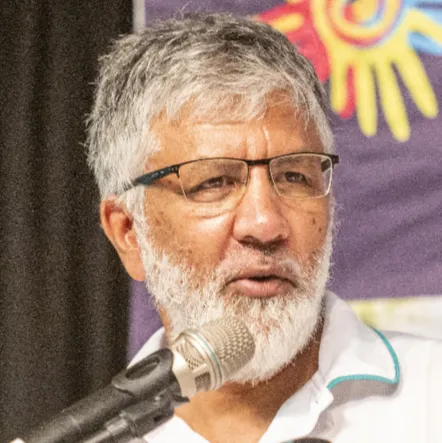
Neeshan Balton
Image: Supplied
Neeshan Balton is the executive director of the Ahmed Kathrada Foundation.
** The views expressed do not necessarily reflect the views of IOL or Independent Media.