

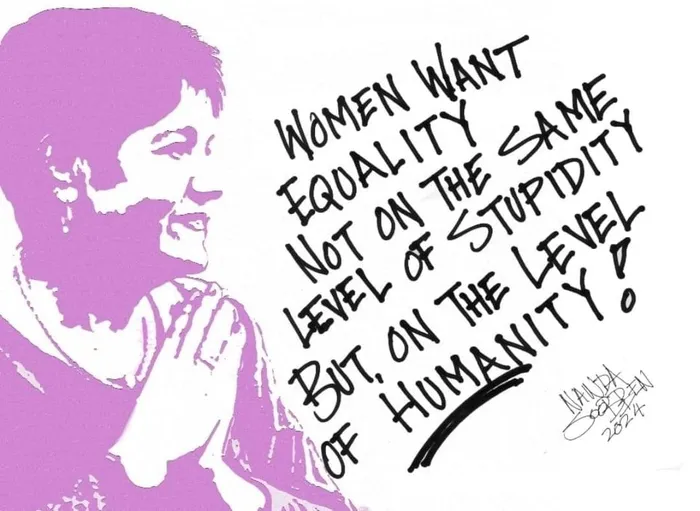
'As long as there are those who believe, who act, who stand up, then the promise of human rights for all remains alive'
Image: NANDA SOOBEN
IN MANY countries, including apartheid South Africa, violence against women was not recognised as a crime but treated as a private matter in which the authority of a man to beat his wife and children was allowed. Old colonial British law stated that a man could beat his wife provided the rod was no thicker than his thumb – called the rule of the thumb.
These old laws stated that the law would not intrude into the private space of the home. There was little protection for battered women in the home. Protection is what many women wanted, and those whom I saw in my law office made it clear that they did not want their spouses to be prosecuted or jailed, nor did they want a separation or divorce. But there was no way that victims could get protection orders from the courts except by applying to the high court, which was an expensive procedure and also led straight along the path to divorce.
In 1986, the late Professor Anshu Padayachee and I set up the Advice Desk for the Abused, an NGO that still functions today at the University of KwaZulu-Natal. We approached the chief magistrate of Durban and urged him to authorise magistrates to issue peace orders in domestic violence complaints. I drew his attention to a little known provision in the Criminal Procedure Act of 1958, which, by the way, is still operative, designed to protect whites against so-called acts of “nuisance” from blacks.
This was how peace orders began and offered some protection in family violence cases. The first legislation on the provision of remedies for GBV or family violence, as it was then called, was adopted in South Africa in 1992 around which date, other countries such as the UK and USA also passed laws against GBV for the first time. The push came from the actions of civil society organisations and the UN Committee on the Convention for the Elimination of Discrimination against Women (Cedaw).
A provision included in the statutes made rape within the marriage a crime. This aroused some controversy and opposition from men. For instance, male MPs asked: "does this mean when I have sex with my wife, she can have me charged for rape the next morning?” The then attorney-general in Natal told me he had expected an avalanche of false complaints from women and was surprised that had not happened.
Wives of some Afrikaans-speaking MPs objected to the rape provision in the law because they said they did not wish to hurt their husbands’ feelings. In my lifetime, I have lived through exhilarating change in our country and internationally. The most rewarding advances came and continue to come from the organised women's movement which demand implementation of international treaties that their countries signed up to, and changes in regional developments and national constitutions.
The UN treaties, including the Universal Declaration of Human Rights (UDHR); International Covenant on Civil and Political Rights; and International Convention on Economic, Social and Cultural Rights, all proclaim that recognition of the inherent dignity, and the equal and inalienable rights of all members of the human family, are the foundation of freedom, justice and peace in the world.
The UDHR provides: all human beings are equal in dignity, and entitled to the full and equal enjoyment of all human rights. All human rights are universal, indivisible, interdependent and interrelated; you can’t exercise your right to liberty and freedom of speech on an empty belly – you need both freedom from hunger and freedom of speech.
Happily, these standards and principles are entrenched in our Constitution and the South African Bill of Rights. They are embodied in regional instruments to which we are bound, such as the African Union’s Maputo Protocol on Women's Rights adopted 20 years ago.
Gender equality is at the core of human rights. Equality and non-discrimination are fundamental principles of the UN Charter adopted by all states in 1945.
It is now 25 years since the adoption of UN Security Council Resolution 1325 on Women, Peace and Security, a landmark commitment to gender equality in conflict prevention and peacebuilding. Thirty years after the Beijing Declaration and Platform for Action, adopted in 1995 at the first UN World Conference on Women achieving gender equality, remains essential for sustainable development, economic prosperity and peace. Despite progress, systemic inequalities persist, hindering women’s and girls’ full participation, leadership and empowerment.
Yet, despite this solid framework of law, millions of women and LGBTI persons around the world continue to suffer exclusion, discrimination and violence. Currently, globally, the need to take action to protect women's rights and environmental rights, and address GBV, have taken on a new urgency.
As the world faces economic uncertainty, climate crises and deepening inequality, recommitting to gender equality is critical for building a just and sustainable future. The Beijing Declaration and Platform for Action, alongside the Sustainable Development Goals (SDGs), Cedaw and other international women’s rights frameworks, remain crucial guiding instruments. However, delivering on these commitments requires urgent reforms, renewed investment and robust accountability mechanisms.
On the implementation of the Beijing Action Plan, 159 countries submitted assessments and reports. The report of the secretary general made it evident that despite progress, systemic inequalities persisted. While there has been small gains, such as:
- Legislative gains: many countries enacted laws to combat GBV and to ensure equal access to education.
- Social and economic advances: expanding social protection systems and care services have improved maternal health.
- Education gender gaps in primary and secondary education have narrowed globally.
In the area of the weaponisation of sexual violence in conflict situations, there has been some progress where violence against women is concerned. There is a series of security council resolutions, a special representative of the secretary-general called the gender advocate, various successful cases at the international, regional and national levels, and a plethora of civil society organisations dedicated to this subject, all testifying to the fact that this form of violence is universally condemned at the political level, though not necessarily for the right reasons.
Still, GBV in wars and conflict against women continues, resulting in enormous suffering. Many of you will recall that I was the judge who participated in the world’s first judgment that found sexual violence against women in the Rwandan conflict as constituting genocide. That was in 1997. Prior to this, for hundreds of years, it was not treated as a crime, and soldiers were free to rape the conquered women as trophies and rewards.
That judgment remains one of the most meaningful moments of my career. For centuries, women's pain in conflict had been ignored or dismissed. In that courtroom, survivors' voices changed the law. I will never forget their courage – their insistence on being heard.
But as I sat in those grand courtrooms (and still do as I serve as judge ad hoc at the ICJ in the case under the Genocide Convention brought by The Gambia against Myanmar), I often thought back to my humble beginnings – justice, I have always believed, must not only be global – it it must also be local. It must reach the person in the village, the woman in the camp, the detainee behind bars. Justice is not just about punishing perpetrators – it is also restoring dignity to victims. Law that does not touch human lives is not justice; it is paperwork.
The list for persistent challenges is much longer. To name a few on the list:
- Under representation in top political, economic and corporate fields, under-investment in women – achieving gender equality in developing countries requires $6.4 trillion annually, yet funding gaps remain vast.
- Backlash against gender equality: misogyny, violence against women's rights defenders, and the roll-back of gender-sensitive policies threaten hard worn gains.
- GBV: nearly one in three women worldwide have experienced physical and/or sexual violence at least once in their lifetime.
- Disproportionate impact of crises: climate change, conflicts and economic instability disproportionately affect women and girls, deepening vulnerabilities.
On October 3 last year, High Commissioner for Human Rights, Volker Turk, launched the third global report on SDG 16 – peace, justice and inclusion. A deep dive into how far we have come towards building peaceful, just and inclusive societies. Despite some gains, not a single target under goal 16 is fully on track. In 2024, at least one life was lost every 12 minutes amid armed conflicts. Armed conflicts can derail progress towards peaceful societies.
This, followed by numerous other resolutions, stands as a reminder of the responsibility of the UN and its member states to ensure a just solution for the situation in Israel and Palestine that respects and protects the human rights of all people. These resolutions are also a stark reminder of one of the main roles of the UN, namely, to ensure that international law is fully respected, and that those found to be violating its core principles are held to account.
Good frameworks and progressive constitutions, like ours, are in place but they remain on paper without the necessary implementation. Women and girls continue to bear the burden of many of societies’ greatest challenges. Pervasive traditions and gender stereotypes continue to hold society back from attaining substantive gender equality. Women and girls face systemic discrimination in the enjoyment of all human rights, including lack of meaningful power and participation in decision-making processes despite their vital role in producing food and resources. Inequitable distribution of wealth, and systemic discrimination and exploitation of women, undermine society as a whole.
Effectively ensuring full enjoyment of human rights by women, girls, men, boys and people of diverse gender identities require a comprehensive understanding of the social structures, social norms, and prejudices and power relations that frame not only laws and politics, but also the economy, social dynamics, family life and community life.
The impact of GBV on our democracy, constitutional values and Ubuntu – indeed we are all anxious over reports of rampant corruption involving political leaders and lawlessness in the highest echelons of law enforcement officials who are responsible for our protection. We welcome the fact that these alleged violations are being investigated publicly by commissions of inquiry, and hope that justice is done.
I am inspired by the vigilance and activism of the women' s movement here in South Africa and internationally. Civil society will never allow a regression of our hard- earned rights.
To the youth, do not underestimate your power. Do not underestimate the enormous progress made by the women's movement the world over. The world does not change overnight because of grand speeches or resolutions. It changes because of the quiet, consistent work of people who refuse to give up.
Justice, after all, is not an abstract ideal – it is a daily practice. It is the courage to speak when silence is easier. It is the insistence on fairness in our own communities. It is the recognition that the suffering of one diminishes us all. I have lived long enough to know that progress is not linear. We win rights ,and then we must defend them again. But every generation carries the torch a little further. And as long as there are those who believe, who act, who stand up – then the promise of human rights for all remains alive.
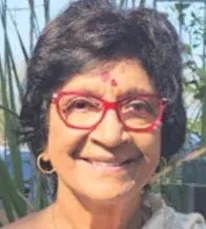
Judge Navi Pillay
Image: File
Judge Navi Pillay served as the high Commissioner of the OHCHR, the UN Human Rights Office from 2008 – 2014. She was the first non-white woman judge of the High Court of South Africa.
She recently delivered a speech – GBV: what does its escalation reveal about the erosion of democracy and human values and our commitment to Ubuntu – at Stadio University in Durban. This is an edited version of the speech.
** The views expressed do not necessarily reflect the views of IOL or Independent Media.