

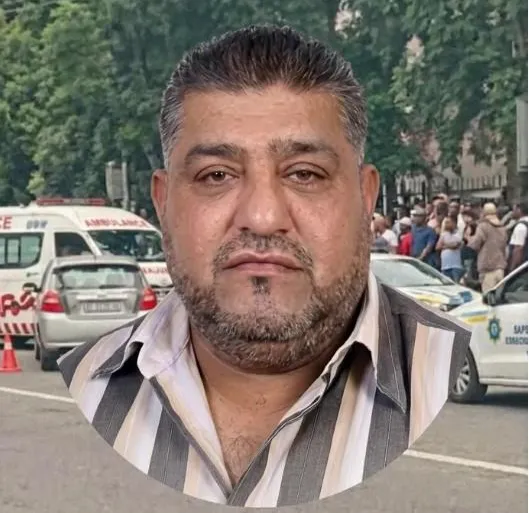
Faisal ul Rehman, 48, was shot and killed in a road rage incident on Barry Hertzog Avenue in Emmarentia.
Image: FILE
Road rage is no longer a traffic problem. It is a symptom of who we have become.
ON A SUNDAY morning in Emmarentia, Johannesburg, two families drove to the same intersection and only one drove home intact. A minor bumper-bash – the kind that happens dozens of times a day across this country – escalated within minutes into a shooting that left a husband and father dead in the street, his wife fighting for her life, and two children, aged 8 and 10, kneeling over their father's body, screaming for help.
Their eldest boy performed CPR with blood-stained hands. He had no idea what CPR was supposed to feel like. He just knew he did not want his father to die. And this is where we are in 2026.
The statistics have been screaming at us for years. According to official crime figures, between July and September 2024 alone, 1,069 murders in South Africa stemmed directly from road rage incidents, arguments, misunderstandings or provocation.
In the October to December 2025 quarter, the number reached 1,158 people killed in circumstances that began with exactly this kind of conflict. These are not gang wars or organised crime hits. These are people who crossed paths on a public road and could not find a way to walk – or drive – away.
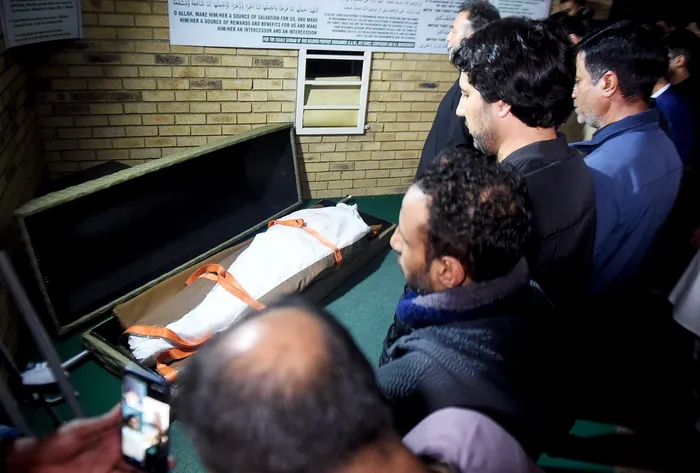
The body of Faisal ul Rehman, wrapped in a white burial cloth, lies in an open casket at a Johannesburg cemetery last Tuesday night as mourners gathered to pay their final respects.
Image: ITUMELENG ENGLISH
The road is one of the last places where ordinary people feel a degree of power. Inside a vehicle, you are anonymous. Nobody knows your name, your salary, or your problems. But they can see your car, your speed, and your decisions – and those decisions, right or wrong, carry consequences for everyone around you.
Clinical psychologist Dr Jonathan Redelinghuys has noted that the frustration of daily life in South Africa – the potholes, the power cuts, the crime, the cost of living – builds up in people until the smallest trigger releases it all at once. The bumper-bash is not the cause. It is merely the match that ignites petrol that has been accumulating for months. The road becomes a theatre for everything that has gone wrong in someone's life, and the stranger in the other car becomes the target. This is not unique to South Africa, but it is uniquely dangerous here because of what many of our motorists carry in their gloveboxes, under their seats, and on their hips.
Let us be honest about something that most people think, but rarely say aloud: there are almost no consequences for bad behaviour on South African roads. Red robots are suggestions. Stop signs are advisory. Overtaking on a solid white line is standard practice. And the people who enforce the rules – when they bother to enforce them at all – are often the same people breaking them.
When the authorities who are supposed to set the standard are themselves weaving through traffic in blue-light convoys, cutting queues and intimidating other road users, the message to every driver behind them is unmistakable: rules are for other people.
Monkey see, monkey do. It is a crude expression, but it is accurate. A society takes its cues from what it observes being rewarded and what it observes going unpunished. When corruption is rewarded, corruption spreads. When reckless driving is unpunished, recklessness spreads. And when a man shoots another man dead in front of his children over a scratched bumper and is not immediately charged – as the National Prosecuting Authority confirmed in this very case – the message sent to every hot-headed driver in this country is devastating.
Life has become cheap in South Africa not because South Africans do not value life, but because the systems that are supposed to protect it have collapsed. A justice system that moves slowly, a policing service that is understaffed and, in too many instances, compromised, and a prosecutorial authority that struggles under enormous case backlogs – these are not just administrative failures. They are the quiet permission slips that make the next act of violence feel survivable for the perpetrator.
I am not here to lecture. I am here because two children lost their father on a Sunday morning over a bumper-bash, and I believe we owe it to them – and to ourselves – to think carefully about how we behave on the road and how we respond when others do not.
First, protect yourself. If someone is driving aggressively behind you or alongside you, do not engage. Do not make eye contact. Do not respond to gestures. Pull over if you can, let them pass, and continue on your way. Your ego is not worth your life. If you carry a firearm, understand clearly that drawing it in a road rage situation – even if you feel threatened – places you in extraordinarily complicated legal territory, as this case itself illustrates. A firearm is a last resort, not a negotiating tool.
Second, protect your family. The moment a confrontation begins, your instinct may be to match the aggression, especially if your children are watching, and your pride is at stake. Resist it. Children do not need to see their parent win an argument on the road. They need to see their parent come home. Brief your family on what to do if a confrontation occurs – stay calm, stay down, do not get out of the vehicle, and call for help if necessary.
Third, protect your community. This means being honest about your own behaviour on the road. Do you speed? Do you cut in? Do you hoot and flash at people who are driving within their rights? Every act of aggression on the road – however small – contributes to the temperature of the environment around you.
If you are part of the problem, you are creating the conditions for the next tragedy. Report reckless driving to authorities. Support efforts to improve traffic law enforcement. Demand accountability from those in power who set the example. The change begins with you, even if you feel alone about this.
A scraped bumper costs a few thousand rand and a few hours of inconvenience. A human life cannot be priced, replaced or returned. That man in Emmarentia had a wife who loved him, children who needed him, and a future that was taken from him over something that should have ended with the exchange of insurance details and a handshake.
We cannot fix the justice system from behind the steering wheel. We cannot rebuild policing capacity by the time we reach the next traffic light. But we can choose, every single day, to be the person who drives away. That choice – boring, undramatic, completely unglamorous – is the one that keeps you alive, keeps your family intact, and contributes, in its small and quiet way, to a country worth living in. For the two children in Emmarentia, the choice was made for them. For the rest of us, it is still ours.
** The views expressed do not necessarily reflect the views of IOL or Independent Media.