

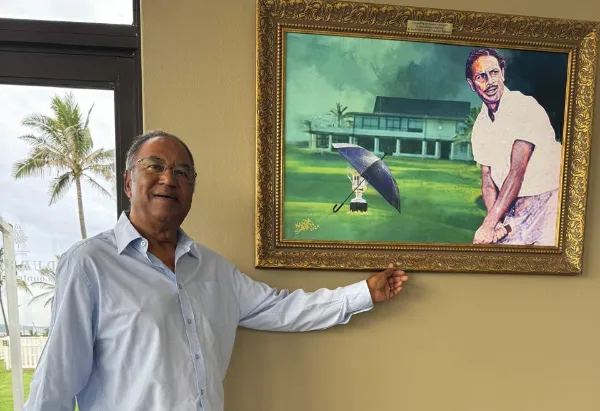
Richard Naidoo showing off the painting at the Durban Country Club.
Image: Supplied
LAST week’s edition of our newspaper contained a photo of a painting at the august golf mecca called the Durban Country Club (DCC). It was a masterpiece of a South African hero painted by the master artist and cartoonist, Dr Nanda Soobben, The said hero was a humble son of Durban who conquered the world through sport, but was not recognised by his own country, until after his death. Yes, draconian laws prevented the great subject of my column today from achieving even more in his lifetime.
The painting was graciously bought by local businessman and my acquaintance, Richard Naidoo, and donated to the DCC. It hangs on the wall of the club’s dining room.
Let’s get to the action now: the boy swung the stick and struck the old golf ball with ease. As young as he was, he moved his hip as he swung the stick knowing that the distance he needed would be achieved. An older version of the boy stood at the water’s edge fishing for the family’s supper. This was practically a daily ritual that saw the boy at one with the universe. The same universe which decades later would look down and witness the same lad, all grown up, and playing golf in some of the finest golf courses in the world. Against all odds.
I called a stick a stick because that’s what it was. Young Papwa used a stick that his father had created from the branch of a tree to resemble a golf stick. Together with a ball that he had found, he discovered solace in constantly practising and honing his putting skills. His interest had piqued when accompanying his father to fish, they had to pass Beachwood Golf Club. The sights and sounds of the golfers busy on the course made an indelible impression on the young man. He, who came from nearby Riverside, from a tin house where he lived with his parents and four siblings.
Sewshanker “Papwa” Sewgolum, born in 1930, was a man destined for greatness. However, life and his country’s then government had other plans for him. He won a series of tournaments., including the international Dutch Open three times. In a normal world that would be applauded and the talent nurtured. In a bizarre move, almost as if it was punishment for his successes, Papwa was banned from taking part in national tournaments. To cut his feet even further, his passport was withdrawn.
A lesser man would have buckled and given up. But all that practice in the harsh beach sand was not for naught. However, let’s rewind a bit. After his dad passed away when the boy was 13, Papwa realised the need to care for his mom and younger brother. Therefore, he left school and looked for work. He started caddying at Beachwood Golf Club and did so for 14 years. Things were tough at home. Papwa immersed himself in the game, constantly practising when he was allowed to, and started honing his skill. He began to enter small, local tournaments which he started to win.
His natural talent for the game despite his very unorthodox grip on the club, did not go unnoticed. It especially drew the attention of a member of Beachwood Golf Club, Graham Wulff, who owned a cosmetic manufacturing business. He allowed Papwa to play where and when it was forbidden to do so, saying he would take the blame if caught. The young man and his talent intrigued him, and he offered Papwa a much-needed job, as somewhere along the journey, Suminthra entered Papwa’s life.
Sensing the need for companionship and for someone to assist his now ageing mom in the home, through the assistance of his brother, an arranged marriage with the girl from Cato Manor took place. Despite his winning overseas tournaments, Papwa was not allowed to play professionally in his own country. He was considered a troublemaker by the authorities.
In 1963, they grudgingly allowed him to play in the Natal Open at the illustrious DCC. Of course, all the archaic apartheid laws had to be adhered to. He could not use the normal changerooms and had to make do with changing in a delivery van. He also had to eat with the African caddies. Much to the chagrin of the authorities and the white golfing brigade, Papwa won the tournament. Almost as if in retaliation and punishment, he was not allowed to enter the clubhouse to redeem his prize.
The famous photo of Papwa receiving his prize outside in the rain went viral throughout the world. The fact that the other golfers and officials were enjoying the luxury and first-class service inside caused an outrage and put more pressure on the anti-apartheid bodies to boycott apartheid sport. Of course, folk tales also emerged from this incident with some saying they saw Papwa’s nemesis, Gary Player, inside the clubhouse sipping hot coffee and laughing at the shameful goings-on outside.
I shall tackle that subject in my next column.
The reprisal from the authorities was swift and harsh. This, all because Papwa’s win and subsequent shameful treatment brought the country’s apartheid aberration directly under the international spotlight.
Among other harassment and punishment, he was banned from playing or even watching golf anywhere. This was followed by his passport being withdrawn, thereby shutting down the possibility of playing internationally. In the following years, not being able to play his beloved game, life was a struggle and he passed on sadly at the young age of 48 in 1978. He took on the might of a powerful, vindictive establishment, and gave them the finger though his natural talent and ability.
He did not win tournaments to prove a point. He played because he loved the game. He was, and will remain, one of our sporting heroes.
In October 24, 2004, the South African government bestowed Papwa with the Order of Ikhamanga in Silver. A little too late, I say. Catch you at the 9th hole in a fortnight.
** The views expressed do not necessarily reflect the views of IOL or Independent Media.
THE POST .