

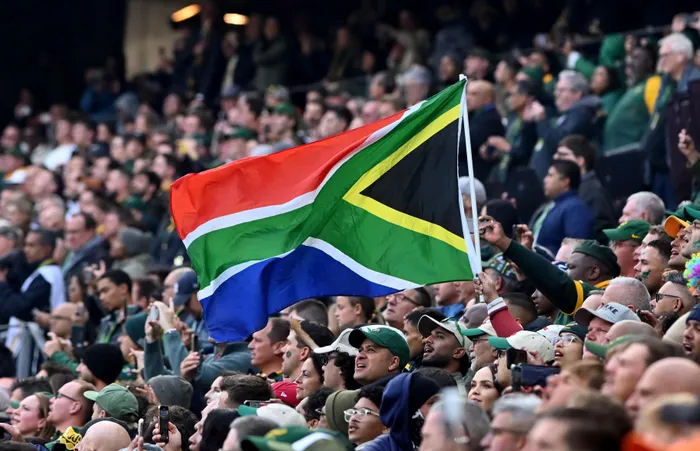
The South African flag was first hoisted on April 27, 1994, coinciding with the start of the country's first democratic elections and the birth of Freedom Day.
Image: Ayanda Ndamane Independent Media
SOUTH Africa is observing two public holidays this week: Freedom Day on Monday and International Workers’ Day on Friday. This gives South Africans two consecutive long weekends. Make no mistake: both holidays hold great significance and meaning for South Africans.
These two public holidays celebrate the gains of past struggles against exploitation and prejudice. They also signify victory in the struggle for fairness, social justice and equal opportunity. The irony is that workers still experience exploitation and unfair labour practices, while many citizens live in fear of violent crime and without access to economic opportunities.
This state of affairs invites us to ponder where we really find ourselves – a time to have a national dialogue about what is on our plate. Freedom Day marks the 1994 anniversary of the first democratic elections. This was the day all adult South African citizens exercised the right to vote for the first time, effectively choosing representatives to represent them.
After 32 years, it is time to reflect on the state of our democracy, especially as the Zondo and the Madlanga commissions have sought to expose the widespread abuse of power by our elected representatives and the rot in state institutions.
Even though the governing ANC is in a tripartite alliance with Cosatu and the SACP, the ANC-led government has not necessarily been a pro-labour movement. South Africans have witnessed and been impacted by some of the most violent industrial strikes and protests in recent memory. In 2012, the South African Police Service (SAPS) killed 34 miners during the Marikana massacre in a tragedy that could have been avoided. Like other violent strikes, the Marikana massacre exposed both the violent nature of workers’ strikes and the incompetence of the state institutions in handling industrial actions.
As we joyfully celebrate, it behooves us to remember what saddles our rainbow nation. Former president Thabo Mbeki once spoke of two nations: black and white, divided and unequal. Mbeki had observed that South Africa remained one of the most unequal societies.
The majority of citizens are stuck in abject poverty, the population of vagrants is rapidly growing, the quality of life is deteriorating, infrastructure is decaying, abuse of power is rife, dereliction of duty is common, and crime and corruption are a new normal.
On Freedom Day, President Cyril Ramaphosa gets to remind South Africans of where we come from as a nation, and where we are in our journey to deepen democracy and create a better life for all. Lest we forget, South Africans fought tooth and nail for democratic rule, and in the process of the fight for freedom, many paid the ultimate price.
Then, a few days later, on May Day, Ramaphosa addresses the working class in celebration of workers’ rights, social justice, and the labour movement's immense contribution in the long fight against oppressive apartheid rule. One of the worst atrocities of apartheid rule was the brutal subjection, exploitation and discrimination of black workers, which they did not take lying down. This April 27 marks 32 years since South Africa replaced the much-maligned white minority rule with democratic rule. Lest we forget, apartheid rule relegated non-whites to second-class citizens, sought to dehumanise them, and exploited the cheap labour of the black working class.
As South Africans celebrate these two holidays, we have much to reflect on and ponder. South Africa remains plagued by widespread exploitation of workers, mainly in the labour-intensive sector, high unemployment, intolerable poverty levels, and one of the highest Gini coefficients in the world: a measure of income inequality.
South Africa has a long history of struggles by the working class. Even 32 years after the dawn of democracy, the working class continues to face many challenges that include exploitation by temporary employment services commonly known as labour brokers, long hours of work, low wages, widespread crime targeting commuting workers, and exorbitant transportation costs.
Workers who commute from places like Stanger to Durban spend too much on transportation because the state has neglected the maintenance of the railway infrastructure. Trains, unlike taxis, are the cheapest mode of transportation for the working class. Then there is the issue of workers who walk long distances to work because they cannot afford transport.
This means there are workers who spend little time with their families. The result is that some workers perform their parenting role hardly at all. In recent decades, we have seen many young people get hooked on drugs. This phenomenon has gone hand-in-hand with the erosion of family values. The result is that the institution of the family is gradually weakened. The rub is that families are the foundation of every society.
This means South Africa needs visionary leaders. Trade unionists-turned-business leaders and politicians are now at the forefront of setting the agenda in South Africa and determining the country's direction. It suffices to say that most, if not all, of these former trade unionists were employed in the labour-intensive sector. This begs the question: what does it mean for South African society with its sophisticated economy to be led and dominated by predominantly former trade unionists?
In an era of globalisation, with its porous borders, more people are migrating in search of greener pastures. In Africa, we are seeing large numbers of people arriving in South Africa. This presents opportunities and challenges for South Africa. The biggest challenge is that South Africa is attracting both unskilled and skilled labour. Some, if not most, of the unskilled immigrants are here illegally. It is these unskilled immigrants who are now competing with unskilled South Africans in the labour-intensive sector. Unskilled immigrants have become a source of cheap labour for businesses in farming, private security, mining and domestic work.
For instance, most farms in the Cape Winelands hire immigrants who are reputed to have a better work ethic than locals. Immigrants, particularly illegal ones, do not make demands for better working conditions and pay. In addition, because immigrants are not unionised like locals, employers sometimes prefer hiring them.
Since 1994, our economy has struggled to create jobs in the labour-intensive sector, in part due to tough labour laws, subdued economic growth, load shedding, and high crime rates. These problems are well-documented and are not making South Africa an attractive destination for foreign direct investment. Another problem is that South Africa has been experiencing a lot of violent strikes in the recent past. The Marikana massacre at Lonmin mines remains one of the most violent industrial labour strikes in the history of our country.
In recent years, public-sector trade unions have gone on strike to protest low salaries. Protesting workers often resort to vandalism and property destruction. Even more disturbing, these workers also intimidate and harass non-striking workers without much protection from law enforcement agencies. In line with Cosatu’s slogan of "an injury to one is an injury to all", many South Africans are being severely inconvenienced whenever workers go on strike.
The time has come for South Africans to hold national dialogues about what is holding us back. It is unfortunate that race and ethnic politics continue to divide us. This can be seen in the membership of trade unions such as Cosatu affiliates and Solidarity, as well as in the voting patterns of our citizens.
** The views expressed do not necessarily reflect the views of IOL or Independent Media.