

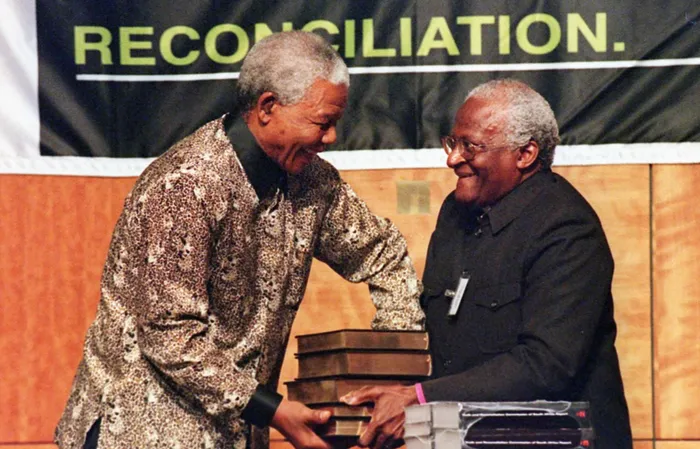
Former president Nelson Mandela receives five volumes of the Truth and Reconciliation Commission's final report from Archbishop Desmond Tutu, in Pretoria on October 29, 1998. Advocate Dumisa Ntsebeza's report, commissioned by the NPA, found that the NPA failed to prosecute apartheid-era crimes due to political interference between 2003 and 2017.
Image: AFP
HOLIDAYS in South Africa are slowly becoming devoid of their political significance, and generally appear to be periods where some South Africans immerse themselves in social media and doom scrolling, idling around and satiating their addictions in alcoholism and other vices. And yet two significant milestones occur this month which most would have ignored.
This Friday is Workers' Day and was first recognised in 1995 as a celebration of worker’s rights and a commemoration of the labour movement’s struggle against apartheid. April also marks the 30th anniversary of South Africa's Truth and Reconciliation Commission (TRC), commemorating its commencement in April 1996, to investigate apartheid-era human rights violations.
While South Africa has one of the most progressive labour law frameworks in the world, the practical enforcement and enjoyment of these rights are low in many sectors, according to recent union analysis. Workers in domestic, farm and informal sectors are particularly vulnerable, often facing lack of social fortification, and slave-like working conditions. Immigrants, on the other hand, especially those in informal or low-skilled jobs, face exploitation, and are often subjected to harassment and abuse, and experiencing inadequate protection under current and proposed labour regulation, and the rise of xenophobia.
Despite the fight for rights, the wage gap remains excessively wide, with many workers still earning salaries below the cost of living, and facing significant precarity. The poorest of the poor have simply been forgotten.
In The Shock Doctrine, Naomi Klein argues that post-apartheid South Africa experienced a "betrayal" where formal political democracy was exchanged for continued economic subjugation. She argued that the ANC was forced into a "shock" transition where it gained political power while allowing the apartheid-era elite to retain economic power and control of banks. In the chapter of her book, Democracy born in Chains, she interviewed a friend of mine and community activist, the late Rassool Snyman, who informed her of the analogy of what the ANC did to being akin to “removing the chains around our necks and simply repositioning them on our ankles”.
This cynicism is unfortunately heightened by the 30th anniversary of the TRC, which operated between 1996 and 1998. It received 7,112 amnesty applications. No major figure of apartheid or individuals who committed gross human rights violations, were ever prosecuted or convicted. This is why after 32 years since the advent of democracy, South Africa still lives in a perpetual unresolved crisis of despair.
Political economist Professor Patrick Bond argued that the TRC was a structural failure, primarily because it prioritised political reconciliation over economic justice. He suggested the ANC adopted “progressive rhetoric while implementing neoliberal policies”, with the TRC representing a "reconciliation" that allowed the existing economic elite to maintain their position. We can thus see that the TRC was successful at storytelling at best and only slightly exposing the horrors of the past, but was a dismal failure because it prioritised the oppressors over accountability, allowing many perpetrators to walk free and their crimes to lie buried in the past.
In his 1998 documentary, Apartheid Did Not Die, the remarkable late war correspondent John Pilger highlighted that while legal apartheid ended, "economic apartheid" remained intact. Pilger’s attempt to discover what freedom meant to the majority of South Africans four years after democracy caused considerable unease among both whites and the new black establishment. It was flighted only once ever on SABC, and caused turbulence among the elite.
In it, he described a new, economic apartheid that kept most blacks in poverty while 5% of the population (whites) still controlled 88% of the nation’s wealth. In secret meetings with the regime, the ANC agreed to “historic compromises”. These included an amnesty for the killers, torturers and collaborators of apartheid, who simply had to take part in a TRC, and not even say sorry.
“People got away literally with murder,” said Pilger.
He argued that the TRC failed to address the systemic theft of land and the ongoing economic control by a small minority, both white and newly-affluent black elites. He noted that the "freedom" promised was limited by the adoption of neoliberal economic policies, which he believed continued to oppress the black majority despite the political “transition”. Further, the judiciary, which enabled such an evil system, were never brought to book. These were dominated by white men who brutally engaged in the judicial imposition of state-sanctioned murder.
Take the following list:
Judge B O’Donovan: he is known as having handed down more death sentences than any other judge during a period in the 1980s, reportedly sending 25 prisoners to be hanged in three years and 39 in total during his career.
Judge DJ (Daan) Curlewis: he explicitly stated in 1991 that a person was more likely to get the death sentence from him or his "ilk" than from more liberal judges. He sent 14 people to the gallows in three years.
Judge Howard (HHW) de Villiers: he was noted for his harsh stance against opponents of apartheid, particularly during the Rivonia Trial, and his sympathetic attitude toward the white establishment.
Judge Kroon: known for sentencing six men from Queenstown (the "Queenstown Six") to death in June 1987.
Further under Chief Justice CJ Rabie, the appellate division was dominated by an "emergency team" of five judges – Rabie, Hefer, Viljoen, Jouber, and JJA Vivier – who were seen as upholding brutal security laws over human rights. The TRC requested that judges appeared to account for their actions, but they shamelessly and arrogantly ignored the request, opting not to take part in hearings.
Its final report stated that: "history will judge the judiciary harshly."
The legal system was used to legitimise apartheid. The judiciary did not question it. And 32 years later, the legal establishment never had a true purge of the evil. While South Africa formally dismantled the legal framework of apartheid, replacing it with one of the most progressive constitutional frameworks in the world, this is in theory only. In practice, the legacy of the ruthless apartheid system persists, and the legal system is often viewed as not having fully addressed its past due to delays in justice and socio-economic disparities.
Is it 32 years too late to now interrogate the same issues and establish the truth behind delayed justice, lack of worker’s rights in praxis, and grotesque levels of unemployment. Future generations may look back on this era not as a successful transition, but as a period where shallow reconciliation was prioritised over justice, leaving them to inherit deep socio-economic inequality. But more disturbingly, a certain degree of historical revisionism may develop if apartheid's crimes are not formally and thoroughly held to account; where our descendants may downplay the severity of the system, thinking "maybe apartheid really wasn't that bad". In such an eventuality, we would only have ourselves to blame.
** The views expressed do not necessarily reflect the views of IOL or Independent Media.