

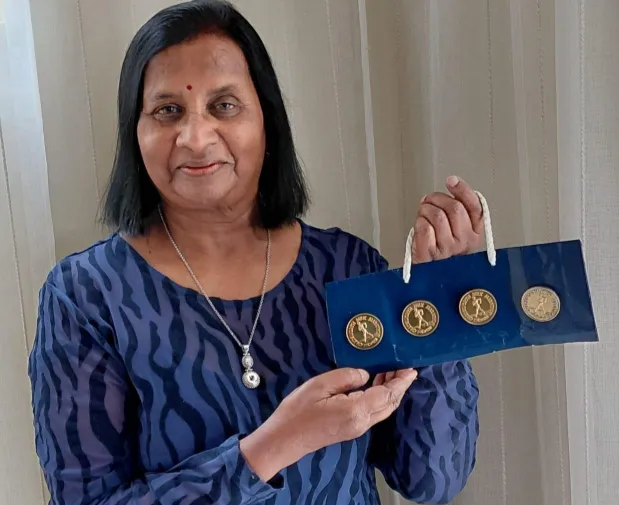
Indrani Kalimuthu with the four gold medals she won for coming first in four consecutive Chatsworth Milk Marathons.
Image: Supplied
IN THE face of petty racism when marathon gates slammed shut on runners of colour, fizzy bottles and milk cartons became unlikely passports, giving Indian athletes the chance to lace up and run.
For more than half a century – from the Comrades Marathon’s birth in 1921 until 1975 – those who were not white were barred from officially competing in the iconic race between Durban and Pietermaritzburg. The organisers clung to exclusion, even as the road itself cried out for equality. To cock a snook at this injustice, journalist Rajendra Chetty rallied against the colour bar by forming the non-racial Natal Roadrunners Association in the late 1960s. His defiance wasn’t just symbolic – it was practical, opening the roads for those denied entry.
And in September 1970, Chetty staged what must rank as South Africa’s first non-racial long-distance road race: a bold run from his hometown of Stanger (now KwaDukuza) to Durban. In that act, the road itself became a protest march, a declaration that running belonged to everyone, not just those the Comrades deemed worthy.
Named the Goldtop Marathon after the popular cooldrink bottled by its sponsors, the Ismail Karodia family, the inaugural race carried both sparkle and rebellion. The first victor was an overseas runner, John Tarrant – proof that the race had international credibility from the outset. But it was Ram Sumer who turned Goldtop into legend.
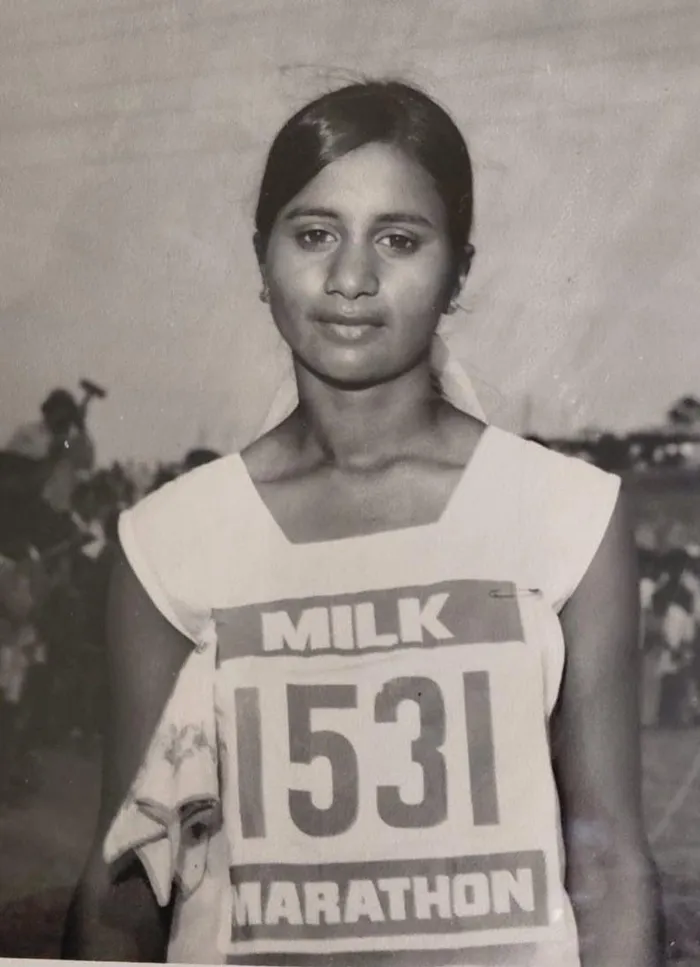
Indrani Kalimuthu came first in the 1970 Chatsworth Milk Marathon.
Image: Supplied
Year after year he broke the tape, an untouchable and unstoppable force of long-distance running, à la a charou Bruce Fordyce. His ritual was as irreverent as it was iconic: puffing hard on a Peter Stuyvesant cigarette before pounding the tar. The image was unforgettable – smoke curling into the morning air as his legs devoured the miles.
Another fierce contender was Poobie Naidoo whose name would later become synonymous with endurance. After his Goldtop exploits, he went on to complete 24 Comrades Marathons from 1978 onwards. And when he finally hung up his running shoes, he built a new kind of legacy: the successful Poobie Naidoo’s chain of sports gear stores, ensuring that the next generation of runners had the kit to chase their own finish lines.
In 1969, the Durban Milk Publicity Council (DMPC) sponsored the first Chatsworth Milk Marathon, with Clover milk and dairy products hogging the branding. Hardly a marathon at 21 kilometres, it was an eclectic mix of walking and running (the latter when marshals were distracted) through the newly laid-out ghetto township. The idea was mooted by DMPC PRO Amichand Rajbansi, probably as a springboard for his political career. Yet the annual event, capped at 2,000 participants, became a fixture - gold medals for winners, trophies for runners-up, and stories that outlasted the milk crates themselves.
Together, the Goldtop and Milk Marathons blurred the line between sport and survival, branding and resistance. They were born of exclusion, yet became platforms of resistance. Cigarettes, cool drinks, and milk cartons – commodities of everyday life – were transformed into unlikely weapons against apartheid’s pettiness, thus declaring that running belonged to everyone.
In the first Chatsworth Milk Marathon, 16-year-old Indrani Kalimuthu (née Naidoo) came second and won a trophy. From 1970 to 1973, she became the name to watch, proving that the Milk Marathon was more than a publicity stunt – it was a stage for hidden talent. For four years in a row, Indrani blazed across the finish line, clutching gold medals year after year in the women’s section, her victories a gleaming rebuke to the narrow lanes apartheid tried to impose.
On the men’s side, it was the postmen – those tireless foot soldiers of communication long before email and WhatsApp – who stamped their authority on the race, delivering first place as reliably as they then delivered letters.
Indrani remembered how her father’s steady encouragement and her family’s unshakable love for sport pushed her to break away from the crowd. There were no high energy bars, no protein shakes, no carefully calibrated diets of complex carbohydrates, to fuel endurance. Instead, the kitchen was her training ground.
“Homemade spices, roasted ground by my maternal grandmother, flavoured the simple, wholesome meals prepared by her mother at home.
“A packet of Tennis Biscuits in her hand, my grandmother would also walk barefoot over long distances, visiting her siblings and other relatives. She was a tough woman. Those genes, together with netball and other school sports, kept me fit and healthy,” she recalled.
Back then, lightweight takkies with shock-absorbing soles had yet to reach Chatsworth – let alone Durban. So Indrani laced up an old pair of canvas sand shoes, polished to a bright white the day before. They carried not only her determination but also the quiet resilience of a community that made do with what it had, turning scarcity into strength.
From 1970 to 1972, the Monday after the Milk Marathon was no ordinary school day at Southlands Secondary. Principal CG Pillay would summon the entire school into assembly, and there, before rows of restless pupils, he would single out Indrani for her triumph. Each time she came first, the applause rolled like thunder, a sub-economic township’s echo of pride. By 1973, she was no longer just a schoolgirl but a teacher trainee, limping from her fourth victory straight into her first practice teaching session at Chatsworth High.
The principal, Manickam Vasar, wasted no time in turning her feat that year into a lesson. At assembly that Monday after her win, he scolded the absentees who had skipped school after the race, then pointed to Indrani: “Here we have someone who participated, won her fourth gold medal, and still reported for duty.”
Now 72, Indrani reflects with a wry smile. The Comrades Marathon tempted her, but family and work commitments kept her from its punishing road. Instead, she poured her endurance into education – 42 years of service across schools, retiring in 2016 as a subject adviser for accounting. Retirement has not slowed her stride: she still lines up for the 10km Spar Women’s Challenge and the World Cancer Day Run, proving that the rhythm of running has never left her.
The Milk Marathon itself eventually collapsed under its own popularity. Safety concerns forced the Durban Milk Publicity Council to reinvent it as the Chatsworth Milk Carnival, with the ever-ambitious Rajbansi at the helm. Held at the Westcliff sportsground, the carnival was a spectacle of township energy and diaspora glamour: more than 70,000 people thronged to watch talented local musicians, singers, dancers, wrestlers, police gymnasts, tug-of-war games, sari queen contestants, and even overseas artists such as Mohammed Rafi and Mahendra Kapoor.
The carnival curtain came down when Rajbansi left the DMPC. If Goldtop cooldrink and Clover milk once cracked open the track for the excluded, then the Rising Sun has laid down the road itself. What began as makeshift entry points has become a full, paved pathway. The Chatsworth Athletics Club, ably led by chairman Dees Govender and draped in the colours of Vijay Maharaj’s Rising Sun media empire, stages the Rising Sun Chatsworth AC Ultra Marathon, a 52km race that is a Comrades qualifier.
Thanks to hundreds of thousands of rand invested by Maharaj, more than 3,000 runners of every race and background take to the streets through Chatsworth. What began as resistance to petty racism has matured into a spectacle of inclusion, where sponsorship is not just branding but a lifeline to dignity and recognition. And in that spectacle, the memory of Indrani Kalimuthu, who as a teenager defied the odds to claim her place on the winner’s podium, runs alongside every step.
Her early triumph is now echoed in the thousands who follow, proof that the road remembers its pioneers. The Chatsworth AC Rising Sun Ultra Marathon is no longer just a race – it is the living proof that equality, once denied, can be claimed stride by stride, until the road itself belongs to everyone.
** The views expressed do not necessarily reflect the views of IOL or Independent Media.