


Babita Deokaran
Image: Supplied
There is a stubbornness about me that never can bear to be frightened at the will of others. My courage always rises at every attempt to intimidate me. | Jane Austen, Pride and Prejudice
I REFLECT on a subject that cuts to the very heart of integrity, justice, and the moral fabric of our society; a subject that covers the risks, moral challenges and the courage of confronting wrongdoing. We often celebrate courage when we see it in retrospect, when it’s written into history books or turned into headlines of triumph. But confronting wrongdoing, especially from within an institution or a system that rewards silence, is seldom glorious in the moment. It is lonely, frightening, and costly.
Babita Deokaran, Mpho Mafole and Martha Rantsofu are some of the names that remind us of the furthest that such cost can reach to the individual concerned. A dedicated public servant using their profession to show loyalty to their kith, kin and country. Țhey followed their conscience which led them to exposing corruption in the Gauteng Health Department, City of Ekurhuleni and Emfuleni Municipality, respectively.
Those implicated in the corruption made them pay with their lives. They stalked them to ensure that their death would be brutal, certain and public. Their stories are not just a tragedy. Țhey are a mirror reflecting what happens when systems fail to protect those who choose integrity over complicity. It was meant to silence all those who would think of choosing integrity over complicity.
Courage should not cost people their lives, but we know very well what the cost of being courageous involves. The emotional, social and physical sacrifices, often requiring one to endure anxiety, loneliness, rejection and possible death. Being courageous demands that one surrenders their ego and security to act on values which can lead to, among others, reputational risks, financial risk, emotional and psychological distress, burn-out and profound vulnerability.
To confront wrongdoing is to enter a moral battleground. It begins quietly, perhaps with a doubt, a document, or an instruction that doesn’t feel right. Like what we call a gut feeling, the personal honesty, professionalism and experience feels the oddity before you know what was contravened. And yet, for many people, that moral impulse collides with powerful counter forces: loyalty to colleagues, fear of retaliation, the risk of losing one’s job, or, the ultimate, losing one’s safety and life.
Whistle-blowing, at its core, is not an act of betrayal. It is an act of loyalty to the public good, to truth and to justice. But power which refuses to be bridled often inverts that moral order: rewarding silence and punishing conscientiousness.

Mpho Mafole.
Image: Facebook
Psychologists call it “moral injury” – the harm that comes when individuals act against their deepest sense of right and wrong, or when they are punished for doing the right thing. We don’t talk enough about the emotional trauma whistle-blowers endure, the isolation, the use of the name of institutions as a launch pad for reputational attacks, the financial ruin. Even those who survive the retaliation often live in the shadows, stigmatised as “troublemakers” rather than honoured as defenders of integrity.
We must recognise that whistle-blower persecution is not just a story of individual courage. It is a symptom of institutional failure. The whistle-blower is persecuted because she has shown that the systems of the institution have been weakened to ensure that they cannot see or report corruption. The whistle-blower has upset this applecart. When wrongdoing becomes normalised, when rules are bent to serve networks of power rather than the public interest, those who speak up are treated as threats to be neutralised, not voices to be heard.
In South Africa and many parts of the world, this culture has been exposed through commissions, inquiries, and investigations, from state capture to local government corruption. But the deeper question remains: why do our institutions still treat truth-telling as a risk rather than something good for the institution and the public?

Martha Mani.
Image: Supplied
Part of the answer lies in weak legal protection. Our whistle-blower laws, while perhaps well-intentioned, often fail in practice.
The Protected Disclosures Act, as well as the proposed amendments for instance, provide a framework but still lack teeth. There is still no guarantee of physical protection. The proposed amendment still does not cover all categories of workers, and it doesn’t provide adequate financial or psychological support. We still have a long way to go. But even the best laws cannot function in a toxic institutional culture, one where loyalty is measured by silence, and compliance by complicity.
Reform, therefore, must be both legal and cultural. The law meant to protect whistle-blowers is sorely inadequate, and attempts to strengthen it are moving at a snail’s pace. However, the system is broken. It has neither the courage nor inclination to arrest the real beneficiaries of corruption, the real beneficiaries of the silence.
To honour the memories of all the assassinated whistle-blowers, we must ensure that speaking the truth never again becomes a death sentence. That requires rebuilding trust, protection, and accountability from the ground up. Reform must begin by treating truth tellers not as rebel rousers, but as those ridding institutions of the cancer of corruption. This means embedding whistle-blower protection into the DNA of governance, not as an after-thought, but as a cornerstone of honesty and accountability.
We need laws that go beyond symbolic protection.
Reforms should include:
- Comprehensive coverage for all sectors, including contractors and temporary staff. In fact, it should not be limited to an employment relationship.
- Automatic protective measures, including, among others, relocation, anonymity, and security for whistle-blowers facing credible threats.
- Independent oversight bodies empowered to receive, investigate, and act on disclosures, insulated from political or institutional interference. We have these bodies in South Africa, but the question is: are they performing their roles? I don’t think so.
- Financial support mechanisms, such as emergency funds or legal assistance, to prevent whistle-blowers from being ruined economically. Countries like Ireland and Australia have recently overhauled their frameworks creating central whistle-blower authorities with investigative powers. We can learn from these examples.
Even the strongest laws will fail in institutions where silence is the norm. We need leadership that values transparency, where senior officials actively celebrate and protect those who raise concerns. Training, ethical leadership development, and zero-tolerance for retaliation must become part of institutional DNA.
Civil society must continue to play a crucial role in offering independent advice, advocacy, and solidarity. My experience has been that civil society has really played a massive role in addressing the plight of whistle-blowers.
Universities, in turn, can create research hubs and legal clinics dedicated to whistle-blower protection, spaces where students can learn not just about the law, but about the moral courage required for public service. Like the Courage Hub.
We must modernise the mechanisms of reporting. Digital platforms can ensure anonymity, track responses, and allow secure communication with investigators. If technology can protect financial transactions, it can protect moral ones too. To make accountability safer, every sector has a role.
Policymakers must legislate courage, designing systems that reward integrity rather than silence. Civil society must keep watch, offering refuge and advocacy when institutions fail. Academics and students must nurture the next generation of ethical leaders – people who see public service not as a career, but as a calling.
The moral battles of tomorrow will not be fought in the headlines, but in your workplaces, your classrooms, your committees. Integrity will ask you to speak when it is easier to remain silent. Prepare for that moment now by building moral muscle, empathy, and courage. Confronting wrongdoing will always carry risk. But the greater risk, the one we can no longer afford, is the risk of silence.
Every act of courage, every protected disclosure, every reform that makes integrity safer, it must move us closer to a society where truth is not punished but protected. Let us build that society, one where accountability is not an act of bravery, but a norm of public life. Where people like Babita Deokaran, Mpho Mafole and Martha Rantsofu, among others, are not remembered for dying for the truth, but celebrated for living it, safely, openly, and without fear.
Courage is about learning how to function despite the fear, to put aside your instincts to run or give in completely to the anger born from fear. Courage is about using your brain and your heart when every cell of your body is screaming at you to fight or flee and then following through on what you believe is the right thing to do. | Jim Butcher.
Those who bury wrongdoing have no interest in the future
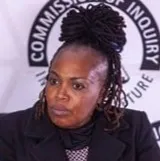
Martha Ngoye
Image: Supplied
Martha Ngoye is a Prasa whistle-blower, executive director of the Defend our Democracy, and a member of the Active Citizens Movement.
This speech was delivered at the Courage Hub South Africa NPC, an initiative dedicated to supporting whistle-blowers and advancing an ethical culture in South Africa's youth.
** The views expressed do not necessarily reflect the views of IOL or Independent Media.