

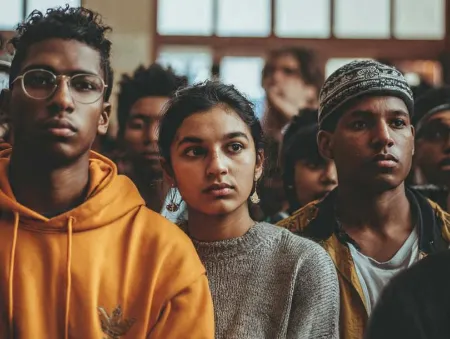
Historically, young people have been at the forefront of political and social transformation. Yet today, there appears to be a noticeable attenuation of this activist impulse among many young Indian South Africans, says the writer.
Image: Meta AI
AS SOUTH Africa approaches another cycle of local government elections, a familiar question resurfaces with renewed urgency: where are the voices of young people, particularly within the Indian community? This question is not merely rhetorical – it is diagnostic. It probes the health of our democratic culture, the intergenerational transmission of civic responsibility, and the evolving identity of youth in a post-apartheid society.
Historically, young people have been at the forefront of political and social transformation. During apartheid, Indian youth, alongside their African and coloured counterparts, were deeply embedded in resistance movements. From student activism to underground mobilisation, they were not passive observers but active agents of change. Figures who are now regarded as stalwarts did not emerge in a vacuum; they were shaped by a political culture that demanded participation, sacrifice, and moral courage.
Yet today, there appears to be a noticeable attenuation of this activist impulse among many young Indian South Africans. While it would be overly simplistic – and indeed inaccurate – to suggest a complete absence of youth engagement, there is a perceptible decline in visible, organised, and sustained civic participation. This is particularly evident in local governance issues, where service delivery failures disproportionately affect entire households, yet the burden of advocacy and complaint often falls on older generations.
To understand this phenomenon, one must move beyond nostalgia, and examine the structural, cultural, and psychological shifts that have redefined youth engagement in the democratic era.
The transition from apartheid to democracy fundamentally altered the terrain of political engagement. Under apartheid, the moral clarity of the Struggle provided a unifying narrative: oppression was explicit, and resistance was imperative. In contrast, contemporary South Africa presents a more ambiguous landscape. While systemic inequalities persist, they are often mediated through bureaucratic inefficiencies, governance failures, and socio-economic disparities that are less overtly racialised.
For many young Indian South Africans, who have grown up in a constitutional democracy, the immediacy of political struggle is less palpable. The absence of a clearly defined adversary can lead to political disengagement, as the stakes of participation appear less existential. This does not imply apathy, but rather a reconfiguration of priorities in a context where survival is no longer contingent on resistance.
The post-1994 era has also seen increased access to education and economic opportunities for segments of the Indian community. This upward mobility, while commendable, has been accompanied by a shift towards individualism. Success is increasingly framed in personal rather than collective terms, with emphasis placed on career advancement, financial stability, and lifestyle aspirations.
This individualistic orientation can dilute the sense of communal responsibility that once underpinned political activism. When success is measured by personal achievement, civic engagement may be perceived as peripheral or even burdensome. The time and energy required for activism are often redirected towards professional and academic pursuits.
It would be erroneous to equate silence with inactivity. Many young people are politically aware and engage with socio-political issues through digital platforms. Social media has become a primary site of expression, allowing for the dissemination of opinions, mobilisation of support, and critique of governance.
However, digital engagement often lacks the depth and impact of organised, on-the-ground activism. The phenomenon of “clicktivism” or “slacktivism” can create an illusion of participation without the substantive outcomes associated with traditional forms of civic action. While online discourse is valuable, it rarely translates into sustained pressure on local government structures or tangible improvements in service delivery.
Another critical factor is the growing disillusionment with political institutions. Corruption, inefficiency, and unfulfilled promises have eroded public trust in governance. For young people, this can manifest as cynicism and disengagement. If political participation is perceived as futile, the incentive to engage diminishes significantly.
This disillusionment is not unfounded. Numerous reports and lived experiences attest to systemic failures at various levels of government. However, the withdrawal of youth from civic spaces only exacerbates the problem, creating a vacuum that is often filled by entrenched interests.
Within many Indian households, there remains a strong emphasis on respect for elders and deference to authority. While these values are integral to cultural identity, they can inadvertently suppress youth expression in civic matters. Decision-making, particularly in community and political contexts, is often dominated by older generations.
This dynamic can lead to a form of internalised silence, where young people feel that their voices are either unwelcome or inconsequential. Over time, this can diminish confidence and discourage active participation in public discourse.
The Indian community in South Africa is not monolithic. It is characterised by diversity in language, religion, class, and political affiliation. This fragmentation can complicate efforts to mobilise collective action, particularly among youth who may not identify strongly with traditional community structures.
Moreover, the intersectionality of identity – being young, South African, and Indian – creates a complex framework within which civic engagement is negotiated. For some, the question is not merely whether to participate, but how and in what capacity.
While the reasons for youth silence are multifaceted and, in some respects, understandable, they do not justify disengagement. The costs of silence are too high, both for individuals and for the broader community.
First, local government decisions have immediate and tangible impacts on daily life. Issues such as water supply, electricity, sanitation, housing, and public safety are not abstract concerns – they affect the quality of life in every household. When young people remain silent, they relinquish their stake in shaping these outcomes.
Second, democracy is not self-sustaining. It requires active participation from all sectors of society, particularly the youth, who represent both the present and the future of the nation. The erosion of youth engagement undermines the legitimacy and responsiveness of democratic institutions.
Third, silence perpetuates a cycle of exclusion. If young people do not assert their voices, policies and decisions will continue to be shaped without their input, leading to outcomes that may not reflect their needs or aspirations.
The challenge, therefore, is not merely to critique youth silence, but to cultivate conditions that encourage and sustain engagement.
Educational institutions must play a more proactive role in fostering civic consciousness, not as an abstract ideal but as a practical imperative. Curriculum and extracurricular activities should emphasise critical thinking, community involvement, and political literacy.
Political parties and civil society organisations must also create inclusive spaces that genuinely value youth participation. This requires moving beyond tokenism and ensuring that young voices are integrated into decision-making processes.
Families and community leaders have a responsibility to encourage dialogue and empower young people to express their views. Respect for tradition should not come at the expense of innovation and inclusivity.
Finally, young people themselves must recognise that silence is a form of consent. To abstain from participation is, in effect, to accept the status quo. The legacy of past generations is not merely a historical narrative – it is a call to action.
The question of where our young voices are, is both a critique and an invitation. It challenges us to examine the socio-political landscape that has shaped contemporary youth engagement and to address the barriers that inhibit participation.
The apparent silence of Indian youth in South Africa is not indicative of indifference, but of a complex interplay of historical, socio-economic, and cultural factors. However, understanding these factors must not lead to complacency. On the contrary, it should galvanise efforts to re-engage and empower a generation whose voices are not only necessary but indispensable.
As the country prepares for local government elections, the time for passive observation has passed. The future of our communities depends on the willingness of young people to step forward, speak out, and take ownership of the democratic process. Silence, in this context, is not neutrality – it is abdication. And that is a luxury we can no longer afford.
** The views expressed do not necessarily reflect the views of IOL or Independent Media.