

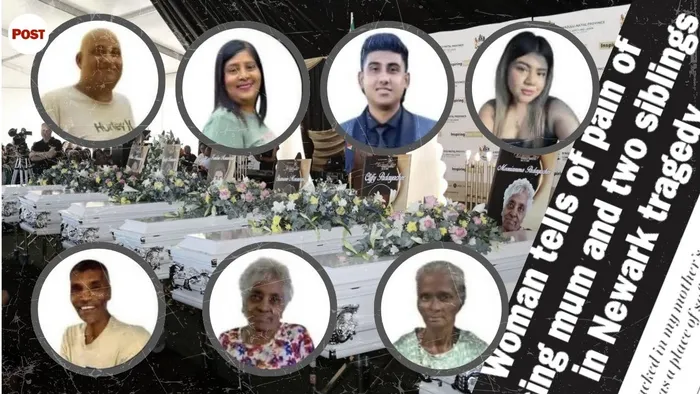
The family of seven who were recently killed in Newark.
Image: Graphic: Chumani Mazwi
WHEN the news broke on April 21 of the brutal abduction and murder of seven members of the Monswamy, Padayachee and Happanah family in Newark, near Mandeni on KwaZulu-Natal’s North Coast, I felt a visceral punch to the gut.
As a South African who has spent a lifetime working across diverse communities in this province, this tragedy struck at the core of our shared humanity.
The victims – Alan and Sandy Monswamy, their children Kraidon and Shamarie, and relatives Cliffy Padayachee, Mooniamma Padayachee and Mariamma Appanah – represented the full spectrum of family life: young adults full of promise, parents building legacies, and elderly women who had lived through decades of our nation’s history only to meet such a senseless end.
Four women and three men, shot and stabbed, their bodies discarded in a veld near Melmoth. This was not random misfortune. It was a calculated, callous, inhumane act driven by pure greed – the most senseless form of evil imaginable.
The horror deepened with the details. The family was kidnapped from their own home in what appears to have been a targeted attack motivated by robbery, yet the perpetrators escalated it into a frenzy of violence that claimed every life. The inclusion of a gender-based violence (GBV) element, including the killing of two elderly women and allegations of rape against the suspects, adds another layer of revulsion.
In a country battling epidemic levels of violence against women and children, no one – regardless of age, gender or background – should suffer such barbarity. As I absorbed the reports, waves of grief, anger and profound helplessness washed over me. How does any society allow such depravity to occur?
In the days that followed, I met with extended family members. The scenes were heart-wrenching. Relatives sat inconsolable, eyes hollow with disbelief, sharing memories of Alan’s quiet entrepreneurship, Sandy’s nurturing presence, the youthful energy of Kraidon and Shamarie, and the quiet dignity of the elder women.
I followed via social media of the mass funeral service at the KwaDukuza Sports Ground on April 26, where thousands gathered in shared sorrow. The eulogies, the cremation rites and the collective mourning offered a fragile thread of hope amid the pain. No words could fully console, but the promise of justice provided some measure of solace.
This heinous mass killing forces us to ask difficult questions about where we are going wrong as a society – and as communities. Drug addicts, thieves and murderers, regardless of race or background, must be treated with the same unyielding disdain, and held fully accountable. Crime has no colour, no creed and no justification. We cannot allow this tragedy to be framed through narrow ethnic lenses. Instead, we must examine our collective failures.
Have we, as communities, failed to instil stronger values in the younger generation? Have we become too complacent in the face of rising criminality, turning a blind eye to the small signs of moral decay that eventually culminate in such atrocities? Have economic pressures, unemployment, substance abuse and the breakdown of family structures created fertile ground for greed-driven violence to flourish?
These are questions we must confront honestly if we are to move forward. As communities that have lived in harmony for many years – often cheek by jowl in the diverse neighbourhoods of KwaZulu-Natal – we must not allow these elements of criminality to divide us. Indian, African, coloured, white and other families have coexisted, traded, celebrated and supported one another through good times and bad. That social fabric, built on mutual respect and shared struggles, is precious.
We cannot permit a handful of criminals to tear it apart or breed suspicion between groups. Our response must be unified: a shared commitment to safer neighbourhoods, stronger families and zero tolerance for those who prey on the vulnerable.
What can we do collectively? The answer lies in active partnership. Parents and elders must reclaim their role in moral education. Religious and cultural institutions should intensify programmes that promote ethical living and respect for life.
Schools must go beyond academics to nurture character and resilience against negative influences. Business and community leaders can create economic opportunities that reduce desperation. Civil society organisations, working hand-in-hand with government, should expand anti-GBV initiatives and youth mentorship efforts.
We need community police forums that are truly effective, early intervention for at-risk youth, and stronger support systems for families in distress. Only through such collective action can we rebuild the social cohesion that has historically defined KwaZulu-Natal at its best. Amid this darkness, there are signs of resolve worth commending.
The South African Police Service (SAPS) deserves praise for their swift response in apprehending the three suspects (aged 21, 26 and 28). This quick action prevented further harm, and showed what is possible when policing is prioritised. I also commend the KwaZulu-Natal government, under the leadership of Premier Thamsanqa (AT) Ntuli, for its compassionate intervention – providing support to the extended family during this unimaginable ordeal, and demonstrating steady leadership in a time of crisis.
The justice system must now deliver without fail. I call on the courts to impose the strictest possible sentences. These perpetrators must face the full weight of the law – multiple life sentences with no leniency or early parole. A strong, unequivocal message must be sent to all criminals: acts of such savagery will not be tolerated in our society. Swift, certain and severe justice is essential to restoring public confidence and deterring future atrocities.
My deepest sympathies go out to the Monswamy, Padayachee and Appanah families. The pain of losing so many loved ones in a single night is incomprehensible.
As a deputy minister and a servant of the people through the Inkatha Freedom Party, I stand in solidarity with you and with every South African sickened by this outrage.
The Newark massacre is a symptom of deeper challenges we can no longer ignore. Let us honour the memory of Alan, Sandy, Kraidon, Shamarie, Cliffy, Mooniamma and Mariamma – not with empty words, but with determined, collective action to build safer, more united communities. Only by standing together – across all racial, cultural and religious lines – can we ensure that no family endures such horror again.
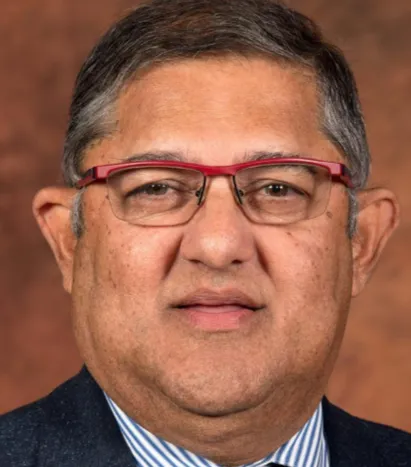
Narend Singh
Image: Supplied
Narend Singh, MP, is the Deputy Minister of Forestry, Fisheries and the Environment
** The views expressed do not necessarily reflect the views of IOL or Independent Media.