

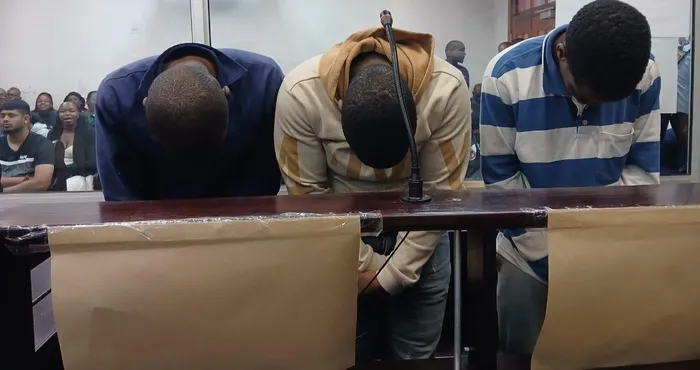
Three men accused of kidnapping and killing seven members of a Newark family have abandoned their bail application in the KwaDukuza Magistrate’s Court.
Image: Doctor Ngcobo/Independent Newspapers
A family of seven has been taken from us. Now every institution in this province – and every leader in this country – must answer one question: what are you going to do about making South Africa safe again?
THE week before they died, seven family members were celebrating.
Kraidon Monswamy, 26, had proposed to his fiancée, Melissa. The family gathered – his parents Alan and Sandy; sister Shamaria; and relatives Mooniamma, Cliffy, Mariamma – and they danced, and they toasted the beginning of something new. A family full of tomorrows.
On Tuesday, April 21, men that Alan had employed, driven to work and fed, broke into that home, bound seven people with rope, forced them into his bakkie, and drove 200 kilometres to a field outside Melmoth. They raped Shamarie. Twice. They demanded banking PINs. They killed them all. Three were shot. Four were stabbed. The youngest was 20. Mariamma would have turned 83 the following Thursday. Lock your door tonight. Then ask yourself honestly whether that is enough. Is this the democratic South Africa we all fought for?
This was not an Indian family. This was a South African family – your family, my family, any family. They worked municipal contracts and Eskom maintenance, employed people in their community, and lived quietly. Neighbour Julie Gengadu told the POST: "They were such good people. They were helpful and kept to themselves."
Community police forum chairperson, Vusi Mawela, added: "Alan had an established business, providing employment in the area. We are shocked by this crime, which has claimed an entire family."
We must also guard against those who would exploit this tragedy for racial or political purposes like some well-known political parties who are silent on this matter. Crime is crime. This family's murder is a South African failure – nothing more, nothing less.
The suspects did not wear masks. IPSS operations manager Phumlani Vezi told The Witness: "The suspects were known to the family and were not wearing coverings. That is why we believe they decided to kill the victims."
They planned to kill from the beginning. Their confidence is not madness. It is a verdict on years of slow justice and sentences that have taught criminals there is nothing to fear. The SAPS proved them wrong this time – the Counter Kidnapping Unit, KwaDukuza detectives, and the Serious and Violent Crimes Unit made three arrests across two districts within hours. This is the SAPS working as it must. It is possible. It should be the standard.
On Tuesday, April 28, Linda Blessing Mthiyane, 28; Bongumenzi Mpungose, 26; and Mthandeni Luyanda Mthiyane, 21; faced 17 charges in the KwaDukuza Magistrate's Court – seven counts of murder, six of kidnapping, rape, robbery, housebreaking, and unlawful possession of a firearm. They abandoned their bail application. Mpungose was charged with alleged rape.
Hundreds of community members outside demanded a maximum sentence. The case is adjourned to June 23 for forensic finalisation across two crime scenes. A fourth suspect remains free. The family could not identify which of the three had worked for Alan, as the court shielded their faces throughout. A relative said what the country felt: "The entire nation wants to see who these guys are. They should not have been given a choice about the matter."
Premier Thamsanqa Ntuli visited the family, attended the funeral, stood outside the court, and paid the funeral costs.
At the funeral, he said: "This is not a normal funeral. When you see seven coffins lying here, not because of a natural cause of death but at the hands of barbaric, ruthless and heartless men, it touches all of us."
Narend Singh, Deputy Minister of Forestry, Fisheries and the Environment, stood with him at the family home on Friday and commended the police response: "This is a classic example of people working together under the proper leadership for a common purpose."
Both men showed up. That matters. And then there is the president. Condolences were conveyed to the family on his behalf – through the premier.
On Freedom Day, six days after Newark, President Cyril Ramaphosa spoke in Bloemfontein about immigration and international solidarity. Not one word in his own voice for Mariamma, who would have turned 83 the day before. Not one word for Kraidon's fiancée, who must now plan a funeral instead of a wedding.
Narend Ganesh – a Durban North political activist who has survived five armed home invasions, including one in which a murder was committed in his own home – wrote to the POST last week: "My call to President Cyril Ramaphosa is to wake up and protect citizens and stop paying lip service to crime – innocent people are being mercilessly murdered, and as president he is duty-bound to act – and act decisively."
Mr President: that call deserves your answer, in your own voice. We must not pick and choose deaths; these were South Africans, born and brought up here, expecting your protection.
Politicians will speak. Communities will march. Then the news cycle will move on – as it always does. The family is left with a silent house in Newark. This is the pattern South Africans know by heart. It is why so many have lost faith. There is one man in this province who cannot afford to move on. That man is Lieutenant-General Nhlanhla Mkhwanazi.
With the national commissioner facing scrutiny before the Madlanga Commission and the ministerial structure in transition, Mkhwanazi carries both the mandate and the moral authority to lead. He has shown he does not bend under political pressure – he confronted interference at the highest levels when it cost him something to do so. KZN trusts him for that.
Now that trust must be repaid by driving this prosecution personally, ensuring the forensics are locked down before June 23, finding the fourth suspect, and making certain the NPA enters that courtroom with everything it needs for a sentence this province will remember.
There are those who will forget the family of seven's names by next week. Mkhwanazi must not be one of them.
The public fury is not irrational. It is the response of a society that has watched slow justice, inadequate sentences, and parole granted to men who committed monstrous acts.
Dr Suhayfa Bhamjee, of UKZN, said it clearly: "When violence is this extreme, it exposes a very real fear that nobody is safe. Calls for the reinstatement of the death penalty come from grief, anger and desperation – not ignorance."
The death penalty will not return – the Constitutional Court settled that in 1995. But under the Criminal Law Amendment Act 105 of 1997, premeditated group murder carries a mandatory minimum of life imprisonment. Seventeen charges. Seven lives. The NPA must treat this prosecution with the full gravity that number demands.
Win this case. Completely. Visibly. Without compromise.
Alan's eldest daughter was killed in a road accident in 2024. Now the rest of the family is gone. Their ashes were scattered into the sea. The house in Newark stands empty. There is no one left to return to it.
Kesaven Pillay said the words that must never leave us: "We grew up in this home and always felt safe."
Families in South Africa should feel safe in their homes. That is not a wish. It is the minimum obligation of a state, a government, a president, and a police commissioner. The police have honoured that obligation. Now the rest must honour theirs. Seven coffins. One empty house. Zero excuses. Set an example so that those contemplating such heinous acts of crime think twice before it’s too late. The world is watching us.
** The views expressed do not necessarily reflect the views of IOL or Independent Media.