

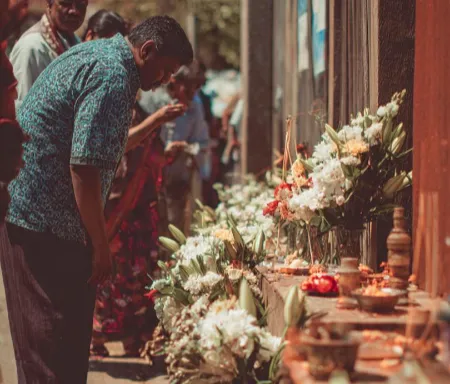
Recent discussions within sections of the Hindu community regarding funeral-related activities taking place within temple precincts have sparked strong emotions, differing opinions and important theological reflections.
Image: Meta AI
Recent discussions within sections of the Hindu community regarding funeral-related activities taking place within temple precincts have sparked strong emotions, differing opinions and important theological reflections.
While some may dismiss these concerns as outdated ritual sensitivities, others view them as fundamental to preserving the sanctity and spiritual integrity of consecrated temple spaces.
The debate is not merely about a building or venue. It touches on deeper Hindu understandings of purity, sacredness, energy, devotion and the relationship between life, death and worship. In many Hindu traditions, temples are not simply places where people gather socially.
They are regarded as sacred spiritual centres that have undergone consecration rituals to invoke divine presence. Once consecrated, devotees believe that these spaces carry a unique spiritual vibration that must be protected and preserved.
In Hindu tradition, temples are therefore not regarded as ordinary structures. Through sacred rituals and the installation of murthis, temples become spiritually-charged spaces dedicated to divine presence. Devotees enter these spaces after prayer, fasting, cleansing and mental preparation.
During sacred observances such as Kavady, this spiritual discipline becomes even more intense. Many devotees undertake periods of fasting, celibacy, vegetarianism, prayer and self-purification in preparation for carrying Kavady to Lord Murugan.
The Kavady period itself is one of immense devotion and sacrifice. For devotees, carrying Kavady is not simply a cultural activity or public procession. It is a deeply spiritual act of surrender, discipline and purification. The body, mind and surroundings are expected to align with this sacred undertaking. This is why many devotees become uncomfortable when activities associated with mourning and death take place within or immediately adjacent to temple premises during this sacred period.
Within Hindu philosophy, death is not viewed as evil or shameful. Hinduism in fact teaches that death is part of the eternal cycle of birth, life, death and rebirth. It is understood as a transition of the soul rather than an end. However, ancient ritual traditions across many Hindu communities recognise different spiritual and ritual states associated with mourning and bereavement. Customs relating to ritual impurity, often referred to in some traditions as theetu or ashaucham, developed over centuries and continue to influence religious practice today.
It is therefore understandable that many devotees feel that funeral rites and temple worship should remain separate. Historically, funeral rites were generally conducted at homes, cremation grounds or designated community spaces, while temples remained dedicated to worship, meditation and spiritual upliftment. In many parts of India even today, bodies are not ordinarily brought into temple premises because of these longstanding ritual understandings.
For many devotees, particularly during sacred observances, the conducting of funeral-related activities within or directly adjacent to temple spaces may therefore create spiritual discomfort. Their concerns should not automatically be ridiculed or dismissed as ignorance or superstition. Such feelings are rooted in centuries of ritual practice, inherited belief systems and theological understanding.
At the same time, another important reality must also be acknowledged. Modern temples, especially in countries such as South Africa, have evolved beyond purely ritual functions.
Many temples now operate as important community centres providing social support, educational programmes, charitable services and facilities for community gatherings. Some temple complexes include halls that administrators may regard as operationally separate from the actual consecrated prayer area.
This is where the debate becomes more complex.
What may appear administratively acceptable to temple management may still be perceived by devotees as spiritually inappropriate. Even if funeral proceedings occur in a downstairs hall or separate section of the property, many worshippers may still feel uneasy knowing that mourning-related activities are occurring within the broader temple precinct during sacred periods such as Kavady. Temple leadership may argue that the hall is merely a community facility, while devotees may continue to experience it as part of the sacred temple environment.
Another concern raised by some devotees is whether exceptions are sometimes made because of influence, seniority or internal politics within temple structures. Such perceptions, whether accurate or not, can create feelings of inconsistency and mistrust within religious communities. Religious institutions therefore carry a responsibility not only to act appropriately but also to ensure that decisions are transparent, consultative and sensitive to the spiritual sentiments of devotees.
At the same time, compassion and humanity must never be forgotten. Families experiencing bereavement often seek comfort within the very religious institutions that shaped their lives and spiritual journeys. Temples are meant to serve communities in times of joy as well as sorrow. The challenge therefore lies not in creating division or hostility, but in finding an appropriate balance between compassion for grieving families and the preservation of ritual sanctity.
The issue therefore requires sensitivity rather than confrontation.
It is important that Hindu communities engage these questions respectfully and maturely without attacking grieving families, temple officials or devotees who hold differing views. Temples occupy sacred positions within the emotional and spiritual lives of worshippers. Decisions affecting ritual practice should ideally involve consultation, transparency and guidance from respected religious scholars and spiritual leaders representing diverse traditions within Hinduism.
Perhaps this debate also presents an opportunity for Hindu organisations to develop clearer protocols regarding the use of temple facilities for funerals, memorials and mourning-related activities. Such guidelines could help balance compassion for bereaved families with the preservation of ritual sanctity and the spiritual expectations of devotees.
Clear policies would also help avoid confusion, division and future conflict within communities.
Hinduism has survived for thousands of years not because it avoided difficult conversations, but because it continuously reflected, adapted and engaged deeply with questions of dharma, spirituality and community life. Constructive debate has always formed part of Hindu philosophical tradition.
This discussion should therefore not divide us. Rather, it should encourage thoughtful reflection on how we preserve the sanctity of our sacred spaces while still embracing compassion, humanity and community responsibility. In an age where many religious institutions are navigating modern realities and community expectations, such conversations may ultimately strengthen rather than weaken our understanding of faith, devotion and sacred tradition.
Dr Rajendran Govender is a social anthropologist and researcher; a commissioner in the Cultural, Religious and Linguistic Rights Commission; board Member of the Pan South African Language Board and Global Coordinator of the Global Repository for Ancient Cultural Endeavours.
He writes in his personal capacity.
** The views expressed do not necessarily reflect the views of IOL or Independent Media.