

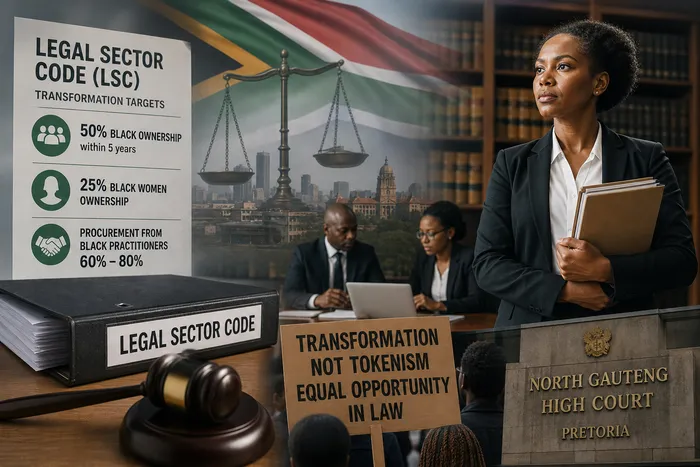
Major law firms challenge new Legal Sector Code aimed at transformation.
Image: AI Generated
YUSUF ISMAIL looks at the ongoing challenges of racial inequality in South Africa's legal profession, examining the implications of the new Legal Sector Code (LSC) and the resistance from major law firms.
THE legal profession, specifically amongst top tier law firms like much of corporate South Africa, remains largely lily white three decades after the end of apartheid.
White people make up about 7% of the population, and 72% of partners at top law firms. In late 2024, the government introduced a new code for the legal sector under a policy known as Broad-based Black Economic Empowerment (B-BBEE), setting a target of 50% Black ownership of large firms within five years, with 25% Black women.
It is a supposed to be a framework premeditated to accelerate transformation within South Africa’s legal profession. It will apply to all registered practicing attorneys and advocates, as well as state legal departments, aiming to ensure the profession reflects the country’s demographic diversity.
It sets specific targets for ownership, and procurement for law firms and advocates, aiming to address historical inequalities and increase the participation of black practitioners, particularly women.
Bowmans, Webber Wentzel, Werksmans, and Norton Rose Fulbright, are challenging this code in the High Court, arguing that the 50% target is “unrealistic, unsustainable, and legally unsound”. Their legal challenge at best is nothing short of being pedestrian and pathetic at worst.
However, the rabbit hole goes deep and it is important to unpack all the players in the saga.
There are multiple charlatans operating at various levels. Firstly, the code was published by Mpho Parks Tau, more suitable as a clown jester as opposed to being South Africa's Minister of Trade, Industry and Competition.
This character has faced several corruption allegations throughout his aphoristic career, primarily involving tender irregularities and State capture links during his time in Johannesburg. Accusations include beneficiary collusion and involvement with Regiments Capital.
Secondly Broad-Based Black Economic Empowerment (B-BBEE) in a general sense dismally failed in 30 years by functioning primarily as a tool for “elite and selective transition” rather than genuine, broad-based economic transformation. Critics state it has hindered economic growth, fuelled corruption, and resulted in high unemployment rates for black South Africans.
Starting in the Thabo Mbeki era, the creation and transmogrification of a small, politically connected black capitalist class who joined the ranks of their previous “white masters”. Instead of dismantling the economic structures inherited from apartheid, B-BBEE co- opted black elites into existing white-owned corporate structures, allowing white capital to maintain control over banks, mines, and a reliance on state tenders in the creation of quick-fix billionaires.
Broad-Based Black Economic Empowerment (B-BBEE) legislation applied to South African law firms prior to 2024, but they operated under generic B-BBEE codes rather than sector-specific ones. It created a situation where a sprinkling of “rented black faces” fronted the traditional big, white law firms who dominated the spectrum of high-end corporate work for JSE-listed companies and state-owned entities (SOEs) in South Africa.
These firms maintained their dominance through extensive capacity, and long-standing relationships with large corporate clients.
During the apartheid era, Bowmans, ENSafrica, Webber Wentzel, and Werksmans operated as leading corporate law firms in South Africa, focusing on corporate, and mining law.
They were the legal power houses underpinning the economic sector which underpinned the apartheid regime. They were part of a white-dominated legal sector that handled legal work for the state and the JSE, while non-white lawyers were largely restricted to criminal or civil matters.
Post 1994, they still maintained their dominance of legal work and are ruthless when it comes to foreclosures for and on behalf or exploitative banks and when getting work from state parastatals. This is how they did it.
These firms were measured under the Amended Generic Codes of Good
Practice. If you fulfilled the bare sub-minimum, it meant you were compliant and that opened up your ability to secure state work in South Africa. By having a few “Black faces” within the firm as token figures, they passed the criteria and the state which preferred them in the first place, justified the contracted work by citing their alleged BB BEE status.
The LSC code aims to change that. The implementation of the LSC would affect the big 5 who hold Level 1 BB BEE ratings under the Generic Codes and any drop to Level 6 or lower under the LSC and would render them ineligible for state legal briefs.
There may be a few existing flaws in the code, but one of the superficial objections is that the code targets only about 5 percent of the legal profession. That is precisely the point. It is about time to decapitate the head of a poisonous snake in our legal midst!
Today the sole practitioner be he white, Indian, black or coloured is struggling. But the big 5 law firms are raking in billions from listed companies and state parastatals.
Under apartheid, the legal profession served as a bulwark of elitist white privilege, with access to legal education, practice opportunities, and leadership roles predominantly reserved for white males.
Decades later, this inequality persists, with black professionals, facing barriers to entry and advancement in the legal profession. High value work and briefing patterns are selectively distributed.
My friend from Umzimkhulu, a brilliant attorney and conveyancer cannot get any panel work from any major bank in conveyancing. Historical advantages have allowed established white firms to maintain dominance on major banking and commercial property panels.
As a strategic manouver, Advocate Ngcukaitobi, widely regarded as a champion of constitutionalism, was roped in by three firms in a pretentious
chess-play. The irony of his representation is the height of cynicism, particularly when his clients are viewed as symbols of the untransformed corporate legal establishment against a code designed to mandate stricter race-based targets.
Those same firms will spit him out and use their own elitist clique in a mergers and acquisition dispute in the same court.
Solidarity, a fanatical, right-wing Calvinistic South African trade union outfit, launched its own application to have the Legal Sector Code overturned. So, the applicants have underpinned their ideological leanings and guilt by association.
It is arrogant as these firms state that “we have trained and employed X number of black lawyers”. Our trajectory should be on the substance of equality. Many legal racists self-identify as politically progressive and anti-racist.
The “I have black friends” defence turns to “we have trained black lawyers”. This is racist denialism whereby whiteness sees itself non-responsible instead of irresponsible, and ignores the historical source of African poverty and the disparities experienced by Africans.
Our commitment to justice and the 30 year anniversary of our Constitution necessitates that we simply just do not preach our commitment to equality but that we actively engage in dismantling the relics of a stinking corpse within the legal fraternity. Only then will justice permeate within the external ambits of society.
** The views expressed do not necessarily reflect the views of IOL or Independent Media.