

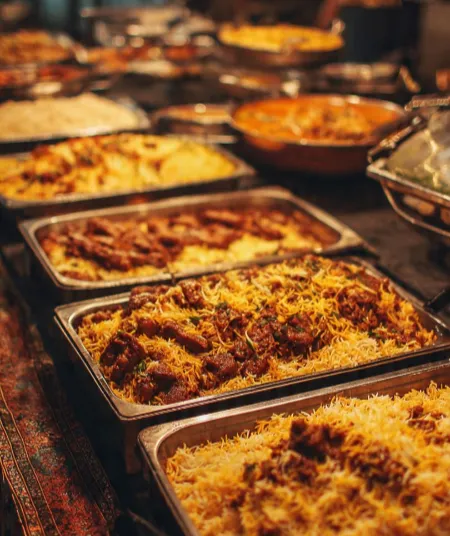
The opportunism for food is no mere Johannesburg quirk; it was perfected in Durban long ago, then carried with those who trekked north to Joburg with ruthless efficiency, says the writer.
Image: Meta AI
In Johannesburg’s glittering banquet halls, Dhushan Rangan has a reputation as the maestro of events catering – lavish spreads of fragrant breyanis, fiery curries, succulent roasts, and delicate desserts that linger on the tongue long after the evening ends. Yet nothing unsettles him more than the quiet chaos that unfolds long before the first course is served.
Guests, armed with plastic containers and foil packets, hover like hawks over the buffet, or in the makeshift kitchen, eager to squirrel away food for later. Dhushan feels so strongly about these antics that he and his wife Karmini, an agricultural training and development facilitator, have taken to social media to ventilate their dismay, and with the hope that some people will give up their bad habits.
They described how grotesque greed transforms joyous occasions such as wedding receptions, birthday parties, and community gatherings into spectacles of gluttony.
The couple recounted how, at a recent function, Dhushan had stepped out of the kitchen for just a moment, only to return and find “an aunty” elbow-deep in the pot of Cornish chicken curry, busily filling a large plastic container with drumsticks, feet and wings. When confronted, she offered a guilty grin and retorted: “these are the best parts, eh?”
Karmini spoke of “Bones Uncle” who arrived at a lavish dinner event armed with a crinkled Checkers plastic bag, intent on gathering bones for his dog.
With the zeal of a DA election campaigner and the persuasion of a Bethesda preacher, he urged other guests to contribute to his peculiar cause, transforming the banquet into a bone-drive, where generosity was measured not in laughter or fellowship, but in scraps destined for Bonzo waiting in his kennel at his Lenasia home.
Dhushan recalled the antics of “Tupperware Aunty” who arrived with a cavernous food container and began scooping generous helpings of lamb breyani at the buffet station even before the function had officially begun. Her explanation was that the packed feast was destined for her son, laid up at home with illness.
“And the son eats for four guests,” Karmini quipped, capturing the absurdity of the excuse.
Equally irksome, she added, was the host’s habit of filling several containers with the assurance, “this is for the house people”.
These parcels were then forgotten, only to be unearthed later when the kitchen is being cleared, hidden away like contraband stashed by Chatsworth drug lords who had just been tipped off about a police raid.
Dhushan sighed that another recurring headache at weddings came from the men staging their “car boot party” to cure the babelaas from the nalengu or hurdhee the night before, when Jameson flowed like the Jukskei River in flood.
They wander into the kitchen, he said, demanding glasses and a plate of chicken bites and samoosas, and head straight to the parking lot. After fortifying themselves, and when all the excess food has been cleared away, the noisy bunch reappears in the hall, insisting on being served.
“When we tell them there is no food left, we’re accused of undercatering. Why does this only happen at Indian functions?” an exasperated Dhushan asked, his voice carrying the weary cadence of someone who had fought this battle too many times.
And this opportunism for food is no mere Johannesburg quirk; it was perfected in Durban long ago, then carried with those who trekked north to Joburg with ruthless efficiency. I have personally witnessed the buffet becoming a war zone of elbows and eyes the moment the bain-marie lids are lifted.

Dhushan Rangsan and wife Karmini.
Image: Supplied
The hall transforms into a modern-day Kurukshetra, the site of the 18-day Mahabharata war. Plates become chariots, serving spoons the weapons, and the battlefield is not fought for dharma but for drumsticks.
Guests who moments earlier exchanged polite greetings now jostle for position, their plates piled high as though famine lurks outside the hall. Some heap food with the same urgency of rations being stocked during the July 2021 riots; others hover like hawks, waiting for chafing dishes to be replenished.
The abundance intended to symbolise generosity instead exposes scarcity of restraint, by rich and not-so-rich alike.
What was once whispered about has now become brazen: guests arriving with plastic and foil food containers, and even ice-cream and margarine tubs repurposed for the occasion, and kept in the car, as essential as the spare wheel. Food meant for communal enjoyment is swiftly converted into private stockpiles. Fried snacks – vades, polis, puri-patha and spring-rolls – vanish, tucked into handbags or pockets before the function has even ended.
In many traditions, food is sacred; a symbol of blessing, community, and shared joy. To hoard it, to strip it of dignity by stuffing it into crumpled plastic, is to miss its meaning. The same guests who bow their heads in prayer before eating are the ones who later scramble to secure leftovers, as though divine grace must be carried home in cling wrap. At its heart, this phenomenon is not about hunger but a desire to maximise personal gain, and sometimes a lack of consideration for others.
The host’s generosity is exploited rather than honoured. What should be a celebration of community becomes a quiet contest of acquisition. Gaining popularity is the Ziploc stealth manoeuvre – under the table or during a quick trip to the buffet, they’ll slide handfuls of wings, biscuits or even slices of cake into the bags they specially carry. Some guests don't bother with bags at all. They will wrap bread rolls, cheese, cubes of butter and pastries in the thick cloth napkins provided by the venue and drop them directly into their purses.
Heavy winter coats or cargo pants are the preferred uniform for the buffet bandit. It’s not uncommon for guests to leave a party with pockets stuffed with individually-wrapped chocolates, fruit from a centrepiece, and chevda wrapped in a serviette. I’ve seen parents who sometimes use their children as decoys. They’ll load up a plate with "food for the toddler", pack it away in a bag, and then go back for a second plate for the child. It’s the perfect cover because nobody wants to be the person who questions why a 3-year-old needs four chicken breasts and two large slices of fried Cape salmon.
Then there is the guest who makes a big show of having to leave early because “it is dangerous to drive late at night”. While saying “goodbye" for the umpteenth time, they’ll grab an entire platter of mixed savouries, claiming they’re "just taking a snack for the road" because they didn't get a chance to eat dinner. When the deepa aradhanai at a memorial service drags on, partly because the singers and musicians are paid by the hour, and partly because every Tom, Dick, and Mary (including those who once owed the deceased money) insists on standing in line to pay public homage, it creates the perfect window for the “bag aunties” to loot.
By the time the final hymn fades, the platters have been stripped bare, resembling Woolies racks after a 50% off sale. If food is the language of fellowship, then our behaviour at the buffet must speak of respect, not rapacity. The antics of “bag aunties” and “bones uncles” may draw laughter in the retelling, but they erode the dignity of our gatherings. Change begins with small acts: hosts setting clear boundaries, guests remembering that generosity is not a licence for greed, and communities teaching children that hospitality is sacred, not exploitable.
Education can be as simple as a gentle announcement before the meal, reminding guests that the feast is meant to be shared in the spirit of gratitude. Religious and cultural leaders, too, can reinforce the symbolism of food as blessing, not bounty to be hoarded. Schools and community forums can weave lessons of consideration into everyday teaching, so that respect for the table becomes second nature.
Ultimately, the buffet is not a battlefield but a banquet of belonging. To act with restraint, to eat with grace, and to leave with gratitude is to honour both the host and the heritage. If we fail to change, our functions will continue to echo not with joy but with the rustle of plastic bags. If we succeed, they will resound with laughter, fellowship, and the true flavour of community.
** The views expressed do not necessarily reflect the views of IOL or Independent Media.