

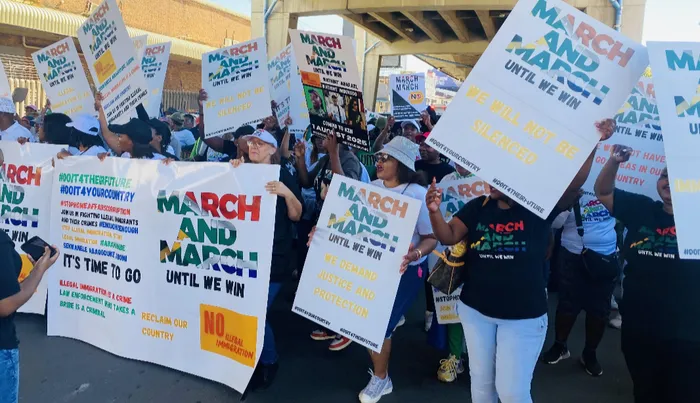
Demonstrators carry placards calling for stricter action against illegal immigration during a march in Johannesburg.
Image: Simon Majadibodu/IOL
SOUTH Africa is once again confronting one of the most emotionally charged and politically sensitive issues in the country’s democratic history, namely illegal immigration.
Recent marches organised by groups such as March and March, Operation Dudula, and several civic formations across Johannesburg, Durban, Tshwane and Pietermaritzburg have demonstrated that large sections of the public are deeply frustrated with the government’s inability to secure borders, enforce immigration laws, and protect already strained public resources. Whether political elites like it or not, immigration enforcement has become a mainstream public demand.
The growing protests are not occurring in a vacuum. They are unfolding against the backdrop of mass unemployment, collapsing municipalities, organised crime, housing shortages, overwhelmed hospitals, drug trafficking networks, and widespread perceptions that the South African state has lost control of its borders.
For decades, South Africa’s governing establishment has approached immigration through an ideological lens shaped by liberation politics. The argument often advanced is that neighbouring African countries assisted the Congress liberation movement during apartheid, and therefore South Africa has a moral obligation to maintain a soft posture toward migrants entering the country.
Countries such as Zambia, Tanzania, Mozambique, Zimbabwe, Angola and others indeed played important roles during the liberation struggle. However, historical solidarity cannot become a permanent justification for weak border control, unlawful migration, or policy paralysis. No sovereign state can sustainably operate on the basis of ideological and emotional indebtedness rather than national interest.
Governments are elected to protect citizens, uphold the law, and preserve social stability. There is an important distinction that must be made clearly and honestly. Legal immigration and illegal immigration are not the same thing. South Africa has every right to welcome skilled migrants, investors, tourists, academics, refugees fleeing genuine persecution, and lawful workers who comply with immigration procedures. But a state that fails to distinguish between lawful and unlawful entry ultimately undermines the rule of law itself.
One of the central frustrations among many South Africans is the perception that the asylum system has been abused for economic migration. Individuals from countries not experiencing war or humanitarian collapse often enter South Africa claiming asylum, remain in the country for years, establish businesses, and eventually regularise their stay through administrative loopholes, fraudulent documentation, marriages of convenience, or backlogged legal processes. This has fuelled widespread public anger, especially in poorer communities where competition over jobs, housing, informal trade, and public services is most intense.
The uncomfortable reality is that many African countries themselves maintain far stricter immigration regimes than South Africa. South Africans who romanticise open-border policies rarely acknowledge this fact.
In Nigeria, foreign participation in certain sectors is tightly regulated and immigration compliance is aggressively enforced. In Ethiopia, several economic sectors historically operated under heavy restrictions on foreign ownership and participation, just this week it was reported by Business Insider the Ethiopian government had restricted foreigners from operating retail businesses. In Ghana, parts of the retail and small-scale trading sector are legally reserved for Ghanaian citizens, with minimum capital requirements imposed on foreigners wishing to trade.
Zimbabwe has repeatedly pursued indigenisation and localisation policies aimed at reserving strategic sectors for locals. Botswana has long protected parts of its small business economy from foreign dominance through licensing restrictions.
Across the continent, governments routinely prioritise citizens in employment, licensing, land ownership, and small enterprise protection. They do so unapologetically because every nation ultimately acts in its perceived national interest.
South Africa therefore should not be intimidated into believing that immigration enforcement is uniquely immoral or “anti-African”. Every functioning state regulates entry into its territory. Even beyond Africa, some of the world’s most developed democracies have dramatically strengthened border enforcement. The United States has expanded surveillance technology and border patrol infrastructure for decades. European nations increasingly tighten asylum rules and deportation systems amid rising migration pressures. Australia maintains some of the strictest border enforcement systems in the world.
South Africa cannot continue behaving as though border security is somehow incompatible with constitutional democracy. This does not mean endorsing xenophobia, extortion for protection, mob justice, or violence against foreign nationals. Criminal conduct against innocent people can never be justified. Foreign nationals who are legally documented and law-abiding deserve protection under the law like any other resident.
However, it is equally irresponsible to dismiss every concern about illegal immigration as “xenophobia”. That label has often been weaponised to silence legitimate public concerns. Communities across South Africa have repeatedly raised concerns regarding undocumented migrants linked to drug distribution networks, illegal mining operations, human trafficking, counterfeit goods, extortion rackets, prostitution syndicates, and organised criminal enterprises.
Law enforcement agencies themselves have acknowledged the role played by transnational criminal syndicates operating across borders. Importantly, crime is not committed by nationality alone. Most foreign nationals are not criminals, just as most South Africans are not criminals. But it is also true that weak border systems create opportunities for organised crime networks to flourish. A country that cannot properly monitor who enters and exits its territory creates vulnerabilities that sophisticated criminal groups exploit.
This is precisely why border enforcement should be viewed primarily as a national security issue rather than merely an emotional or ideological debate.
South Africa’s borders remain dangerously porous. Corruption among some officials from Home Affairs or by border patrol officers has further undermined immigration enforcement. Fraudulent documentation, bribery at ports of entry, and inefficient asylum processing systems have created a perception that immigration laws are selectively enforced or easily manipulated. The consequences are visible everywhere.
Public hospitals in many provinces are overwhelmed. Informal settlements continue to expand. Inner-city buildings are increasingly controlled by criminal syndicates. Competition in the informal economy has intensified. Youth unemployment remains catastrophic. According to official statistics, South Africa’s unemployment rate remains among the highest in the world. Ordinary South Africans are therefore asking a simple question: how can a state struggling to provide for its own citizens continue absorbing large-scale undocumented migration without consequences?
Political parties cannot have the luxury of avoiding this debate because they fear accusations of xenophobia or political incorrectness. The public mood is changing rapidly. The recent marches demonstrate that immigration has become an electoral issue. The state now faces two choices.
The first option is continued denial, weak enforcement, and reactive governance. That path risks deeper social instability, vigilantism, and growing tensions between communities. The second option is firm, lawful, constitutional enforcement of immigration laws combined with stronger regional cooperation and modern border management.
South Africa should choose the second path.
Government must urgently invest in advanced border infrastructure, including drones, biometric verification systems, AI-assisted surveillance, integrated databases, thermal imaging systems, and modernised ports of entry. Border policing must become professionalised, technologically equipped, and corruption-resistant.
The Department of Home Affairs requires radical reform. Asylum processes should be accelerated and tightened to ensure that genuine refugees are protected while fraudulent claims are identified quickly. Deportation systems must function efficiently and lawfully. Individuals who enter illegally and fail to regularise their status should face deportation in accordance with South African law. Furthermore, the country should seriously consider stricter localisation measures in selected sectors of the informal economy where local citizens have been economically displaced.
Many countries across Africa and the world already reserve certain sectors for citizens. At the same time, South Africa should strengthen bilateral agreements with neighbouring countries to improve labour migration management, intelligence sharing, anti-trafficking operations, and border security cooperation. Ultimately, this debate is not about hatred toward foreigners. It is about whether South Africa still believes in the principle of sovereign governance.
No country can survive indefinitely without controlled borders, credible immigration systems, and public confidence in the rule of law. The liberation struggle was fought so that South Africans could govern themselves democratically and determine their own national future. That democratic right includes the right to decide who may lawfully enter, reside, and operate within the Republic. The growing public demand for stricter immigration enforcement should therefore not be ignored, demonised, or dismissed. It should be channelled into lawful, constitutional, rational policy reform.
South Africa must reject both extremes: xenophobic vigilantism on the one hand, and politically paralysed denialism on the other. A sovereign nation has the right - and indeed the duty - to secure its borders, enforce its laws, prioritise its citizens, and maintain social stability. Doing so does not make South Africa less African. It simply makes South Africa a functioning state.
Sources from recent reporting indicate that anti-illegal immigration marches have taken place in Durban, Johannesburg, Tshwane and Pietermaritzburg during 2026, reflecting growing public concern regarding undocumented migration, border control, crime and public service pressures. International responses from several African governments and debates around Operation Dudula and related movements have further intensified the national conversation around immigration policy and enforcement.

Nandkishor Singh.
Image: Supplied
Nandkishor Singh writes in his personal capacity as an activist, academic and patriot.
** The views expressed do not necessarily reflect the views of IOL or Independent Media.