

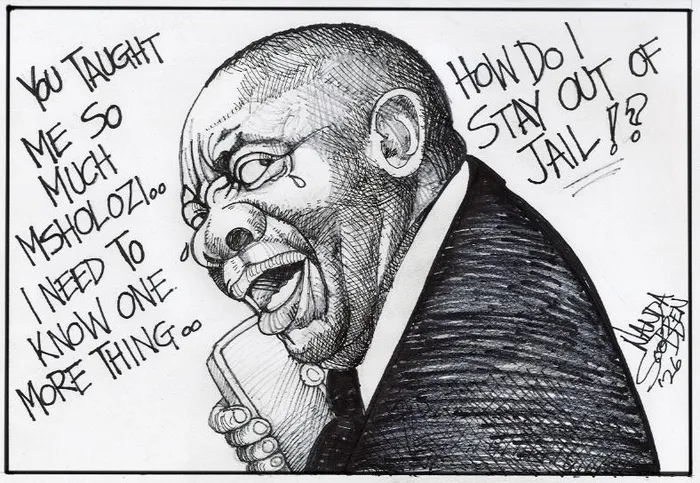
A cartoon by Nanda Soobben.
Image: Nanda Soobben
CYRIL Ramaphosa is a man for all seasons. An African Dick Whittington. A cunning dog during the heights of apartheid. As the ANC’s lead negotiator in the early 1990s, Ramaphosa was considered highly tactical and shrewd, particularly at Codesa.
In 1982, at the request of the Council of Unions of South Africa, Ramaphosa founded the National Union of Mineworkers (Num) and served as its first general secretary. Under his leadership, the Num grew from 6,000 to over 300,000 members, becoming the most powerful union at the time. He led the Num in one of the largest strikes in South African history, a three-week shutdown of the mining industry.
Yet, after 1994, he became the poster boy of Anglo American. When Anglo American began unbundling assets, selling major stakes to black investor groups, Ramaphosa, being the saccharine casanova, led a consortium that acquired a large stake in Johnnic and JCI.
From rags to riches, he became a billionaire overnight. His Shanduka Group became his vehicle for wealth, growing to a portfolio over R20 billion by 2014. It held assets in major companies like MTN, Standard Bank, and Liberty.
The very man fighting for the rights of miners and workers instantaneously joined the persecutors in one magical sleight of hand only he could achieve. As a non-executive director at Lonmin platinum mine during the August 2012 Marikana massacre, where police killed 34 striking workers, emails revealed he urged “concomitant action” against strikers, which pressured police into a violent response. He was well suited to take over from a corrupt Zuma presidency and played his cards like a classic poker player, pouncing on the unassuming victim like a lion tearing up its prey. Yet he had the proverbial stinking dead carcass waiting to be discovered.
In mid-2022, in typical “set a thief to catch a thief”, Arthur Fraser, the former head of the South African State Security Agency (SSA), went to a police station in Johannesburg and filed a criminal complaint against Ramaphosa. Fraser accused Ramaphosa of kidnapping, bribery, money laundering, and “concealing a crime” in relation to the alleged theft of what the international media claimed was $4m from his Phala Phala Farm.
He made a statement accompanied by photographs, documents and CCTV footage of the alleged theft taking place. According to Fraser, criminals broke into Ramaphosa’s Phala Phala farm in the Limpopo province, on February 9, 2020, and discovered large sums of dollar bills hidden in various pieces of furniture.
Fraser alleged that Ramaphosa’s housekeeper discovered the cash and messaged her brother, who knew a gang of robbers. The gang included four Namibian citizens and two South Africans who gained entry into the premises by cutting the wire perimeter and entering through a window of the main farmhouse. The break-in was captured on CCTV footage.
Ramaphosa, who said in a statement that he was abroad at the time, claimed to had reported the incident to the presidential protection police unit. Fraser claimed that the housekeeper and the perpetrators were later paid nearly $10,000 for their silence.
The housekeeper was apparently later reinstated, but assigned to a different job on the farm.
The irony cannot be lost where one crook (Fraser) attempts to outbid another crook (Ramaphosa). Between 2007 and 2009, Fraser oversaw a parallel intelligence unit that was found to have engaged in wide-scale financial mismanagement, nepotism, and the misuse of hundreds of millions in taxpayer rand as exposed by Jacques Pauw.
The Zondo Commission found that Fraser was allegedly a "law unto himself” regarding SSA finances. Another “master of disguises” from being accused of corruption to becoming an accuser of a high-stakes poker player for being involved in corruption and receiving cash.
This cash was allegedly paid by a Sudanese businessman, Hazim Mustafa, as a security deposit for 20 buffalo that were never ultimately delivered.
The core issue remains the legality of holding large amounts of foreign currency, the failure to report the crime to the police, and the allegation that state resources were used for a private investigation.
The more one looked at the case, the more unanswered questions existed.
How did a Sudanese businessman, Hazim Mustafa, know to visit a private farm on Christmas Day 2019 to buy buffalo for cash?
Why was the money kept in couches for over a month, and why was the robbery not reported to the SAPS for 44 days?
Did Ramaphosa himself stuff cash of that magnitude into couches or did his workers?
Why were elite police officers and private agents used to track down the burglars instead of using formal, legal procedures?
Did the president violate the Prevention and Combating of Corrupt Activities Act by not reporting the theft to the police, and why was it not reported in the first place?
What happened to the transaction where one pays and stock was never delivered. Did this imply that Ramaphosa was unjustifiably enriched?
Were there more sinister elements at play in the source of that money. Could the monies have been proceeds of narcotics?
Why did Mustafa claim he declared the cash at OR Tambo International Airport upon arrival and yet Sars stated they found no record of this declaration.
Because the buffalo were never delivered, the Reserve Bank concluded there was no “perfected transaction” which legally meant Ramaphosa had not yet become “entitled” to the foreign currency, and “theoretically” it was not his money; hence he had breached no exchange control regulations. Was this another one of his genius master strokes?
Then in November 2022, came the report by retired Chief Justice Sandile Ngcobo who found prima facie evidence that the president might have violated the Constitution (Section 96[2](a)) regarding personal interests and conflict of office, and that he possibly committed serious misconduct.
This was automatically grounds for impeachment. But the poker player was not having any of it. He had his cards stacked, and his coterie of illegal casino players holding his falling chair, and with one swift stroke, the ANC used its majority in the National Assembly to vote down the adoption of the Section 89 panel report which failed by a vote of 214 against 148. This was unprecedented and reminiscent of the Zuma days once again. His own party was now actively shielding him from any possible impeachment inquiry which eventually led to the EFF along with the African Transformation Movement (ATM) taking Ramaphosa to the Constitutional Court regarding the scandal. The EFF and ATM argued that Parliament failed to hold the president accountable after a Section 89 panel found he might have breached his oath of office.
Then on May 8, the Constitutional Court ruled in favour of the EFF and the ATM. In a landmark decision (Economic Freedom Fighters and Another v Speaker of the National Assembly and Others [2026] ZACC 17), the court found that the National Assembly acted unlawfully and unconstitutionally when it voted in December 2022 to reject the Section 89 Independent Panel report. The EFF successfully argued that Rule 129I, which permitted the National Assembly to block the process before it reached an investigative stage, was unconstitutional.
The court ruled: “Rule 129I fails to respect this distinction. It permits the National Assembly to terminate the process in both situations in the same manner, including in circumstances where the evidentiary threshold has been met, but the factual record remains incomplete …
“The defect, therefore, lies not in the fact that some processes may end without a full inquiry. It lies in the rule’s capacity to permit the premature termination of a process in circumstances where further investigation is necessary to enable the National Assembly to discharge its constitutional function. That is constitutionally untenable.”
The court declared the National Assembly’s decision to block the impeachment inquiry against Ramaphosa, irrational and a failure of its constitutional duty to hold the executive to account; and ordered that the Section 89 independent panel report must now be referred back to an impeachment committee.
The implications of the ruling are now profound, with significant political and legal ramifications which now dictates that Parliament must now reconsider the Section 89 panel report, effectively putting the impeachment process back on the table.
A strong message will be sent through this judgment that nobody is above the law, and that Parliament cannot blackmail and use its majority vote as a mandate for malfeasance and skullduggery.
This ruling emerges at the time of another scandal where Ramaphosa was seen walking last week with a potential criminal Zimbabwean businessman, Wicknell Chivayo, during a recent visit to Zimbabwe. Chivayo is under investigation by the Hawks for alleged money laundering involving R15 million in a gold case.
Ramaphosa became president on an anti-corruption ticket. He may end up leaving on a corruption ticket.
Having breached anti-corruption laws, the spineless NPA decided not to prosecute him, but he now may face impeachment proceedings.
Ramaphosa’s political career (even during his 1990s supposed abdication and entering business) has been a see-saw and he has outfoxed most of his adversaries. His personality brings to mind the quote from science fiction writer Frank Herbert who said: “All governments suffer a recurring problem: Power attracts pathological personalities. It is not that power corrupts but that it is magnetic to the corruptible.”
** The views expressed do not necessarily reflect the views of IOL or Independent Media.