

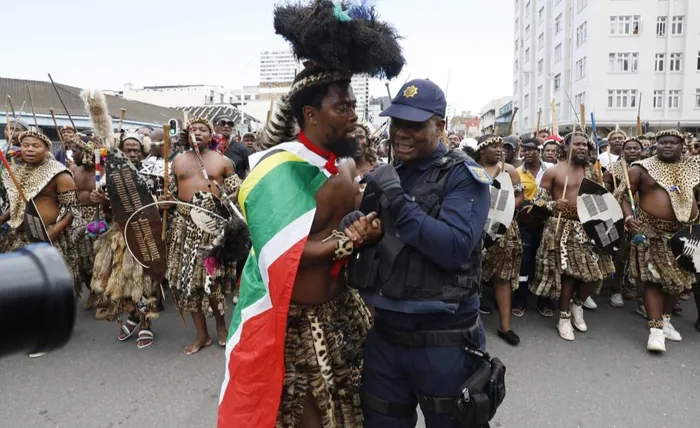
Thousands of supporters of the anti-illegal immigration movement, March and March took to the streets of Durban, marching through the coastal city to demand stronger action against undocumented foreign nationals. The demonstrators were joined by Zulu regiments dressed in traditional regalia, with two members riding on horseback.
Image: Doctor Ngcobo/Independent Media
THE leader of the March and March movement, Jacinta MaNgobese-Zuma, recently posted on her Facebook page that it was time to “Make Africa Great Again (Maga)".
This line of thinking appears consistent with Donald Trump’s campaign slogan. In her post, she implored illegal immigrants to “go home and fix your country”.
In recent months, we have witnessed terrifying protests and the escalation of other actions by social movements such as March and March, and by Operation Dudula, over the illegal immigration crisis in South Africa. It suffices to say that migration worldwide has reached crisis levels, as people from the poorest developing countries seek greener pastures to escape poverty.
While March and March is a self-declared non-violent movement, there are growing fears that its protests have the potential to turn violent and that some rogue elements could hijack the protests for other purposes, such as the looting of foreign-owned shops and extortion.
This has prompted some African governments to issue alerts to their citizens living in South Africa and to implore the South African government to protect immigrants.
The threat facing immigrants is undoubtedly becoming a major diplomatic headache, a hot potato, and, quite frankly, an embarrassment for the South African government. Lest we forget, South Africa’s foreign policy is predicated upon unflinching support for Africa, in particular, and the broader developing world.
The March and March movement’s protests over illegal immigration are spreading across provinces. Initially, the movement’s protests were confined to eThekwini. However, in recent weeks, March and March took them to the cities of East London in the Eastern Cape, then to Pretoria and Johannesburg in Gauteng.
The question now is: which cities are next as March and March seeks to expand its influence and make its presence felt across South Africa?
As the immigrant communities in South Africa brace for more anti-illegal immigration protests, it behoves all of us to reflect on these protests.
For countries such as Nigeria, Zimbabwe and Malawi, what is the meaning of independence or the right to self-determination if millions of their citizens cannot access economic opportunities and are forced to leave their countries? This means the right to self-determination has not worked in many parts of Africa, as evidenced by the mass exodus of Africans leaving their home countries in search of greener pastures.
Both the crisis of illegal immigration and the growing frustration with it in South Africa can be traced to post-colonial African governments' inability to create economic opportunities for their citizens. In South Africa, the previously disadvantaged majority is growing impatient, frustrated, and angry with unemployment, high poverty levels, and a general lack of opportunities.
In South Africa, the ANC-led government is between a rock and a hard place. It needs to urgently address the needs of poor South Africans while dealing with the crisis of illegal migration.
The flamboyant and colourful March and March protests have become notorious for instilling fear in the immigrant communities, both legal and illegal immigrants. The protesters' modus operandi has drawn large crowds and attracted attention, both domestically and internationally. Interestingly, it has complicated South Africa’s foreign policy towards African states such as Nigeria, Malawi, and Zimbabwe.
This is creating a diplomatic nightmare and puts South Africa’s government under growing pressure to protect its hosts, that is, foreign nationals.
Never before has this vociferous and relentless demand for the deportation of illegal immigrants been seen or heard of in the past 32 years. This begs the question: why is there now this sudden explosion of anti-illegal immigrant sentiment, including from political parties notably ActionSA, the Patriotic Alliance, and the MK Party?
This is because political parties such as the ANC sense that the anti-illegal immigrant issue appears to resonate with some voters. Many political parties fear that alienating these movements is likely to persuade their supporters and sympathisers to use their votes to punish political parties that are insensitive to the issue of illegal immigration.
South Africans have been growing impatient, frustrated, and angry that the advent of democracy has not improved their lives as they had envisaged. It is worth noting that more than 30 million South Africans remain dependent on social grants. This is a clear indication that previously disadvantaged South Africans continue to lack access to economic opportunities.
Now, the March and March movement is appealing to, and exploiting the frustration and anger of the poor black majority. It puts the blame for the lack of economic opportunities on illegal immigrants. Lest we forget, illegal immigrants are considered a source of cheap labour as employers avoid hiring unionised South Africans.
This means there is intense, growing competition for economic opportunity between the previously disadvantaged black majority South Africans and illegal immigrants, mainly from Africa.
As early as the 1930s, migrants from Malawi, Mozambique, Lesotho, and Zimbabwe worked in the mining and agricultural sectors. What makes matters worse now is that our economy is struggling to grow and create jobs in the labour-intensive sector.
I dare say that South Africans would not be growing frustrated with illegal immigration had their lives meaningfully improved in the post-apartheid era.
Like many governments in Africa, the post-apartheid South African government has not delivered on its promise of a better life for all. What most post-colonial governments in Africa have in common is that they have mismanaged their economies, engaged in massive corruption, and reneged on their promise to improve the lives of their people
While there are many reasons why illegal immigrants leave their home countries to live in South Africa, one common reason is the dire state of many African economies. This is an indictment of African leadership.
MaNgobese-Zuma has questioned the selective outrage of African governments over perceived xenophobic attacks in South Africa. She wonders why African leaders remain silent when people suffer in countries affected by war, religious violence, and instability, yet quickly unite when South Africa becomes the topic. She urges African leaders to focus more on protecting ordinary citizens instead of serving their personal interests. In this way, she is forcing uncomfortable conversations about leadership and accountability.
As all eyes fall on the Government of National Unity (GNU) to act boldly to dispel perceived threats to immigrants, another equally big challenge is to acknowledge, address, and deal decisively with the reality that the majority of the previously disadvantaged remain poor with no signs of any light at the end of the tunnel.
The dismal failure of African governments to deliver on their promise of a better life for their people in the post-colonial era appears to be boiling over in South Africa, and laying bare the myth of self-determination and freedom.
Last week, Khumbudzo Ntshavheni, Minister in the Presidency, warned that widespread protests and marches over illegal immigration pose a national security threat and reputational risk to South Africa. What Ntshavheni omitted to mention was that there could be dangerous criminals and terrorists hiding in South Africa, since it was easy to get in and out of the country.
Ntshavheni was also mum on why criminals who are in South Africa illegally are drawn to the country. It is now an open secret that South Africa’s blatant lawlessness and weak criminal justice system are the greatest magnets that attract shady characters such as Radovan Krejir from the Czech Republic.
As the Madlanga commission reveals, the South African Police Service (SAPS) is rotten to the core, and if one extends one’s imagination, all the state institutions are severely compromised and captured by criminal syndicates..
** The views expressed do not necessarily reflect the views of IOL or Independent Media.