

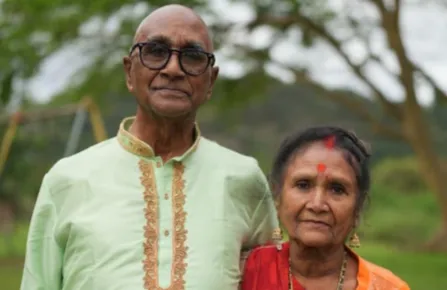
Take the story of Heraman and Prabha Sookoo of Shallcross. Married in 1966 in a ceremony on a day so hot that even their clothes protested, they barely spoke to each other on that occasion. Their parents had settled the match before the couple had much say, and two years later, they stood together as near strangers. Sixty years on, they are anything but strangers.
Image: Supplied
ONE of my quiet pleasures is paging through the POST, and at times stumbling upon those wedding anniversary stories that read like small miracles.
Sixty years. Sixty-five. Sometimes 70.
In an age where a phone battery barely lasts a day, here are marriages outlasting governments, fashions, and entire television eras.
And more often than not, these unions have one thing in common: they were arranged.
Not forced, let’s get that straight before the modern cynics choke on their cappuccinos, but arranged. There is a difference, and it matters.
In an arranged marriage, the families introduce, the couple disposes. Consent is not only present; it is essential.
The old matchmaker aunty
The old matchmaker auntie with the sharp eye and sharper tongue does not drag anyone to the altar; she merely opens the door and says: “Have a look. Good family.”
Quite often, the POST runs stories like this. A couple with 50, 60, sometimes 70 years of marriage, faces crinkled like old maps, telling a reporter that it was an arranged match. Love grew, they say. Slowly, maybe. Quietly, like a root taking hold underground while nobody watched.
Back in the day, the process had a certain theatre to it. A go-between aunt, or a well-meaning colleague, would whisper about “a nice girl” or “a respectable boy”.
This was not Tinder
If the families nodded, approval being the original green light, the courtship began. This was not Tinder. This was choreography.
The young man would arrive at the young woman’s home carrying a packet of bhajia, some sweetmeats, and, if he was particularly astute, her favourite magazine. Conversation would be supervised, tea would be poured like a ritual, and somewhere in the background, a future mother-in-law would be quietly assessing whether this young lady could produce a decent curry and maintain a respectable home.
The boy’s ability to put food on the table was analysed like a tax return. Nobody was begging the universe for a soulmate while a chatbot quietly emptied their bank account.
And yet, for all this scrutiny, something remarkable happened. Love, real love, not the fireworks of cinema but the slow-burning coal that keeps a house warm, often grew.
60 years later
Take the story of Heraman and Prabha Sookoo of Shallcross. Married in 1966 in a ceremony on a day so hot that even their clothes protested. They barely spoke to each other on that occasion. Their parents had settled the match before the couple had much say, and two years later, they stood together as near strangers. Sixty years on, they are anything but.
They raised children, sadly buried a son, endured life’s cruel arithmetic, and still held on to each other. Not because violins played in the background, but because they made a decision, a daily, sometimes stubborn decision, to stay, to work, to resolve problems.
“We never stayed angry for long,” Heraman says. That, right there, is not romance as advertised, but romance as practised.
The POST's Lonely Hearts column
I remember, too, the POST’s “Lonely Hearts” columns, and before that, Gora Bibi’s legendary matchmaking page in the now-defunct weekly, The Leader. Hand on heart, those were the most unintentionally hilarious pieces of journalism ever printed.
Almost every single person seeking love enjoyed “long walks on the beach”. Their hobbies were “music, reading, and keeping fit”.
They wanted a “homely girl” or a “decent boy”, and they always, always ended with the desperate battle cry: “No chancers, please.”
I often wondered if chancers were a specific ethnic group, so many people were terrified of them.
And yet, out of those little boxes of newsprint, beautiful stories emerged. People met, married, and stayed married. Nobody was catfished by a prince from a country that did not exist. Nobody was left explaining to their bank why they sent R200,000 to someone whose profile picture belonged to a smiling dentist from Belgium.
The digital world romance scammers
Today’s search for love often takes place on screens. Profiles are curated like shop windows. Preferences are filtered with clinical precision. And yet, for all this technological wizardry, loneliness lingers like an uninvited guest. The irony is rich: never have we been more connected, and never have we struggled more to connect.
Of course, the digital world has its successes. But it also has its hazards, romance scammers, fleeting attachments, and the quiet exhaustion of endless choice. There are good people out there, decent, kind, worthy of companionship, who simply never cross paths because modern life moves too fast for meaningful introductions.
In my line of work, I see another trend: people are marrying later. The impulsive teenage unions of the past have given way to cautious, calculated commitments in one’s thirties or beyond. This is not entirely a bad thing; maturity brings perspective.
I speak with some experience. I knew my wife as an acquaintance for 15 years before we married. For 13 of those years, she existed in my mind as “a nice, quiet, hardworking girl”.
It took me over a decade to realise what my elders might have spotted in 10 minutes, that compatibility is not always loud.
The quiet wisdom of arrangement
The truth is this: arranged marriages are not relics of a backward past. They are systems, imperfect, yes, but often effective, that recognise a simple human fact: choosing a life partner is too important to be left entirely to chance or chemistry.
Families, for all their flaws, have a vested interest in the happiness of their members. They see what infatuation sometimes blinds us to. They ask inconvenient questions. They vet.
They worry. In short, they care. And in a world where “in-laws” are often treated as outlaws, perhaps we have underestimated the value of that care.
This is not to suggest that arranged marriages are a cure-all. They are not. Nor are love marriages doomed. Both models succeed or fail for the same reasons: the character of the individuals involved, their willingness to compromise, and their commitment to the long haul.
But perhaps we need to reconsider the quiet wisdom of arrangement. Not as coercion, but as introduction. Not as control, but as guidance.
Because somewhere between the bhajias and the bioscope, between the awkward silences and the shared struggles, something enduring was being built. Not a perfect love story, but a resilient one.
And in the end, that may be the only kind that lasts.
** The views expressed do not necessarily reflect the views of IOL or Independent Media