

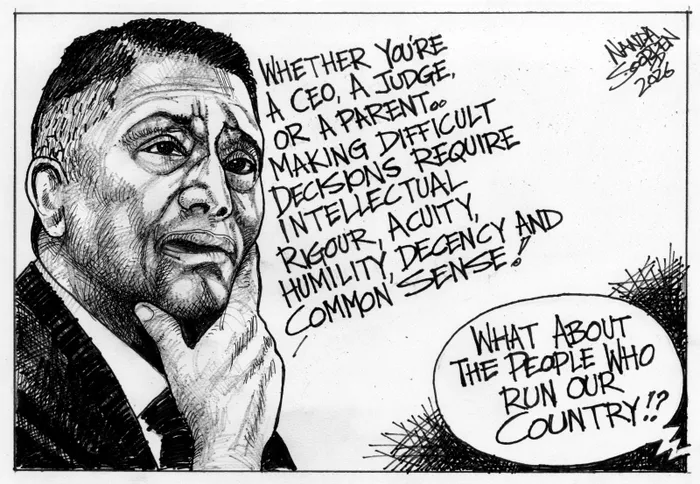
Professor Karthy Govender recently addressed law students at the annual School of Law student awards ceremony at UKZN.
Image: Nanda Soobben
Professor Karthy Govender recently addressed law students at the annual School of Law student awards ceremony at UKZN.
FOR the rest of your careers, you will wear the badge of honour that you were award-winning students at one of the premier law schools in the country. However, I think you are smart enough to know that this is the start of the journey, and your achievements thus far, in and of itself, does not guarantee enduring success.
Since the advent of democracy, four of the six chief justices of the country sat on the same benches as you at this law school and went on to lead the judiciary. That statistic on its own must inspire you to translate the potential you have into tangible outcomes that would be beneficial to yourselves, your families and the nation that has, in part, invested in your future.
It is also appropriate to recognise the former Dean, Professor David McQuoid-Mason, for creating an environment and culture at this law school, that enabled lawyers of the calibre of the various chief justices to be nurtured and developed.
When I commenced my career meaningfully, Nelson Mandela was president and we had just adopted the interim Constitution, a document that was a peace treaty designed to extricate us from the injustices and ashes of the past towards a future committed to respect for fundamental human rights. It was a time of hope. You commence your career in a very different context.
The Madlanga Commission has revealed industrial scale corruption and sheer sloth at the highest levels at the South African Police Service and at some of the major municipalities in this country. The biggest drawback is that people are losing hope in the system of governance that we adopted in 1994. It is a non-sequitur for our constitutional democracy to be blamed for the malfeasance and misconduct of senior public officials who betrayed their oath of office for pieces of silver.
However, more needs to be done than just pointing out the irrationality of this perception. I urge you to be defenders of our Constitution and offer the following ideas for your consideration on how to restore public confidence.
It is most unlikely that a Madlanga Commission would be set up and allowed to function in this unimpeded manner in any other system other than a constitutional democracy. The lack of accountability in authoritarian or theocratic regimes would not permit such a process. As debilitating as it is to listen to some of the evidence at the Madlanga Commission, there is a concomitant sense of satisfaction that people who thought that they were above the law because of their political connections are, at the very least, being held accountable in an open and transparent process in the court of public opinion.
The ability of the nation to reset will be available to us upon the completion of this inquiry.
Our current electoral system reposes enormous powers in the hands of political party bosses. As a consequence of the findings of the state capture inquiry and the evidence we are hearing at the Madlanga Commission, we can conclude that the current system needs to be changed. Simply tinkering on the outer perimeters as we did before the 2024 elections, is not good enough.
Justice Froneman in his dissent in the New Nations case stated that the system for electing representatives to the national and provincial legislatures gave primacy to ensuring equality of the political voice. It is now time to turn the dial more in the direction of greater accountability. We must engage in a national debate about whether we need a joint constituency-based and party list proportional representation system.
This would mean that some members of Parliament would be directly accountable to their constituents as they would be elected by them. At a time when no single party has garnered a majority of votes, fundamental changes to the electoral system may be feasible. This is now necessary.
Some surveys have demonstrated growing dissatisfaction with our current system, but at the same time support remains steady for the freedoms that we enjoy. I suspect that we are simply seeking more order in our lives as opposed to the jettisoning of our constitutional democracy. People want public officials to carry out their responsibilities, and want the laws and policies enforced. There has to be consequence management when employees fail to perform their public duties. The state must function better.
Accounting officers that approve multimillion-rand tenders when they ought not to, must be held accountable. Recent figures indicate that the state is paying some R800 million per annum to public officials who are suspended from work. This, in a context where we cannot employ teachers and doctors to perform vital tasks. Systems and processes need to be changed to ensure fairness to employees while not abusing the public purse in this severely-constrained economic environment.
It is vital that we protect and advance the impartially, dignity and effectiveness of the judiciary. There is a direct constitutional obligation requiring the composition, functioning, structure and jurisdiction of all courts to be rationalised with "a view to establishing a judicial system suited to the requirements of the new Constitution".
Zondo CJ, the former chief justice, submitted a report to the executive on how to advance the independence and effectiveness of the judiciary. Hopefully the currently Government of National Unity will appreciate the importance of the report and take the necessary steps to implement it. To my mind, the SA judiciary has been outstanding in discharging its constitutional responsibilities, and its measured and thoughtful jurisprudence must be a source of pride to us all.
Our constitutional democracy has also been sustained and developed through non-state actors. The media, civil society and other institutions have played an indispensable role in advancing the ideals of our Constitution. The Constitution protects the freedom of the press and other media. This right is vital in equipping us with the necessary information to make perceptive choices when we decide on how to exercise our cherished right to vote, and is essential in the quest for transparency and accountability. This right is best protected in a constitutional democracy and least respected in authoritarian systems. Imagine our lives without access to a free and independent media.
I am also of the view that merit needs to play an appropriate role in appointments, particularly in the public sector. Given the economic disparity in our society, affirmative action is required to achieve substantial equality. The law requires an employment equity plan, and appointments need to be made in accordance with the plan. Thus it is constitutionally sanctioned and entirely legitimate to advance persons who were previously disadvantaged by unfair discrimination.
However, affirmative action is a means to an end, and is not an end in itself. It is for this reason the law requires, that the plan sets targets and not inflexible quotas, and that suitably-qualified persons be appointed. The requirement for suitably-qualified persons, as Justice Moseneke has pointed out in the Barnard case, is to prevent the hurtful insinuation that affirmative action is a refuge for mediocrity.
Public institutions such as local government have broad public law duties such as ensuring the provision of services to communities in a sustainable manner. Universities have the obligation to educate the nation effectively. Properly implemented affirmative action will allow the appointment of persons who advance diversity and representivity in the workplace, but who can meaningfully contribute to improving the quality of life and freeing the potential of people because of their suitability for the post.
If the consideration of merit is not given appropriate recognition, service delivery in the final analysis will suffer and the constitutional obligations, urgently required in our society, will not be met. Affirmative action should not be used as a fig leaf for cadre deployment.
Finally, let me turn to a few personal reflections on success. A successful practitioner will normally enjoy the good things in life. But let me suggest another way to gauge success other than by measuring the tangible manifestations of success. I would suggest that the litmus test of success in professional life is whether you are entrusted with the responsibility of making decisions that impact on the lives of others.
Do people, organisations and institutions have sufficient confidence in your professionalism, competence, integrity and wisdom to trust you with making decisions that impacts on their lives and fortunes? Whether you do this as a judge, CEO, Dean of the law school, academic, advocate, attorney, or legal adviser, this trust must be rewarded by sagacious and judicious decisions.
Making difficult decisions requires intellectual rigour and acuity. It generally cannot be the product of instinctive or intuitive reactions. That is the lazy alternative to thinking. In order to be truly effective, you need wisdom and depth of knowledge. Listen to selected podcasts, and read to acquire knowledge and to ascertain how to coherently and logically structure your thought processes.
Years ago, I came across a survey that sought to ascertain whether the leading CEOs had characteristics in common. It found that despite differences in race, gender, racial, religious and cultural backgrounds, they possessed the qualities of discipline, order and the ability to execute. Some of you may already possess these qualities and, if so they need to be nurtured and constantly enhanced. Set yourself the responsibility to acquire wisdom, conduct yourself with integrity and the returns will be significant.
I am of the view that to be a good human being there has to be a reasonable equilibrium between competency in your professional life, and compliance with minimum standards of morality and decency in your private or personal life. Personal virtues of compassion, grace, humility, kindness and compliance with minimum moral norms of decency will always hold you in good stead.
In the words of President Obama: "Have the audacity of hope. Reach and do not artificially limit your horizons. Be extraordinary. It would be an indictment if at the end of your careers there is a realisation that you failed to fulfil your potential."
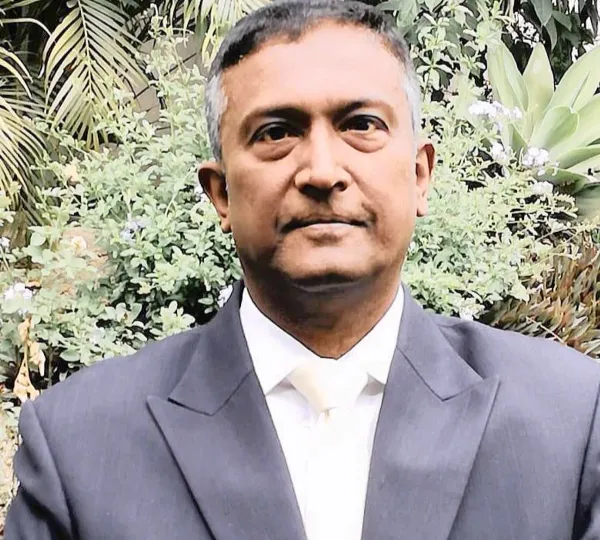
Karthy Govender Professor Karthy Govender.
Image: Supplied
Professor Karthy Govender is retired professor of law
** The views expressed do not necessarily reflect the views of IOL or Independent Media.