

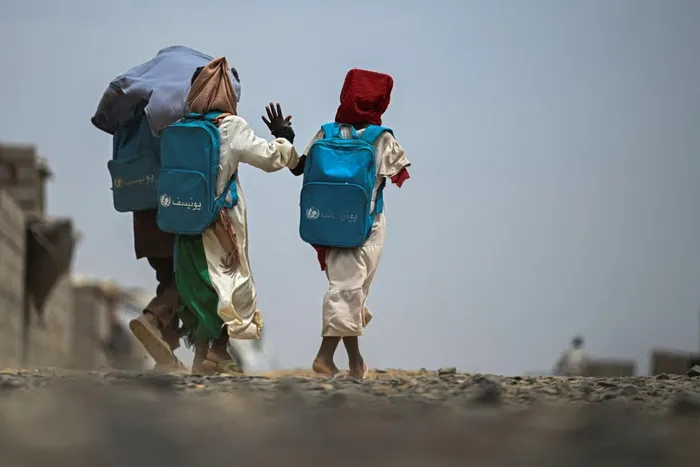
A Sudanese girl, who lost her right arm because of injuries sustained in the civil war, leaves an elementary school run by the Sudanese Coalition for Education in partnership with the United Nations International Children's Emergency Fund (Unicef), south of Port Sudan. In Sudan, where a war between the army and the paramilitary Rapid Support Forces has killed tens of thousands and triggered one of the world’s largest humanitarian crises, more than eight million children are currently out of school, according to the UN’s children’s agency
Image: KHALED DESOUKI / AFP
FOR more than three years, I have watched the images coming out of Gaza, and like so many of you, my heart has been torn open by what I see: children pulled from rubble, mothers screaming names that no one answers, an entire population starved and bombed in full view of the world.
We have marched, posted and donated because we understand instinctively that some horrors cannot be met with silence. But here is the question that has been burning inside me, and I am going to ask it plainly even though it makes me uncomfortable: why do so many of us, especially here in Africa, turn our faces away when the same carnage happens just a few thousand kilometres north of us?
I am not saying we should cry less for Gaza. God knows the Palestinian people deserve every tear and every march. But the silence around South Sudan and Sudan reveals something rotten in how we value black life. Not their silence. Ours.
When South Sudan became independent in 2011, I felt a flicker of hope. Here was a new African nation, born out of decades of struggle, finally free to build something beautiful. But within two years, that hope was drowning in blood, and the world barely glanced up. The media told us it was ethnic violence, Dinka versus Nuer, ancient tribal hatreds. I believed that story for longer than I care to admit because it was convenient. It let me feel sad without feeling responsible. But how do two groups who fought side by side suddenly wake up wanting to slaughter each other? Hatred has to be fed, armed, and someone has to profit from it.
The truth is both simpler and more sickening. South Sudan sits on enormous oil reserves, and whoever controls the capital, Juba, controls the pipeline, the money, and the ability to buy as many guns as they want. So when President Kiir, who is Dinka, and his former deputy Machar, who is Nuer, fell out in 2013, they reached for their ethnic militias because those militias were the only real institutions the country had.
Decades of war had left South Sudan without schools or functioning courts, but it had plenty of armed young men loyal to their commanders, who told them the other tribe was trying to take their future. The young men believed it, because what else did they have to believe in. The ethnic violence was real, but the cause was not ancient hatred. It was a political and economic fight dressed up in tribal clothing, and the world’s media swallowed the costume and called it the whole show.
Once you see the lie behind one war, you start seeing it everywhere, and what I found made me feel something close to physical nausea. The CIA is not running the show here the way they did in Angola, but what replaced them is worse: a network of foreign oil companies, Gulf monarchies, and regional strongmen who have calculated the price of a black life and found it laughably cheap.
Chinese and Malaysian state-owned companies pump South Sudan’s crude without asking who is dying to keep the flow moving. Western governments that helped broker independence did nothing meaningful to stop the civil war. You do not need to stage a coup when you can simply let the existing rulers tear each other apart and arm both sides while they do it. That is spectatorship with a business model.
What has shaken me most, the one thing that makes me want to scream, is the role of the United Arab Emirates (UAE). We see the UAE as a glittering holiday destination, but we do not see it for what it has become in Africa: a financier of genocide. I will say that again because I want it to land. The UAE is deeply, directly, and knowingly involved in financing the mass slaughter of black Africans in Sudan and South Sudan. Not for oil, but for gold.
The armed group controlling much of the gold deposits along the chaotic border is Sudan’s Rapid Support Forces, the RSF, which grew out of the Janjaweed militias that carried out the Darfur genocide 20 years ago. The same RSF that the United States State Department has formally determined committed genocide again in 2023 and 2024, mines gold and smuggles it to Dubai, where the UAE refines it and sells it to the world as legitimate.
In return, the UAE flies weapons and drones to the RSF through Chad and over South Sudanese territory, with the permission of South Sudan’s own president. The bodies stacking up in Darfur are not a cost that the UAE calculates. They are a footnote. A price of doing business.
I have sat with that knowledge for weeks, and I still do not know how to hold it without crying. We are not talking about a few bad actors. We are talking about a global system that has quietly decided that a black African life is worth less than a kilo of gold. When Ukrainians die, the world holds emergency UN sessions and sends weapons. When Palestinians die, half the world marches. But when South Sudanese or Congolese die, the world yawns and calls it complex tribal dynamics and turns the page. That is not ignorance. That is a choice. And we, as Africans, have to ask ourselves why we are so quiet about it.
I am writing this from South Africa, and I am afraid, not of bombs falling on Johannesburg tomorrow, but of what we are becoming. I watch as foreign powers interfere in our elections, weaponise our energy crisis, and as our own leaders grow more comfortable with strongman tactics and treating public office as a licence to steal. The collapse of a country does not begin with a single explosion. It begins with a stolen budget that should have fixed the power grid, a looted hospital that never gets rebuilt, a community kitchen run by volunteers because the state has stopped pretending to care. We already have those things in South Africa. We are further down that road than we want to admit.
I am not writing this to make you feel guilty about caring for Gaza. Please do not hear that. I care for Gaza, too. I have wept and marched for Gaza. But I have noticed something terrible about myself and about the people around me: I can feel the pain of a Palestinian child instantly, viscerally, without any effort, yet I have to force myself to feel the pain of a South Sudanese child.
That gap in my own heart shames me. The reason we call these wars ethnic violence is not because the description is accurate. It is because it allows us to feel sympathy without feeling responsibility. If it is just ancient hatred, then nobody caused it and we can shrug with a clean conscience. But if we call it what it actually is, a UAE‑sponsored genocide and a global system that has priced black life below gold, then we cannot shrug any more. Then we have to ask ourselves whether our empathy is real or just fashionable.
The blueprint for destruction is already written, in oil contracts, gold smuggling routes, and weapons shipments that fly over our heads while we scroll through our phones. The only question that remains is whether we will read that blueprint before it becomes our address, and whether, when we read it, we will finally find the courage to burn it down.
** The views expressed do not necessarily reflect the views of IOL or Independent Media.