

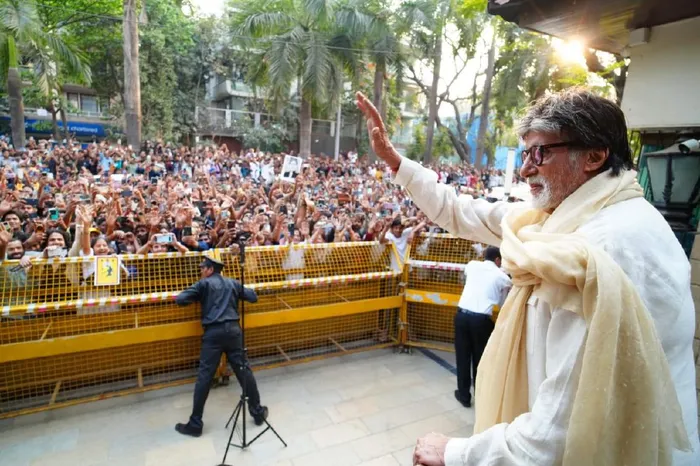
Amitabh Bachchan heard the lesson from JRD Tata and, unlike many who have heard it, he actually lived it. For over four decades, without a single exception, Bachchan has stepped outside his Juhu home, Jalsa, every Sunday to greet the fans gathered outside.
Image: FILE
Amitabh Bachchan. Dilip Kumar. Kareena Kapoor Khan. Three icons, three choices - and one truth that the entertainment industry would prefer you never fully grasped: you made every one of them. And you can unmake them just as surely.
Two flights. Three legends. And a lesson about power that most of the powerful would rather you forgot.
On the first flight, a superstar sat in silence while fans approached with warm smiles and walked away unacknowledged. On the second, not one but two of Bollywood’s greatest icons discovered, each on a separate occasion, that the unremarkable gentleman seated beside them was, in fact, one of the most powerful industrialists the world had ever produced. He had no entourage.
He required no recognition. He simply read his newspaper and sipped his tea. One set of stories is about ego. The other is about its quiet, complete dismantling.
Together, they tell you everything you need to know about who actually holds power in the relationship between the famous and the people who made them famous.
The London flight: What Kareena forgot:
Recently, Infosys co-founder Narayana Murthy and his wife, the celebrated author Sudha Murty, were travelling from London when they found themselves seated beside Kareena Kapoor Khan.
Murthy watched in quiet disbelief as fans approached the actress with warmth and genuine affection and received not so much as a glance in return. Every person who came to acknowledge Murthy himself received a standing welcome, a full minute of genuine human engagement.
Sudha Murty offered a gentle defence. A star with millions of admirers, she reasoned, cannot be expected to respond to everyone. Murthy was unmoved. His response, delivered later at an IIT Kanpur session, was measured but pointed: when someone shows you affection, you can show it back in however brief a manner. These small acts, he said, are precisely how we keep our ego in check.
What Murthy understood, and what Kareena appeared not to, is that the fan standing in the aisle was not interrupting her career. That fan is her career. Every ticket purchased, every film streamed, every social media post shared - these are not expressions of admiration for a person who exists independently of public favour.
They are the bricks of a structure that collapses the moment the public decides to stop building it.
“When somebody shows affection, you can also show it back, in however cryptic a manner. These are all ways to reduce your ego.” - Narayana Murthy.
The man nobody recognised: JRD Tata and the price of arrogance:
At the peak of his career, Dilip Kumar found himself seated beside an elderly gentleman in plain, simple clothing who showed not the faintest flicker of recognition. Dilip mentioned he worked in films. The man nodded politely. He clarified that he was an actor. The man offered nothing more than courteous acknowledgement. As they landed and names were exchanged, the gentleman smiled and said: “Thank you... nice to have met you. I am J. R. D. Tata.”
Years later, Amitabh Bachchan had the identical experience. The same unassuming man. The same engrossed reading. The same quiet dignity. The same reveal at the gate. Bachchan later said the encounter taught him a lesson he never forgot: no matter how large you believe yourself to be, there is always someone larger.
Humility costs nothing:
Consider what JRD Tata represented in that moment. He had built an empire that employed hundreds of thousands of people. Steel, aviation, hospitality, chemicals - the Tata name ran through the architecture of modern India. And yet he sat in a plain shirt, read his paper, and felt absolutely no need to be known. His power was so complete, so deeply rooted, that it required no performance whatsoever. The celebrity who cannot acknowledge a fan in an aircraft aisle is performing power they do not actually possess. Real power, as JRD Tata demonstrated twice over, sits quietly and needs nothing from the room.
“No matter how big you think you are, there is always someone bigger. Be humble - it costs nothing.” - Dilip Kumar and Amitabh Bachchan, independently, on meeting JRD Tata
Forty years of Sundays: What Bachchan got right
Amitabh Bachchan heard the lesson from JRD Tata and, unlike many who have heard it, he actually lived it.
For over four decades, without a single exception, Bachchan has stepped outside his Juhu home, Jalsa, every Sunday to greet the fans gathered outside. The tradition began in 1982 during his recovery from a near-fatal injury on the set of Coolie.
Hundreds of fans had gathered outside his home and prayed for his survival. He made a private vow: if he lived, he would never forget who held vigil for him. He has kept that vow for more than forty years.
He removes his shoes before meeting the crowd. His reasoning, shared on his blog, is that people visit temples barefoot — and his well-wishers occupy that same sacred space in his life. He has written publicly that there can be no greater symbol of human love than these forty-plus years of Sunday gatherings, and that he bows his head in gratitude for every one of them.
This is not a publicity exercise. Bachchan’s career would survive the cancellation of a Sunday appearance. What it represents is something rarer and more valuable than strategic image management: it is the genuine understanding that his decades of success were not self-generated. They were gifted to him, week by week and ticket by ticket, by the very people standing outside his gate. He has never forgotten the terms of that arrangement.
You hold the power, use it:
The gap between Kareena on that London flight and Bachchan on any given Sunday is not a gap of talent. Both are formidable performers. It is a gap of comprehension. One understands the transaction. The other, on that day at least, did not.
As a fan, a consumer, an audience member — you are not the passive beneficiary of someone else's gift. You are the origin of it. The celebrity exists because you bought the ticket. The star trends because you shared the post. The icon endures because you kept showing up, decade after decade, with your attention, your money, and your loyalty.
That is not a small thing. It is everything. And it is entirely yours to withdraw. Stop romanticising indifference. Stop mistaking rudeness for mystique. When a public figure treats your affection as an inconvenience, they have not merely been impolite. They have forgotten the precise transaction that placed them where they stand. That should matter to you — not as a personal slight, but as a signal.
A signal that the relationship has become one-sided, and that you are owed nothing in return for continued loyalty.
Bachchan understood this. Dilip Kumar understood it, standing at an airport gate with the quiet education of a lifetime compressed into a handshake. Narayana Murthy understood it on a London flight, standing up for every visitor while a film star stared at the seat in front of her.
They made their choices. Now make yours.
Your adoration is not an obligation. It is a weapon. Use it wisely.
The views expressed in this article are those of the author and are intended for general readership.