

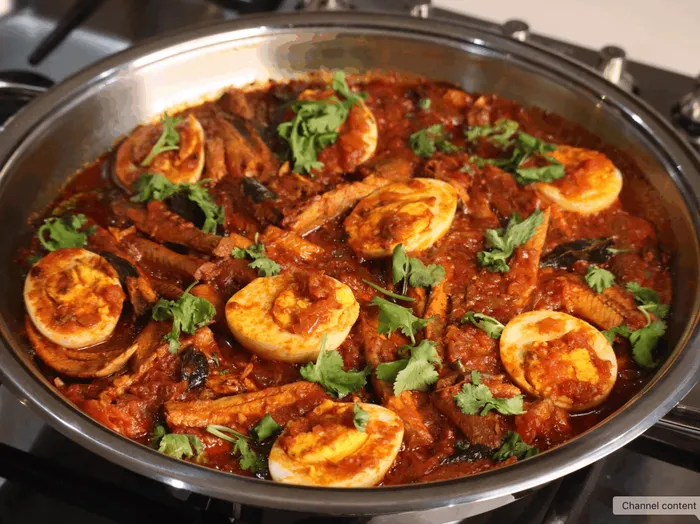
The great Indian breakfast - tinned fish chutney with boiled eggs.
Image: Supplied
What’s the fuss about a few lumps in a bowl?
South Africa’s uproar over powdered breakfast cereal ProNutro’s reformulation – its supposedly “watery", "lumpy", "strange” new texture – begs the question: what’s the big deal? It’s only cereal, not State Capture Part 2. Yet, the fury reveals something deeper than breakfast. It’s nostalgia dressed up as outrage, routine masquerading as betrayal.
Why the rage? Because apparently, it’s the new national pastime – to whine, bitch, moan and groan about absolutely everything. Forget cricket or rugby; the real sport is outrage.
The “too sweet” taste of New Coke? A tragedy worthy of Shakespeare. The removal of the iPhone’s headphone jack? A crime against humanity, forcing millions to endure the indignity of adapters. Discontinuation of Simba’s Tomato Sauce chips? A cultural catastrophe, as if the nation’s heritage had been bulldozed. And don’t even get me started on the horror of washing powder packaging changes, as if the apocalypse begins in the laundry aisle.
Consumers don’t just complain; they stage operas of grievance. Each tweak becomes a betrayal, each redesign a declaration of war. The chorus swells: “It’s not the same.” “They’ve ruined it.” “Bring back the old one.” And like clockwork, petitions bloom, hashtags trend, and executives scramble to issue apologies for crimes as grave as … changing the font on Clover dairy products.
My 30-something daughter, addicted to ProNutro chocolate since toddlerhood – back when her Pa heroically fell asleep in the cinema and snored through the climax – now refuses to touch the reformulated version. And so her mother and I sit with guilt gnawing at us, worry pressing on our hearts. What is the poor child going to have for breakfast now?
Fifty years ago, the South African table was alive with mielie meal or cream of wheat porridge simmering on the stove, eggs fried in butter, vetkoek puffed golden, or bread toasted over open flames. Township kitchens stirred mielie pap, sometimes sweetened with condensed milk, sometimes salted and hearty. Indian homes carried yesterday’s curry straight on to the breakfast table, the spices still bold from the night before. Middlecut tinned fish chutney and boiled eggs, sharp and fiery, met its match in crisp toast – an unlikely pairing that spoke of thrift, invention, and appetite.
Breakfast was not just fuel; it was culture, craft, and comfort. It was the smell of onions frying, the sound of kettles whistling, the sight of family gathering before the day’s work.
I can still imagine the scene during the golden age of Indian cinema when the breakfast table was never just furniture – it was a stage.
In Hindi films, families gathered around steaming cups of chai, brass tumblers brimming with milk, and plates of parathas or poha. In Tamil cinema, the spread was idli, dosa, sambar, and coconut chutney, rounded off with the frothy swirl of filter kaapi. The father’s voice rose above the rustle of the newspaper, the mother fussed gently over the children, and the clatter of vessels filled the room.
That tableau became shorthand for harmony and tradition, a portrait of domestic life where togetherness was savoured before the day scattered everyone into the world.
Today, Bollywood’s breakfast table could be anywhere – Paris with its flaky croissants, Pretoria with a hurried coffee-to-go, London with a sandwich snatched on the run, or New York with a protein shake gulped in the backseat of a cab. The leisurely spreads of parathas and idli-sambar have yielded to the global language of speed: cereal poured in haste, a latte clutched on the commute, a croissant grabbed at the corner café.
The camera now lingers on the rush – characters dashing out the door with a sandwich in hand, phones buzzing, deadlines looming. It is the mirror of urban life, where time is scarce, family meals are rare, and the morning table has been replaced by the rhythm of the commute.
And yet, nostalgia lingers. Those cinematic breakfasts evoke a gentler world, where the morning meal was not a hurried necessity but a pause, a prayer, a bond. To rekindle them is to hear the rooster at dawn – predictable in its rhythm, punctual in its call, and complete in its promise of a new day.
The boxed revolution – cereals, instant oats, powdered drinks – promises speed, nutrition, and modernity. But it has narrowed the imagination. Children grow up believing breakfast comes in packets, not pots.
There was a time when breakfast was not a matter of choice, but of circumstance. The morning table held whatever our mothers prepared: a pot of cream of wheat or mielie meal porridge, sometimes hard and lumpy, sometimes smooth, but always eaten without complaint.
I often find myself wondering how my mother – certainly, an honorary Master Chef in heaven now – managed each night, before she laid her head to rest, to dream up what breakfast would greet us at dawn. Each morning was a new gift, a different delight, always brimming with nourishment and care.
There was the gentle sweetness of phutu with desiccated coconut, the earthy depth of Maltabella porridge with its malty embrace, golden pumpkin fritters crisp at the edges, humble boiled madumbe, or the plain porridge stirred from mielie meal scooped by weight at the corner grocery store.
No glossy boxes lined our shelves, no bold promises of “high energy” or “fortified vitamins”. Just food – plain, honest, and unpretentious. Food that carried the fragrance of love, the rhythm of tradition, and the quiet assurance that we were cared for.
It was in those bowls and plates, steaming in the morning light, that I learnt nourishment was never about labels or marketing. It was about a mother’s devotion, her hands weaving sustenance out of simplicity, and her heart serving it with tenderness.
And yet, those growing up in my generation, never lacked energy, much like Duracell batteries. We went through long school days filled with lessons, sports, and games. We played outdoors until the evening shadows stretched across the yard. Our bodies were powered not by additives or marketing slogans, but by the quiet resilience of simple meals.
Today, the breakfast aisle is a carnival of excess. Shelves groan under the weight of cereals in dazzling boxes, each competing for attention with cartoon mascots and bold claims: “Boosts immunity”, “Packed with protein”, “Superfood blend”. Children stand wide-eyed before this parade, spoilt for choice yet strangely disconnected from the roots of nourishment. Parents, too, much like my dear daughter, are seduced by convenience: pour, add milk, and the day begins.
But something has been lost. In the rush to embrace variety, we have surrendered intimacy. Breakfast has become a transaction, not a ceremony. The clatter of spoons in enamel bowls, the aroma of porridge simmering on the stove, the laughter of siblings sharing boiled sweet potato – these were the textures of my childhood. They stitched families together in ways no supermarket brand can replicate.
Nostalgia reminds us that scarcity bred gratitude. We did not complain when porridge was lumpy; we ate it because it was there, because it was made with care. Today, abundance breeds entitlement. Children push away bowls, demanding alternatives. Adults scroll through endless diet trends, chasing novelty instead of nourishment.
The irony is sharp: with fewer options, we had more joy. With more options, we seem less satisfied. The body may be fed, but the spirit is starved.
Breakfast was once a grounding ceremony, a reminder of where we came from and who we belonged to. It was the taste of heritage – grains ground by hand, recipes passed down through generations, meals that carried the imprint of family struggle and endurance. Now the morning meal has become another disposable option in a consumer’s catalogue.
Perhaps the lesson lies in remembering that energy is not manufactured in factories or sealed in boxes. It is born in kitchens, in the patience of mothers stirring pots before dawn; in the resilience of children who ate what was given and thrived.
We are spoilt for choice today, but choice without gratitude is emptiness. To reclaim the spirit of breakfast is to honour the lumpy porridge, the sweet phutu, the pumpkin fritters. It is to taste memory, not marketing. And in that taste, we rediscover the truth: nourishment is not about variety, but about love.
** The views expressed do not necessarily reflect the views of IOL or Independent Media.