

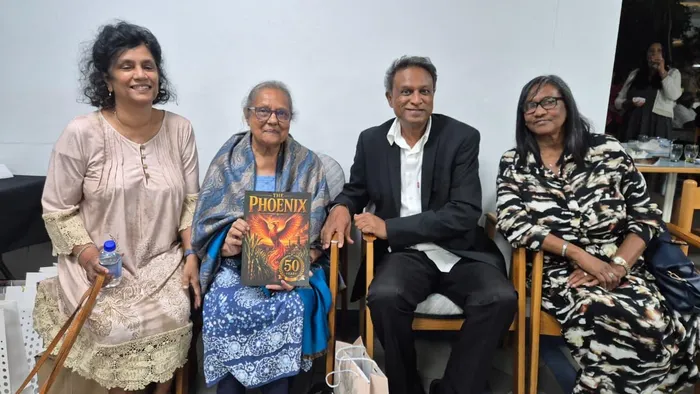
Salina Sankar, from left, Ela Gandhi, Professor Robert Gengan and Eunice David.
Image: Sibonelo Ngcobo/Independent Media
In the rich but often painful tapestry of South Africa’s liberation struggle, many names are etched in bold letters – but some, like Eunice David, are written in quiet gold, their impact profound yet often unheralded. A stalwart activist of Phoenix, Eunice was one of those rare individuals whose strength lay not in loud slogans or appearing in public platforms, but in consistent, fearless action and deep compassion.
I first came into contact with Eunice in the early-1980s, during one of the most turbulent and repressive periods of apartheid rule.
While the state cracked down on political dissent, Eunice emerged as a trusted community organiser and quiet revolutionary.
She never craved the limelight. Instead, she worked in the trenches – in church halls; in street, house and flat meetings; in dusty township lanes – giving voice to the voiceless and hope to the oppressed.
Soon after relocating to the then newly-formed township of Phoenix, Eunice witnessed first-hand the brutal legacy of racial segregation. Her early experiences of injustice shaped her lifelong commitment and political consciousness to equality and justice. Inspired by her late father, the teachings of Mahatma Gandhi and the fire of the anti-apartheid movement, she joined hands with local civic organisations, faith-based groups, and women’s collectives to push for political change – not just through protest, but through active service. Eunice joined the Phoenix Working Committee (PWC), a popular civic organisation, which was established in 1978 to take up people’s problems. The PWC became her lodestar.
She became an integral part of its leadership, and was elected as its general secretary.
Eunice believed that activism began at home. She mentored young women, empowered single mothers, and stood by families whose sons and daughters had been detained or killed by the state. She opened her home to political activists and exiles. She delivered food parcels, organised prayer meetings, and helped many find legal support in times of crisis. In every sense, Eunice was the moral backbone of the Phoenix community.
What I admired most about her was her moral clarity. While many were silenced by fear, Eunice spoke her truth – gently, but firmly. She was deeply spiritual, drawing strength from her Christian faith, yet wholly inclusive in her embrace of people from all walks of life. She reminded us constantly that justice was not a slogan – it was a way of life.
She was the natural choice when Congress leaders were looking for an organiser for the Durban Housing Action Committee (DHAC). Eunice was part of a small, but vibrant team at the offices of the DHAC which we founded in March 1980 at the Phoenix Settlement.
Eunice and I travelled together by bus to launch the United Democratic Front in Cape Town in the winter of 1983. We coalesced around the slogan: “UDF unites – apartheid divides.”
When democracy came in 1994, many activists moved on. But Eunice remained in Phoenix, continuing her work among the poor and the forgotten. Eunice was again chosen by Congress leaders as a councillor in the eThekwini Municipality to represent her ward in Phoenix. Here she learnt fast and furiously about what it meant to govern, and how one could unwittingly get lured by the trapping ego, wealth and power.
Eunice was not one that could be co-opted or corrupted. She saw the cracks in our young democracy – the corruption, the poverty, the social fragmentation – and she never stopped challenging us to do better. She served on local civic bodies, advised NGOs, and was a fierce advocate for civic rights and women’s safety. Even in her later years, frail in body but not in spirit, she attends community meetings, and never missed a chance to remind us of our duty to serve.
In 2016, Eunice and I co-founded the Active Citizens Forum (ACM) to champion accountability from our public officials. She was elected once again as the first general secretary of the ACM – a position she fulfilled with great aplomb.
To me, Eunice was not just a comrade –she was a guidepost – one of the best woman leaders that I had the singular pleasure of working with. She reminds us of what it means to live ethically, simply, and with courage. Eunice was the kind of activist whose legacy is not measured in headlines, but in lives touched, injustices challenged, and the deep respect of a community that loved her.
Now in her retirement and battling health issues, Eunice’s light continues to burn in the hearts of those who carry forward her legacy of service, humility, and resistance.
Siva Naidoo is an activist and a trainer in Ubuntu and human values. He can be reached at [email protected].
** The views expressed do not necessarily reflect the views of IOL or Independent Media.