

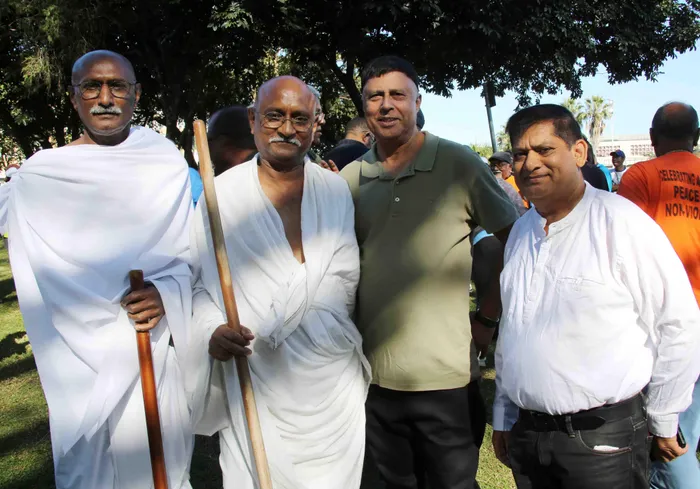
In Phoenix, tried and tested leaders such as Sham Maharaj and Muni Kooblal continue to render valuable service to the community. Lazarus Naidoo, from left, Krishna Perumal Govender, Sham Maharaj and Muni Kooblal.
Image: Tumi Pakkies/Independent Newspapers
THE story of South Africa’s freedom Struggle cannot be told through the names of presidents, political parties, or famous leaders alone. The foundation of our democracy was built by thousands of ordinary men and women whose sacrifices remain largely unknown.
They were teachers, trade unionists, students, priests, domestic workers, activists, community organisers, and underground operatives who risked imprisonment, exile, torture, and death so that future generations could live in dignity.
Many returned quietly to their communities after 1994, never seeking recognition or reward. Yet without them, apartheid would never have fallen.
It is therefore necessary to tell and write these stories before they disappear forever.
Too many young South Africans today know little about the human cost of freedom. They do not know who marched, who organised, who sheltered activists, who endured banning, who lost jobs, or who disappeared into prison cells so that democracy could emerge. Schools often touch only superficially on the Struggle years, reducing a painful and complex history to a few textbook pages.
Freedom did not arrive like manna from heaven. It was earned through blood, sweat and tears; sacrifice; courage; discipline; and collective resistance against one of the most brutal systems of racial oppression in modern history.
Across all racial and cultural groups, individuals stood up against injustice. Their stories belong not to one political organisation or one community, but to the nation as a whole. If these stories are not preserved, future generations may grow up disconnected from the values that shaped our democracy: justice, equality, sacrifice, compassion, and service to humanity.
Many Struggle veterans are modest people. They shy away from publicity and often underplay the heroic roles they performed. Some feel disappointed by what South Africa has become.
As corruption, looting, and state capture continue long after the Zondo Commission’s findings, many former activists watch with sadness and disbelief. They sacrificed their youth and freedom for a democratic society rooted in integrity and accountability. Instead, they see public institutions weakened, communities still trapped in poverty, and some political leaders enriching themselves while ordinary citizens struggle.
To some veterans, it may feel as if their sacrifices were in vain.
But that is precisely why their stories must be told. Their lives remind us that democracy is not a finished project. Freedom requires constant vigilance, ethical leadership, and active citizenship. By documenting these histories, we honour not only the individuals themselves but also the ideals for which they fought.
I say this, not as an observer, but as someone who still considers himself an activist. The Struggle for justice did not end in 1994. While the laws of apartheid were defeated, the struggle for ethical governance, accountability, dignity, and social justice continues. I had the privilege of working alongside scores of brave comrades who put their lives on the line during some of the darkest years of repression. Many of them will never appear in history books, yet they carried the struggle on their shoulders through acts of sacrifice both big and small.
In Merebank, one of the most outstanding community leaders I had the privilege of working with was the late Ramsamy Govinden. He was deeply committed to justice, civic responsibility, and community upliftment. Alongside him stood the late Elvis Govender, another dedicated activist whose contribution to community mobilisation deserves recognition and remembrance.
I also acknowledge Roshan Ramdeen, the recently retired school principal and respected community activist, who continues to influence society positively through his wisdom and leadership. Other notable Merebank activists include Prakash Naidoo, Jeevan Padayachee, Dr Ashok Chandika, and Pops Rampersadh, all of whom contributed in various ways to community development and activism during difficult and turbulent times.
That is why I am deeply encouraged that the people of Phoenix, one of the communities where I volunteered as an activist during the late 1970s, are beginning to tell their own stories as they commemorate 50 years of existence. This is more than a celebration of a township or a milestone anniversary. It is a recognition of struggle, resilience, sacrifice, and community solidarity forged during difficult political times.
In Phoenix, tried and tested leaders such as Sham Maharaj, Eunice David, and Muni Kooblal continue to render valuable service to the community. Among the women activists who helped shape Phoenix in earlier years, Peggy Pillay and Selena Pillay stand out as credible and committed community leaders whose contributions should not be forgotten.
It is also important to recognise the enduring role played by community organisations. The Phoenix Child and Family Welfare Society and the Phoenix Community Centres continue to shine as credible institutions making their mark through social support, welfare work, and community development initiatives.
The organisers of this commemoration must be commended for taking this important initiative. Merebank activists are writing a book about its history. I urge all communities to reclaim and preserve their own histories before they are lost to silence and time. Phoenix, Tongaat, Merbank, Pietermaritzburg and countless other communities produced many unsung heroes and heroines; and there are many untold stories.
They were workers, youth activists, women organisers, civic leaders, religious leaders, and ordinary residents who resisted injustice in countless ways. Their experiences deserve to be recorded and shared with younger generations.
Storytelling is an act of preservation and resistance. It protects truth from being erased by time, political convenience, or public amnesia. It also inspires young people to understand that they, too, have a responsibility to shape the future of South Africa.
A nation that forgets its heroes risks losing its moral compass. But a nation that remembers, honestly and fully, keeps alive not only the spirit of those who believed that a better South Africa was possible, but the values of those leaders.
Yet remembering the past has never been my primary concern. As an Ubuntu and human values trainer, I am preoccupied with the future above all else. Telling the story of past leaders is not to bring a smile to the oldies or their families.
It is to challenge our youth to understand that leadership needs to be developed, applied, and shared. The unsung heroes of yesterday are not museum pieces or relics to be admired from a distance. They are living proof that ordinary people can do extraordinary things when they choose courage over comfort.
That lesson has no expiry date. It is the torch we must now pass, hand to hand, into a future that will demand from our young people the same bravery, the same integrity, and the same relentless hope that freedom once required.
Siva Naidoo is an activist and a trainer in Ubuntu and human values. He can be reached at [email protected].
** The views expressed do not necessarily reflect the views of IOL or Independent Media.