

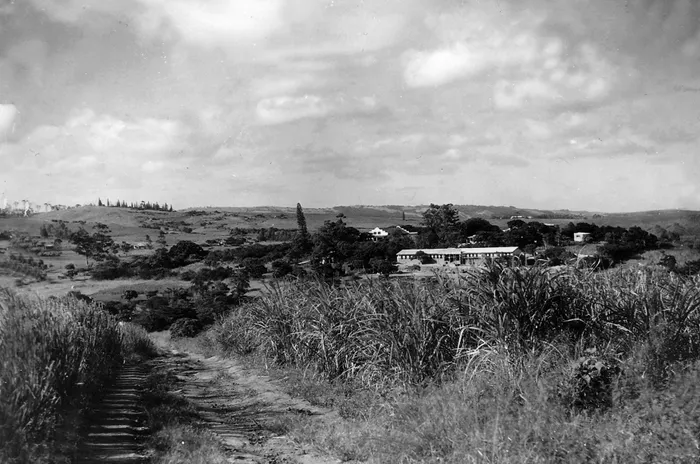
Phoenix Settlement, 1900s.
Image: 1860 Heritage Centre
1. The period between the 1950s and the 1970s in South Africa witnessed the emergence of a central state housing policy in delineated group areas.
2. The genesis of Phoenix from the late 1950s through to the mid-1970s occurred within the council's evolving apartheid housing strategy, the roots of which can be traced back to the council's attempt to seek a permanent solution to the "Indian problem" of the 1940s.
3. The need for an Indian township to the north of Durban was first conceptualised in 1957 when the city engineer suggested the establishment of a self-contained and self-sufficient township (the "Indian City of the Future") on the North Coast in the vicinity of Verulam.
4 On July 20, 1962, The Natal Mercury reported that the rehousing of Indians in Durban (some 60% of whom were living in shacks or other totally unsatisfactory conditions) was the biggest social and economic problem facing the council.
5. Phoenix emerged out of a number of bureaucratic decisions, spanning a period of 12 years from the initial City Council acceptance of the scheme proposal, to the first residents taking occupation in March 1976.
6. The central state was initially opposed to the idea of Phoenix on the grounds that Chatsworth would meet the demand for Indian housing.
7. Natal Estates was a major landowning company that had been farming sugar in the Mount Edgecombe area since 1895.
8. By 1950, 16 old-time sugar estates, including the Phoenix Sugar Estate, had been incorporated into the company.
9. Natal Estates informed a municipal delegation that the area "should be left alone" since its acquisition by the council would have "the effect of destroying the profitability of one of the largest mills in the sugar industry".
10. The local state's refusal right up until 1970 to consult with the Indian community on any matters relating to the establishment of Phoenix, was itself a statement of power relations, since Indians lacked the necessary formal political access to the structures of the local state.
11. The council approval for the scheme came in April 1964.
12. The government was first informed of the council's proposals on June 26, 1964.
13. Those Indians who were forced to move (by the Group Areas Act), and who could not afford to buy land and build their own homes in "economic" areas such as Reservoir Hills and Silverglen, were provided with homes in the first municipal housing schemes built at Springfield, Merebank and Chatsworth.
14. Others, who were less fortunate, moved into temporary dwellings in areas such as Tin Town on the Springfield Flats, where they proceeded to live for many years until their removal to Phoenix in 1976.
15. The mayor met representatives of Natal Estates. The company stressed that they were not willing sellers, particularly as some of the land was suitable for industrial purposes which would increase its value.
16. Chris Saunders indicated that the lowest price the company would be prepared to consider, was R600 per acre.
17. In November 1965, the town clerk furnished the Department of Community Development with a letter of application for the approval of Phoenix.
18. It is apparent that the government was stalling in coming to a decision, possibly because of the low priority afforded to Indian housing provision. At that time, the government was concentrating on the provision of coloured housing at Atlantis and Mltchells Plain in Cape Town.
19. The development of the township had been planned over seven years beginning in 1968.
20. There had been no consultation with Indians regarding the choice and planning of Phoenix.
21. On April 11, 1968, the secretary for planning informed the town clerk that the minister of planning had approved the recommendation of the group areas board that the Phoenix / Mount Edgecombe area be proclaimed for Indian ownership and occupation.
22. The scheme would accommodate 176,000 Indians, 79,500 of whom would be from Durban.
23. Cluster housing was advanced as an alternative residential pattern aimed at overcoming the drab and depressing appearance (of Chatsworth).
24. Provision was made for 18 community areas at Phoenix, where approximately 22,000 housing units were to be constructed, providing accommodation for 150,000 people.
25. Land was set aside for a major shopping and civic centre, teacher's training college, a hospital, and for industrial purposes.
26. Just over R48 million was budgeted for the building of 22,050 dwelling units, 85% of which were to cater for the sub-economic / lower income bracket.
27. Phoenix was officially opened on March 5, 1976, by SJM Steyn, the then minister of Indian Affairs, Community Development and Tourism.
Source: The Origins of Phoenix, 1957-1976: The Durban City Council and the Indian Housing Question by David Bailey.
* Edited by Kiru Naidoo.