

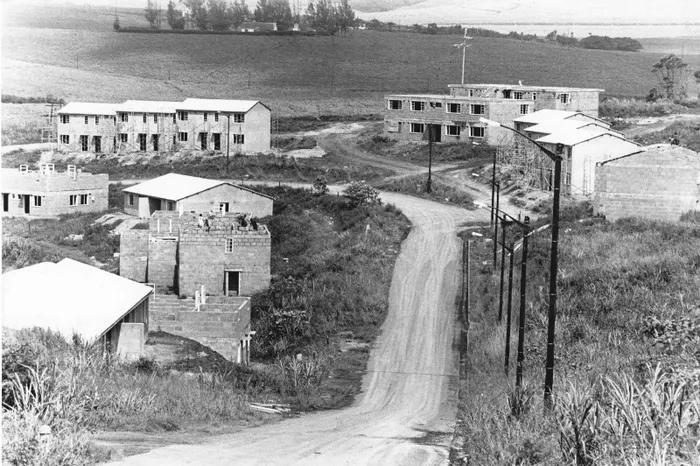
Planning for the establishment of Phoenix as a new public low-cost housing scheme began on August 29, 1966, by the Durban City Council.
Image: Independent Newspapers Archives
“THEY gave us numbered units on sugar cane fields and called it a future. We turned it into a home, a community, a history – and from that home we sent our children out to change the world. That is the story of Phoenix. It deserves to be told whole.”
I have been writing about this community for the better part of three decades, and yet, when the POST editor Yogas Nair called to ask me to mark Phoenix’s 50th year, I sat for a long moment before I put pen to paper. Not because I had nothing to say.
Because I had almost too much. And because so much of what I wanted to say, I suspected many people – even those who live here – had never fully heard.
Phoenix did not begin in 1976. Its story starts in 1904, when a young Indian lawyer named Mohandas Karamchand Gandhi purchased a 100-acre farm approximately 20 kilometres north of Durban, and founded the Phoenix Settlement. It was here that Gandhi printed the Indian Opinion newspaper and developed the philosophy of Satyagraha – passive resistance – that would eventually inspire liberation movements from Alabama to Johannesburg. The soil beneath Phoenix has that lineage. Not many neighbourhoods anywhere in the world can claim the same.
The modern township, however, was born not of inspiration but of coercion. In 1950, the apartheid government passed the Group Areas Act. In 1958, Durban was rezoned as a “white” city. An estimated 75,000 Indian South Africans were stripped from established communities – from Cato Manor, from Glen Anil, from Riverside – and told to relocate. Accept a nominal payment and go, or be moved by force and receive nothing.
Families were deposited on to former sugar cane farmland, into units numbered like prison blocks – Unit 1, Unit 2, Unit 3. No street names. No history. Just a number, a plot, and the instruction to be grateful.
I grew up knowing people who made that journey. Aunties who wept quietly when they spoke of Cato Manor. Uncles who never stopped referring to the plot they lost as “the land”. Children – now grandparents themselves – who arrived in Phoenix to find bare earth and government promises. What they built on that earth is one of the quieter miracles of South African social history.
Because here is what Phoenix became: a mother. Those sterile boxes became homes with guava trees in the yard, dhal cooking on Friday afternoons, and Diwali lights that turned the township gold every October. Temples, mosques, churches, and schools rose from that ground. Indian, coloured, black, and white families grew up side by side, borrowing sugar over the fence, watching each other’s children, sharing grief and celebration in equal measure.
Phoenix did not see race the way the government that created it, intended – and while the government that succeeded apartheid is no architect of that same evil, it has never quite managed to stop seeing what apartheid taught it to see. She gathered everyone she could and called them her own. And from that ground, she sent her children out to the world – to boardrooms and operating theatres, to courts of law and halls of Parliament, and yes, even to the office of the mayor of eThekwini Municipality. The city that once rezoned itself white answered, for a time, to a child of Phoenix. If that is not a complete arc of history, I do not know what is.
This township, born of forced removal and racial humiliation, has produced an extraordinary catalogue of human achievement. Entrepreneurs with businesses recognised across continents. Medical specialists practising at the highest levels in the United Kingdom, the United States, Canada, and Australia. Engineers, lawyers, scientists, academics, artists, and figures of state whose first classroom was a school in one of those numbered units. Phoenix raised them, nurtured them, and when the world was ready for them, she let them go – though she never let them forget where they came from. Ask any one of them. They will tell you: Mother Phoenix.
Over five decades, Phoenix grew into one of the most densely populated areas in the greater Durban corridor – approximately 200,000 people today.
Phoenix Plaza, opened in 1993, gave the township its commercial heartbeat. In 2020, the Phoenix Settlement was declared a national heritage site. Visitors arrive from around the world to stand where Gandhi stood, to touch the press on which the first Indian newspaper in South Africa was set in type. The world understands what happened on this ground. The question is whether we, at home, have caught up. But I will not mark this anniversary without speaking plainly about the shadows. In 1985, racial violence swept Inanda. Gandhi’s home – Sarvodaya – was burned to the ground.
Then came July 2021. When rioting erupted across KwaZulu-Natal following Jacob Zuma’s imprisonment, Phoenix was thrust into a fire not entirely of its making. Thirty-six people were killed. The SA Human Rights Commission found racially-motivated killings at roadblocks throughout Phoenix – violence its investigators connected to wounds stretching back to the anti-Indian riots of 1949 and Inanda in 1985.
Generations of pain, never properly addressed, erupting again. And then the politicians arrived. With the speed of people who have spent careers turning human suffering into electoral currency, they descended on Phoenix. A community of 200,000 people – Indian, coloured, black, and white, all of them her children – was reduced to a racial category, a headline, a weapon. The complexity, the history, the grief was discarded. What remained was useful: a township that could be labelled, blamed, and filed away.
I have watched this pattern my entire career, and I am tired of it. The only people in South Africa who still need us to be Indian, coloured, black, and white – who need those divisions sharp and constantly refreshed – are the politicians who would have nothing to say, and no power to hold, without them. Her children do not walk through the world as racial categories. They walk through it as doctors, engineers, lawyers, and scientists, formed by the same streets, the same schools, the same smell of Saturday morning cooking, and the shared understanding that the neighbour across the road – whoever she is, whatever she looks like – is family.
Phoenix is not a problem to be managed or a wound to be periodically reopened for political effect. She is a place that took the worst a racist state could design and turned it, through sheer collective will, into something of enduring human value.
Let this 50th anniversary be the moment we reclaim that narrative – and tell the politicians, without apology, that we are done being sorted into their columns. We are Phoenix’s children. All of us. And she raised us better than that.
* The views expressed do not necessarily reflect the views of IOL or Independent Media.