

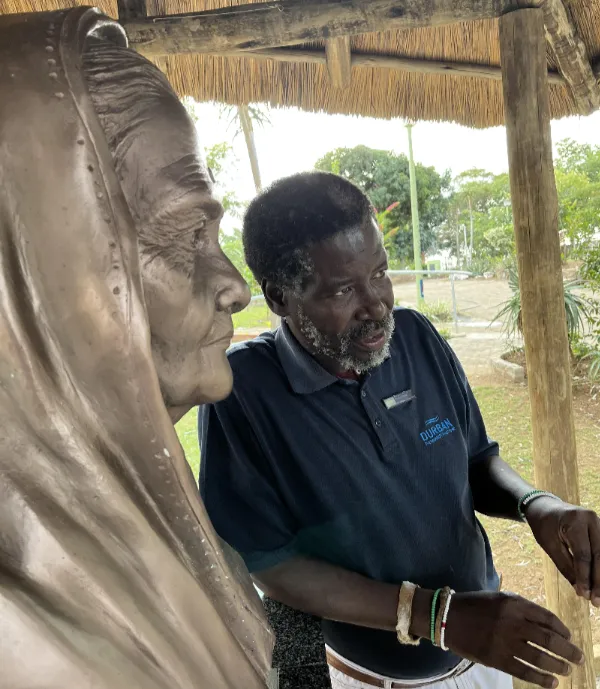
Bongani Mthembu, curator of the Gandhi Settlement in Bhambayi, next to a bust of Kasturba Gandhi just outside her historic home.
Image: Kiru Naidoo
"When I knock on the door of Sarvodaya in the morning, I hear their voices," whispers Bongani Mthembu, the curator of the Gandhi's Phoenix Settlement in Bhambayi, adding: "I then greet 'Namaste Kasturba'."
Mthembu is a spiritual man of commanding height and regal bearing, accentuated by the specks of grey in his beard and a demeanour that pays homage to his faith in the Prophet Isaiah Shembe. The historic settlement was founded by Mahatma Gandhi in 1906. It was razed to the ground in apartheid-inspired race violence in 1985 which within a matter of days drove the long-settled Indian community out of Inanda.
Patient efforts over the next decade and a half in working with those who had invaded the land by among others, Struggle stalwarts Mewa Ramgobin and Ela Gandhi, restored just over one acre of the original 100-acre expanse as a monument to peace and non-violence. Ela Gandhi remains at the helm of volunteers that ensure that the settlement is of service to the local community and keeps alive its founding principles.
Mthembu is omnipresent as the daily face and voice of the settlement to visitors who come from all corners of the planet. His guest book shows inscriptions from those originating in France, Denmark, India and the UK, among others. Sadly, there are far fewer visitors from just across the road in the township of Phoenix.
To drive from the settlement into the township one can either go through a short dirt road or out on the potholed tar patch that services the Kasturba Gandhi Primary School.
Phoenix, Inanda, Ntuzuma and KwaMashu (PINK) live cheek by jowl sharing not dissimilar socio-economic conditions, but the social distance has yet to be bridged. Granted that there have been stellar efforts by community activists in movements like the Phoenix Working Committee and Gandhi Development Trust to bring people together over the years, but much more needs to be done.
Anniversaries of whatever sort concentrate the mind on the legacies of the past or for the future. The township of Phoenix marks the 50th anniversary of its founding this year. It is a unique opportunity to chip away at historic suspicions and more recent traumas. Apartheid’s strategy of divide and rule might have been buried with the first democratic election in 1994, but community relations were severely tested by the 2021 insurrection, and the looting and violence that ensued.
One critical submission to the SA Human Rights Commission analysed that the violence was “… politically driven and propelled by a desire to demonstrate political power … a show of force to signal to the ruling party (that certain forces) … had the power to bring the country to its knees”, and where “… the instigators of the violence used the poor socio-economic conditions of the poor to lead them to loot and destroy property”.
The frequently reckless language in the news media and on social media five years ago were further polarising. But in the five years that have passed and this being Phoenix’s golden jubilee, time has proven something of a healer. The streets, the malls, the schools and the sport fields of Phoenix that have escaped the reach of the developers, are spaces where both ordinary Indian and African people commune easily.
The Phoenix Highway that was drew considerable attention in the 2021 violence and mayhem is an artery connecting the communities, a lifeline for commerce and social interaction. The challenge is to leap beyond the relaxed communion into deliberate, tangible and measurable outcomes in uniting people.
One can fairly reliably hazard that such a united people will together stand against the forces of division and destruction of the type attempted in the insurrection. Historic traumas whether colonial dispossession and conquest, systematic apartheid violence and exclusion or the race riots of 1949 and 1985, or indeed the trauma and loss of 2021, cut deep to the bone in both the African and Indian communities. One cannot, however, doubt that there is a resilience among South Africans to look beyond and look ahead.
In Greek mythology, the phoenix is the immortal bird that is constantly reborn. The answer to the questions that confront contemporary society in Phoenix and everywhere else do not lie in mythology. They rest in the minds and the hands of the ordinary working people who desire only that which is good for each other. Gandhi was inspired by John Ruskin’s words, “the good of an individual is contained in the good of all”. If each could knock on one’s neighbour’s door with a "Sawubona", "Molo Makhelwane" or Mthethwa’s poignant "Namaste", the path to peace will be paved with eternal goodwill.