

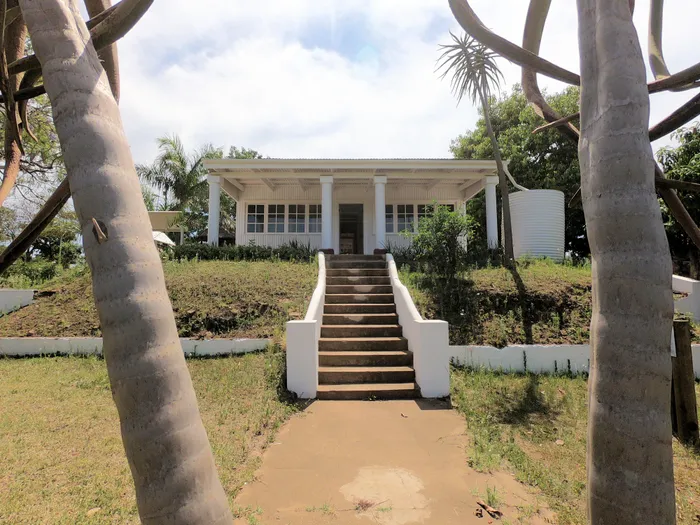
Sarvodaya: the Gandhi House.
Image: Satish Dhupelia
In 1904, at the age of 35, Mohandas Gandhi became a property owner in South Africa, with a title deed to his name. The 100 acres of land, at a purchase price of £1,000, was made possible by his successful legal practice in Johannesburg.
The attorney’s development thus far had been shaped by cities – Porbandar, Rajkot, Bombay, London, Durban, Pretoria, and Johannesburg. With his new purchase, Gandhi sought to transform the Natal countryside in a significant way, and, in turn, this place would shape him in substantially different ways from the urban environments to which he had become accustomed.
The property lay 15 miles (24km) from the city of Durban. It could be reached by taking the North Coast railway line with an exit at the seventh station, Phoenix. From there, was a further journey by foot for two-and-a-half miles (4km) through dirt roads. Situated along the Piezang River in Victoria County, and purchased in two separate plots from two white colonists, the land was undeveloped, unoccupied, and covered by long grass.
Along it were a number of fruit trees with the only built structure, a modest hut. Within four years, 60 residents resided there – families with husbands, wives, children, brothers, sisters, uncles and aunts, and Gandhi’s own wife and children. He called it a "little village".
The ideas behind the purchase and the ensuing development of the settlement, whose name came from the nearby Phoenix Station, had come from many readings and discussions over the years with friends, about what a just and good lifestyle should be. New ideas from a new reading and the immediate concerns about the financial status of the International Printing Press and the newspaper it published, Indian Opinion, both of which had thus far survived by significant financial contributions from Gandhi’s personal savings, prompted the acquisition of Phoenix Settlement.
Its vision was bold and innovative. It represented an experiment with a new economic model to manage labour relations, and a new model of land ownership. It was an attempt at "co-operative" living, and the lives of press workers were foremost in the idea behind this. The hierarchy between owner/employer, and workers and between workers with different skills, was to be replaced by equal relations, whereby all would receive the same wage.
While Gandhi owned the land, press workers could hope to acquire a few acres in their own name, and if there were profits, these would be shared. This was to be a "Press Estate", first and foremost for the well-being of press workers. The distance from the city would rule out negative urban influences, and the availability of farmland meant workers could grow their own produce. The labour performed would also ensure good physical health.
Any illnesses would be treated by nature-cure methods. Press workers, who comprised men and women, for women were encouraged to emerge from domesticity, were also meant to be teachers of the many children on the farm. The education of these children also encompassed press work.
Phoenix Settlement was quite unique in this colony of Natal in terms of the racial, linguistic, religious, class, gender and generational composition of its residents. Its residents included those categorised in the colony as white and Indian, as well as those who, in colonial parlance, were coloured.
The languages spoken at Phoenix included English, Hindi, Gujarati, Urdu and Zulu. Those residents being fluent in the latter, conversed with the day labourers or passers-by who visited at Phoenix. Their religious beliefs were diverse too, for there were Hindus, Muslims, Jews, Christians, and Parsis. The Phoenix lifestyle meant that all religions and languages were to be respected and that, contrary to colonial education, the vernaculars of the children were to be respected. Additionally, history lessons were meant to develop a sense of pride in India, and education meant education as a service to humanity.
Phoenix Settlement grew and transformed in its first decade of existence, which was also the last 10 years of Gandhi’s stay in South Africa. The settlement played a central role in the Satyagraha struggle, for it was through the vehicle of Indian Opinion that the ideas of Satyagraha were publicised, and the struggle documented for public consumption as it proceeded.
Phoenix Settlement developed from being a place for press workers to, additionally, becoming a farm, where, through a disciplined lifestyle and a particular type of education, passive resisters were to be produced. Much of which Gandhi came to be associated with, such as his vow of celibacy, fasts to change behaviour and dietary explorations, is associated with Phoenix Settlement.
This was Gandhi’s African legacy. His own estimation of Phoenix Settlement, just after he had left South Africa, was: "There is no institution in the world to excel Phoenix in its ideals or way of life."
As the first of Gandhi’s experiments in "co-operative" living, Phoenix has some significance, for it was a testing ground, and inspired him to experiment further.
Tolstoy Farm, just outside Johannesburg at Lawley, followed in 1910. An ashram was established in 1915 at Kochrab in Ahmedabad which was soon after re-established at Sabarmati in the city. Sevagram ashram was started in the village of Segaon, just outside Wardha, in 1936. Each of these drew on the ideas tested at Phoenix, but to each Gandhi brought something new and different. Phoenix Settlement is also of significance to the world, for in its history lay the Gandhian package with its solution for world peace through non-violence and just living.
This year when we commemorate 50 years since Phoenix Township was established, Phoenix Settlement – which shares its border with at least two wards of the township – celebrates 122 years of its founding. The latter was founded to challenge the segregationist ideology of the colonial era, the former was born to fulfil apartheid ideology.
From these two areas, however, came a formidable resistance to apartheid. Phoenix Settlement with its multiracial gatherings in the apartheid era was an anathema to the state, and not surprisingly pro-apartheid forces destroyed much of it in 1985.
My book traces this long history of Phoenix Settlement well into the democratic era when it received recognition from the South African Heritage Resources Agency as a national heritage site. In 2000 the then President Thabo Mbeki urged South Africans to 'cherish' and 'preserve' this site.
Today, Phoenix Settlement serves as a symbol of non-violence and reconciliation, and strives to serve the Bhambayi community within its borders while preserving the Gandhian heritage buildings. And in nearby Phoenix Township, there are many peace activists who seek to bring African and Indian residents together in harmony, and to heal the many racial tensions that have scarred the area.
Extract from Gandhi’s African Legacy: Phoenix Settlement 1904 to 2024, a History Through Letters (UWC Press, 2024) by Uma Dhupelia-Mesthrie. Emeritus Professor, Department of Historical Studies, UWC.
** The book can be ordered from [email protected] and purchased at the 1860 Heritage Centre.