

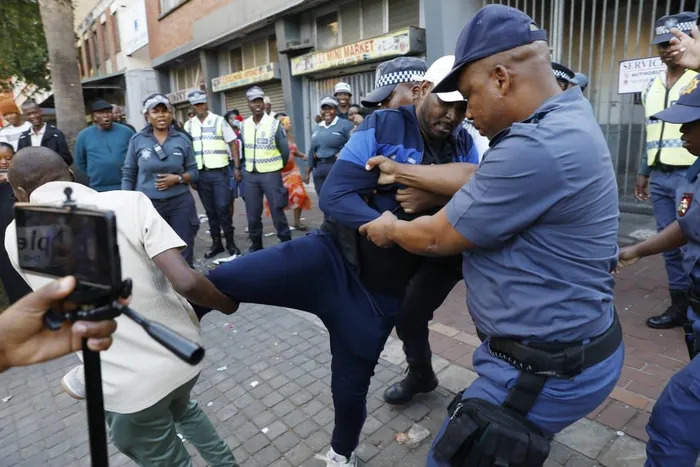
Tensions ran high outside Durban's Diakonia Centre when foreign nationals and locals clashed, police were required to restore calm.
Image: Doctor Ngcobo/Independent Media
SOUTH Africa stands at a deeply uncomfortable crossroads. Across several communities, frustration over illegal immigration, deteriorating service delivery, unemployment, crime and economic stagnation has begun to spill into increasingly volatile protests.
In some areas, demonstrations have escalated into intimidation, vigilantism, and open threats of violence.
Against the backdrop of the looming June 30 deadline by which undocumented foreign nationals are expected by some groups to leave the Republic, tension has become palpable.
The central question confronting us is both moral and constitutional: are we beginning to substitute the rule of law with the rule of the mob? This question is not merely academic. It cuts to the very foundation of our constitutional democracy. South Africa is a state founded on law, due process, human dignity and institutional governance.
When communities lose faith in the state’s ability to enforce immigration laws, maintain order and deliver basic services, they become vulnerable to the dangerous temptation of self-help. History repeatedly demonstrates that once societies normalise mob justice, it becomes exceedingly difficult to contain its consequences. There can be little doubt that many South Africans have legitimate grievances.
Communities across the country are buckling under immense socio-economic pressure. Unemployment remains catastrophically high. Public healthcare facilities are overcrowded. Schools struggle with capacity. Housing shortages persist.
Crime has eroded public confidence in the state’s ability to protect ordinary citizens. In many townships and informal settlements, residents perceive competition over scarce resources as an existential threat to their own survival. Within this environment, the issue of illegal immigration has become deeply politicised and emotionally charged. Many citizens believe that porous borders and weak immigration enforcement have contributed to increased pressure on public services and labour markets.
Whether these perceptions are always supported by empirical evidence is secondary to the political reality that communities increasingly feel abandoned by the state. Yet frustration, however understandable, can never justify lawlessness. Recent reports of violent demonstrations, threats against foreign-owned businesses, and inflammatory rhetoric are deeply alarming.
Equally disturbing are allegations that certain foreign nationals have threatened to contaminate food products sold in their stores with poison should attacks continue. Whether isolated or widespread, such threats intensify fear and deepen mistrust within already volatile communities. Fear mongering, disinformation, and retaliatory threats create fertile ground for panic and collective violence.
Once communities begin viewing one another as enemies rather than neighbours, the social fabric of the Republic begins to fray. South Africa’s immigration framework is not ambiguous. The law provides clear mechanisms for border management, asylum applications, refugee protections, detention, deportation, and legal residence.
The Immigration Act and Refugees Act establish processes that must be followed by the Department of Home Affairs and law enforcement agencies.
If individuals are in the country unlawfully, the state has both the authority and responsibility to act within the confines of the law. Deportation and enforcement measures are state functions – not the mandate of angry crowds, political opportunists, or self-appointed vigilantes. This distinction is critical. The moment citizens assume the role of immigration officers, prosecutors, judges and executioners, constitutional order begins to collapse.
Today the target may be undocumented foreigners. Tomorrow it may be political opponents, ethnic minorities, journalists, activists, or anyone deemed undesirable by the crowd. Mob justice has no permanent boundaries because it is governed not by principle, but by emotion and force. At the same time, it would be dishonest to ignore the fiscal and administrative strain that unmanaged migration can place on a developing state.
South Africa cannot sustainably absorb unlimited economic migration while simultaneously battling domestic poverty, unemployment and infrastructure collapse.
The state has a duty to protect its borders and prioritise the welfare of its citizens while still respecting international law and human dignity. Compassion without governance becomes chaos; governance without compassion becomes oppression.
Mature leadership requires balancing both realities. In confronting this issue, South Africans must also remember our own history. During the darkest years of apartheid, neighbouring African states opened their borders, homes, training camps, universities, churches and communities to South African exiles and liberation activists.
Countries such as Zambia, Tanzania, Mozambique, Botswana, Zimbabwe and others bore enormous political and economic costs in supporting the Struggle for our freedom.
Many citizens of those nations suffered reprisals because they stood with oppressed South Africans when much of the world remained silent. Remembering this history does not mean ignoring present-day challenges.
Nor does it require citizens to accept illegal immigration without question. But historical memory should temper our anger with humanity. A nation that forgets solidarity risks losing its moral compass.
This is precisely why xenophobic rhetoric must be rejected unequivocally. It is one thing to call for lawful immigration enforcement and secure borders; it is entirely another to demonise entire nationalities or ethnic groups. Collective blame is intellectually lazy and morally dangerous. Criminality is not a nationality.
Lawbreaking individuals must be dealt with decisively, but innocent people cannot become targets simply because they speak differently, worship differently, or come from another African country. The warning signs of dehumanisation should concern us all.
The famous words attributed to Pastor Martin Niemöller remain painfully relevant: “First they came for the Jews, and I did not speak out – because I was not a Jew.”
The poem endures because it reminds humanity that silence in the face of injustice eventually consumes everyone. Societies that normaliSe hatred against one group inevitably create conditions where nobody remains truly safe.
At this difficult juncture, leadership matters profoundly. In KwaZulu-Natal, Premier Thami Ntuli has demonstrated commendable restraint, wisdom and stability in navigating an emotionally-charged environment. Rather than inflaming tensions for short-term political gain, his approach has reflected the measured leadership required during periods of social anxiety.
In moments such as these, public officials must lower temperatures rather than exploit fear. There is reason to believe that under his stewardship, KZN can navigate this crisis responsibly while preserving both public order and constitutional values.
Ultimately, South Africa faces a defining choice. We can demand stronger immigration enforcement, improved border control, and accountable governance within the framework of the Constitution.
Or we can surrender to populist anger, vigilantism, and mob rule. The former strengthens democracy; the latter destroys it. A constitutional democracy cannot survive if citizens lose faith in lawful processes.
The state must urgently restore public confidence through visible enforcement of immigration laws, improved service delivery, and decisive action against criminality regardless of nationality. But citizens, too, carry responsibility. Anger cannot become licence for violence. Fear cannot become justification for hatred.
And frustration cannot become an excuse to abandon the rule of law. South Africa’s greatest test has never been whether we face crises.
Our history guarantees that we will.
The true test is whether, in moments of pressure and uncertainty, we remain faithful to the principles that define us as a constitutional democracy rather than descending into the dangerous comfort of the mob.
** The views expressed do not necessarily reflect the views of IOL or Independent Media.