

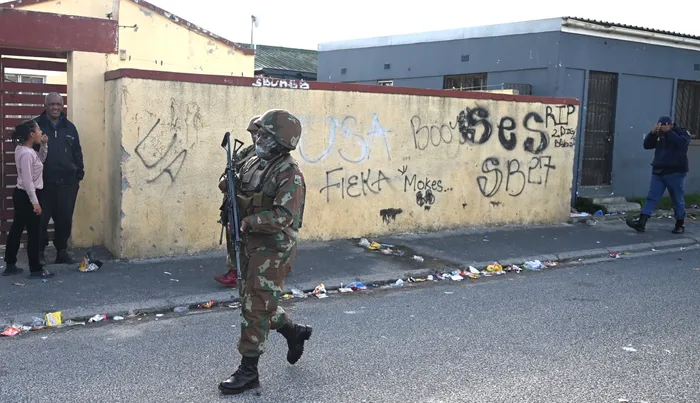
The Cape Flats may dominate the news, but violence has spread far wider. Gangsterism is no longer “somewhere else.” It is at our doorstep.
Image: Ayanda Ndamane/ Independent Media
LET ME tell you something uncomfortable. Over the course of my life, I have met a few real-life gangsters.
Not the movie kind, the actual living-and-breathing ones. And here is the truth we don’t like to admit: some of them had good qualities. They could be generous. Funny.
Loyal to their mothers in a way that would make you pause.
I am not saying this to romanticise them. I am saying it because if we are going to speak honestly to our youth, especially here in South Africa, where the pull of fast money and street reputation are very real, we need to start with the truth.
People don’t wake up one morning and choose to become villains. Many are shaped by poverty, broken homes, and communities where being feared feels like the only way to be seen.
So no, this isn’t a piece to condemn or mock. It’s something else. It is a warning. Because in a country where gunshots are no longer shocking and funerals come too often, this conversation is not theoretical.
It is urgent.
Let us be real. You have seen the headlines. You have heard the sirens at night. You have probably lost someone, a cousin, a neighbour, a friend from school.
The Cape Flats may dominate the news, but violence has spread far wider. Gangsterism is no longer “somewhere else”. It is at our doorstep.
And the only way to survive it is simple: don’t open that door.
Because here’s the part nobody tells you, not in the music, not on social media, not in the stories that make it sound glamorous: even the “good” gangster loses.
I was reminded of how distorted our ideas of gangsterism have become during a harmless night out years ago. A few friends and I were having dinner, joking the way people do.
At the time, we had this silly habit of quoting lines from The Godfather. Bad accents, dramatic whispers, the whole performance.
“I am going to make him an offer he cannot refuse,” one of us said, trying his best Marlon Brando impression.
We laughed. It was nonsense. Harmless.
But a man sitting with us, someone we had just met, went completely silent. Pale. Uncomfortable. He didn’t laugh. He barely spoke again that night. Later, we heard through others that he had told people we were dangerous men. Real gangsters.
That moment stuck with me. Because it showed just how powerful and warped, the image of the “gangster” had become.
A few movie lines were enough to convince someone that violence was sitting at the table. Now imagine the effect of real symbols: money, cars, reputation on a young mind looking for identity.
But here’s what those symbols don’t show you.
From what I’ve seen, the men who appear to be “winning” in that life almost always lose in the end. They die young, often violently. One day they are posing for photos, the next they are reduced to a headline. Their families live in constant fear, jumping at every unfamiliar car, every knock at the door. Trust disappears.
Even among their own circles. And for what?
A chain that can be pawned. A car that attracts more danger than respect.
But there is something worse than dying young, something far less visible, and far more enduring. Prison.
There is nothing glamorous about it. Nothing powerful. Nothing admirable. It is not the movie version where someone “runs the yard”. It is cramped, tense, and deeply lonely. It is the same walls, the same faces, the same anxiety, day after day. It is missing everything that matters: birthdays, weddings, funerals. It is watching your mother grow older from behind a barrier. It is knowing that life is continuing without you, and you cannot get that time back.
I have seen hardened men, men feared on the outside, break down when they speak about prison. Not for effect. Not for sympathy.
But because something inside them was permanently altered by it.
And the tragedy is this: when they finally come out, the world has moved on.
Opportunities are gone. Relationships are strained. Even the so-called “brotherhood” of the streets fades quickly. Loyalty, it turns out, has limits.
So, what are you left with? Not much.
That’s why this message matters. Especially for young South Africans trying to find their place in a tough environment. Yes, some gangsters have redeeming qualities. Yes, many were shaped by difficult circumstances. But none of that changes the outcome. That road leads in one of two directions, a grave or a cell.
There is another path. It may not be flashy. It won’t trend on social media. But it is real. It’s the quiet dignity of an honest life. It’s being able to sit with your family without fear.
It’s growing older, watching your children grow, building something that lasts. It’s peace, something money and reputation can never buy.
We don’t need more legends cut short. We don’t need more names added to memorial T-shirts. We need young people who choose to live, fully, freely, and without looking over their shoulder.
So, if you’re standing at that crossroads, understand this clearly: the gangster’s story always ends the same way. Yours doesn’t have to.
Choose wisely, youngster. Because the coolest thing you can be is still here.
** The views expressed do not necessarily reflect the views of IOL or Independent Media.