


If your salary went up by 4%, you kept pace with inflation. Just. But your electricity did not go up 4%. Neither did your water, your medical aid, your insurance, or your rates. When you add it all up, the real cost of your life in 2026 is climbing far faster than any pay increase most South Africans will ever see, says the writer.
Image: Pexels
LAST week, the people who control interest rates in South Africa made a decision that will cost you money every single month. They raised the repo rate by 0,25%, moving the prime rate to 10,50%. That does not sound like much. But it is just the latest item on a very long list of things going up this year – most of them rising at two, three, or five times the rate of inflation. And almost none of it is your fault.
If your salary went up by 4%, you kept pace with inflation. Just. But your electricity did not go up 4%. Neither did your water, your medical aid, your insurance, or your rates. When you add it all up, the real cost of your life in 2026 is climbing far faster than any pay increase most South Africans will ever see. That is why it feels like you are working harder and still falling behind. Because you are.
Here is what that 0,25% adds to your home loan every month:
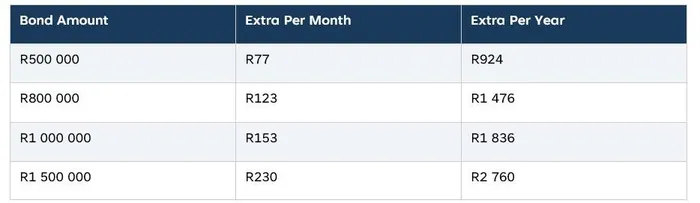
Here is what that 0,25% adds to your home loan every month:
Image: Supplied
On a R250,000 car deal over 72 months, add R38 more per month. Painful, but the rate increase is honestly not the biggest hit you are taking right now.
From July 1, nearly every municipality is hiking electricity, water, rates, and refuse. Inflation is 4%. In eThekwini, water is going up nearly 14%. In Johannesburg, close to 14% when levies are included. In Pietermaritzburg, sanitation is up 13%. Electricity rises 9% nationally, but more in eThekwini.
Here is the part that should make you angry. Since 1996, research shows electricity prices at South Africa's biggest municipalities have gone up more than five times faster than inflation, and water prices six times faster. Over 30 years. The pipes have gotten worse. The power cuts more frequent. The service less reliable. Poor management and, in too many places, corruption, are being billed straight to your account every single month.
Then there are the debit orders that creep up every January or April without anyone calling to warn you. One month your balance just does not stretch as far.
Medical aid went up 7% to 9% at the big schemes – Discovery 7,2%, Bonitas 8,8%, Medihelp 8,46% – despite the regulator recommending 3v3%. Some smaller schemes hiked nearly 19%. Four in every 10 South African households have already cut back or cancelled cover just to afford daily living costs.
Vehicle and home insurance is up 10% to 20%, driven by vehicle theft, bad roads, and rising repair costs. Life cover and personal policies are up 5% to 15%. All hitting at once. None of it are in line with the 4% inflation your salary was measured against.
Here is your monthly budget in one table:
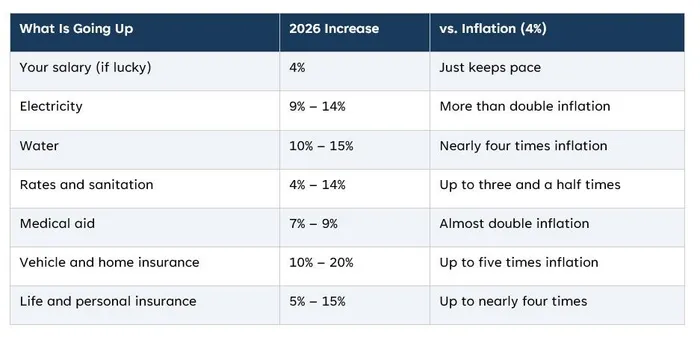
Your monthly budget in one table.
Image: Supplied
Your salary kept pace with inflation. Everything else left it behind. This is why the money disappears before the month is over.
The rate increase was triggered by wars far from your front door c Israel and Iran pushing petrol higher, Russia and Ukraine keeping bread and cooking oil expensive, and US President Donald Trump's trade decisions weakening the rand. Everything we import gets more expensive. It lands on your shelf with a higher price tag.
The municipal increases are a different story – years of pipes not fixed, infrastructure neglected, and money for services not getting there. You are picking up that bill monthly. The Reserve Bank and Finance Minister Enoch Godongwana are doing a solid job nationally – South Africa got its first credit rating upgrade in 16 years, and Sars is collecting R21 billion more than forecast. Real achievements. But none of that shows up on your water bill.
A rate increase works in your favour if you have a fixed deposit or savings account. The same move that hurts borrowers, helps savers. If a fixed deposit is coming up for renewal, do not let it roll over automatically – call your bank, shop around, and ask for a better rate.
The pressure is coming from every direction at once. A rate increase here, a tariff hike there, an insurance renewal up 15% while you were not looking. None feel like a disaster alone. Together, they are the difference between a family that is coping and one that is not.
You did not cause this. But knowing what is happening to your money – and why – is the first step to making sure it does not get the better of you.
** The views expressed do not necessarily reflect the views of IOL or Independent Media.