

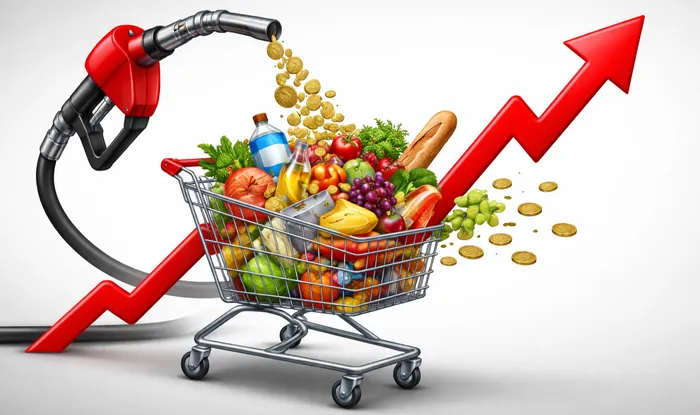
The combination of a phased rollback in temporary fuel levy relief and a “surprise” interest rate hike by the South African Reserve Bank has created a perfect storm, in the economic sense, says the writer.
Image: ChatGPT
SOUTH Africa’s macroeconomic climate has long resembled a high-wire balancing act. From budget speeches to SONAs, we are a society grappling with structural unemployment, stagnant economic growth, and a fragile fiscal framework; the margin for error is razor-thin.
Recently, that wire was stretched even tighter. The combination of a phased rollback in temporary fuel levy relief and a “surprise” interest rate hike by the South African Reserve Bank (SARB) has created a perfect storm, in the economic sense.
For ordinary citizens and business owners already operating under extreme economic constraints, these developments represent more than just financial metrics; they constitute an escalating affordability crisis.
At the start of the year, there was cautious optimism that South Africa might lower interest rates as inflation moderated. However, rising geopolitical tensions, particularly in the Middle East and the closure of the Strait of Hormuz - through which around 20% of the world’s oil flows - led to a surge in global Brent crude prices, disrupting those expectations.
As a net importer of oil, South Africa was quickly affected by external shocks. By April, fuel prices had surged by 11.4% within a single month, causing consumer inflation to rise to 4.0%. This figure is approaching the upper limit of the South African Reserve Bank's new 3% target. The inflation pressure inevitably leads to an increase in interest rates.
To protect the struggling public, the National Treasury implemented emergency measures, reducing the General Fuel Levy by R3,00 per litre for petrol and nearly eliminating the diesel levy with a R3,93 rebate. This R17,2 billion intervention temporarily supported key economic sectors.
However, relying on emergency tax holidays is unsustainable for a country with a significant fiscal deficit. The government cannot permanently forfeit its second-largest source of tax revenue, which would lead to a phased withdrawal of the relief.
As these levies are progressively reinstated, the cushioned reality motorists enjoyed is giving way to harsh market prices. With coastal petrol prices hovering around R24 per litre and inland prices breaching the R25 mark, the country's logistical backbone faces structural cost inflation that cannot be ignored.
Compounding the fuel price crisis is the SARB's aggressive posture. Confronted by mounting inflationary risks and the threat of "second-round effects" - where temporary fuel price increases permanently drive up the costs of regular goods and services - the Monetary Policy Committee (MPC) implemented a 25-basis-point hike.
The decision raised the benchmark repo rate to 7.00%, consequently driving the prime lending rate up to 10.50%.
"The committee acted because inflation risks had intensified and overlapping shocks could trigger second-round effects. The decision was meant to manage those risks and help bring inflation back to target." - Lesetja Kganyago, SARB Governor.
While economically orthodox, this pre-emptive strike targets a consumer base with no financial runway left. The central bank is explicitly prioritising long-term price stability, but the short-term medicine is incredibly bitter for a population heavily reliant on credit.
The combination of a rising fuel levy and a higher prime interest rate creates a dual challenge for the South African economy. It impacts both disposable income and the operational capacity of businesses.
The homeowner and consumer debt trap
The rate hike directly increases the cost of servicing existing debt. For middle-class households, the impact is immediately tangible on long-term liabilities like home loans and vehicle finance. For instance, on a modest R1 million home loan, a 25-basis-point increase adds an extra R168 to the monthly bond payment. For an average South African home priced at roughly R1,69 million, repayments increase by nearly R284 per month.
While these figures may seem manageable in isolation, they do not exist in isolation. When combined with an extra R300 to R500 required monthly to fill a vehicle's fuel tank, household savings are completely wiped out. Consumers are forced to cut spending on discretionary goods, creating a slump in the retail and hospitality sectors, which together employ approximately 25% of the country’s workforce.
The multiplier effect on food security
The National Treasury has provided significant diesel relief to support the agricultural and transport sectors. However, as diesel levies return to R3,93 per litre, logistics companies will pass these costs onto retailers.
The agricultural sector is facing heightened challenges, including rising fuel and transport costs, inflated fertiliser prices, and drought risk due to unpredictable weather patterns. These increased production costs will likely lead to food inflation, threatening basic food security for lower-income households that spend a large portion of their income on food.
Stifling SMMEs and economic growth
Small, Medium, and Micro Enterprises (SMMEs) are the lifeblood of the South African economy and key drivers of employment, yet they are the least equipped to survive macroeconomic volatility. Unlike large conglomerates, smaller businesses lack the cash reserves to absorb sustained fuel price hikes or higher debt-servicing costs.
Capital that could have been used for expansion, inventory, or hiring is instead diverted to paying off utility bills and commercial loans. The result is a hiring freeze, structural downscaling, and, in worst-case scenarios, business closures.
South Africa is trapped in a challenging economic situation. If the reserve bank doesn't raise interest rates, inflation could spiral out of control, harming the poorest citizens. Conversely, increasing rates and normalising fuel levies may stifle any remaining economic growth.
A careful balance is crucial. While global oil shocks are beyond South Africa's control, domestic policies need precision. Economists and opposition parties advocate for overhauling fuel price regulation and exploring alternative funding mechanisms. South Africa should take cues from other countries using tax cuts, price caps, and subsidies to mitigate the impact.
Until these reforms occur, South Africans will continue to face a tough economic environment, testing the resilience of local consumers.
** The views expressed do not necessarily reflect the views of IOL or Independent Media.