

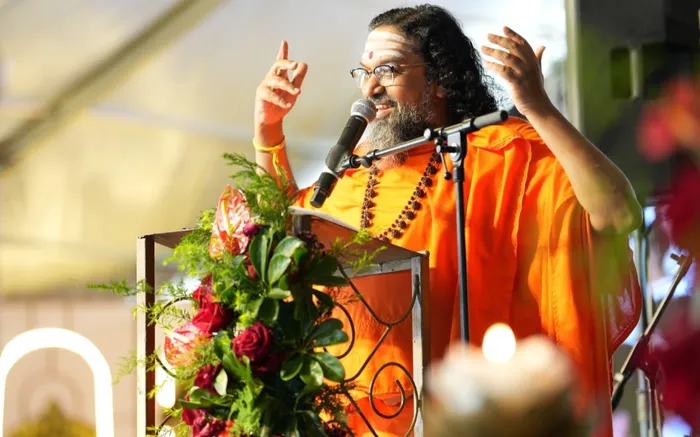
Swami Abhedananda resident Acharya of Chinmaya Mission South Africa.
Image: Supplied
IN EVERY society there are individuals who do more than simply lead institutions - they inspire transformation, shape moral consciousness and leave an enduring imprint on the hearts of people. Such leaders become bridges between tradition and modernity, between spirituality and social responsibility, and between individual upliftment and collective progress.
Over the past 20 years in South Africa, Swami Abhedananda of the Chinmaya Mission has emerged as one of those rare spiritual figures whose influence transcends religion, language, geography and generation.
As the Chinmaya Mission celebrates seventy-five years globally and Swami Abhedananda commemorates twenty years of selfless service in South Africa, this milestone presents an important opportunity to reflect on the extraordinary contribution of a spiritual leader who has profoundly shaped the religious, social and humanitarian landscape of South African Hinduism.
When Swami Abhedananda arrived in South Africa on 4 June 2006, it marked the beginning of what would become a transformative era not only for the Chinmaya Mission, but for countless individuals and communities seeking meaning, guidance and hope in an increasingly complex world. Over two decades, his life of profound austerity (tapasya), visionary leadership and boundless compassion has revitalised scriptural study, united diverse communities, empowered the youth and fed thousands daily through humanitarian outreach programmes.
The Chinmaya Mission itself has a rich and distinguished history. Founded in 1951 by the revered spiritual master Swami Chinmayananda, the organisation emerged with the mission of making the timeless wisdom of Vedanta and Hindu scriptures accessible and relevant to modern society. Headquartered at Sandeepany Sadhanalaya in Mumbai, India, the Mission today operates in numerous countries through temples, schools, educational programmes, youth movements, humanitarian initiatives and spiritual outreach programmes. It has become one of the most influential global Hindu organisations dedicated to spiritual education, ethical living and service to humanity.
What makes Swami Abhedananda particularly remarkable is his extraordinary ability to make profound spiritual concepts understandable to ordinary people. In an age where religion is sometimes perceived by younger generations as rigid, distant or overly ritualistic, Swamiji has managed to reconnect thousands — especially the youth — to the deeper philosophical and practical dimensions of Hinduism.
His discourses are known nationally and internationally for their simplicity, humour, warmth and practical relevance. Like a master musician capable of turning complex notes into beautiful melodies that resonate with all audiences, Swamiji possesses the rare ability to translate ancient Vedic wisdom into guidance that speaks directly to modern life. Through humour, relatable examples and deep scriptural insight, he has transformed the Bhagavad Gita, Ramayana, Upanishads and Vedantic philosophy from texts that many once viewed merely as ritual readings into living guides for everyday existence.
His contribution to spiritual education has been immense. Nationally and globally recognised as an expert exponent of Bhakti and Vedanta philosophy, he has taught the Bhagavad Gita in its entirety three times and conducted extensive teachings on the Srimad Bhagavatam, Ramcharitmanas, Valmiki Ramayan, the major Upanishads and the Brahma Sutras. He also pioneered South Africa’s first-ever two-year residential Vedanta course conducted in the traditional Gurukul style. In addition, he completed several one-month and six-month courses that benefitted South Africans from numerous organisations and backgrounds.
Swamiji also recognised the importance of preserving ancient languages associated with Hindu scriptures. Under his leadership, ongoing weekly Sanskrit classes were established across all Mission ashrams catering to all levels of learning. This commitment to preserving scriptural literacy has helped many younger South Africans reconnect with their spiritual and linguistic heritage.
Under his stewardship, the physical and spiritual footprint of the Chinmaya Mission in South Africa expanded dramatically. Six ashrams were established, including four in Durban, one in Cape Town and one in Johannesburg. Major spiritual landmarks such as Chinmaya Shivam and Chinmaya Annapoorna have become internationally recognised centres of worship, learning and pilgrimage.
His contribution also extends beyond South Africa’s borders. Swamiji personally led thousands of South Africans on spiritual pilgrimages to India’s holiest sites including Mount Kailash, the Chhota and Bada Char Dham, the 12 Jyotirlingas, Vrindavan, Dwarka and Jagannath Puri. Through these pilgrimages many devotees experienced a profound reconnection with their civilisational and spiritual roots.
Yet perhaps the true greatness of Swami Abhedananda lies not merely in buildings constructed or discourses delivered, but in the extent to which spirituality has been translated into practical compassion and social responsibility.
His most recent initiative, the “Nourish to Flourish” project, stands today as one of the most inspiring examples of faith-driven humanitarianism in contemporary South Africa. Through the transformation of the Rajput Hall in Arena Park, Chatsworth into the magnificent Annapoorna Temple and a state-of-the-art kitchen and distribution centre, the initiative now provides more than 2,000 meals daily to underprivileged communities.
In many respects, this project represents Hindu philosophy in action.
The initiative beautifully reflects the ancient teaching that service to humanity is service to the Divine. At a time when poverty, unemployment and inequality continue to affect large sectors of society, “Nourish to Flourish” has become far more than a feeding scheme — it has become a symbol of dignity, compassion and hope. Importantly, it transcends race, religion and cultural background, bringing together schools, welfare organisations and multiple Hindu bodies in collective service to vulnerable communities.
Swamiji’s humanitarian vision also extends to the direct adoption and support of hundreds of underprivileged Hindu families in Chatsworth who continue to receive emotional, material and spiritual support through the Mission’s outreach programmes. This deep level of community care reflects a spirituality rooted not only in philosophy but in human empathy and compassion.
Swami Abhedananda’s influence among young people has also been extraordinary. Through programmes such as CHYK (Chinmaya Yuvak Kendra) and Balvihar, he created dynamic platforms that nurture leadership, discipline, spirituality and social responsibility among children and young adults. Through personal coaching and mentorship, hundreds of young professionals openly acknowledge the profound role his guidance played in shaping their personal and professional journeys.
Today, the Mission boasts a healthy and highly committed balance of age and gender participation across its centres — something many religious organisations struggle to achieve in modern times.
In an increasingly fragmented world, his emphasis on unity deserves particular recognition. South African Hinduism reflects a rich diversity of linguistic, regional and cultural traditions. Yet Swamiji consistently promoted inclusivity and collective identity, creating spaces where people from different language and cultural backgrounds unite through spirituality and service. Initiatives such as “Rice to Rise” became symbolic of this unifying vision and brought thousands together in shared devotion and humanitarian work.
Another remarkable aspect of his leadership has been his foresight in embracing technology long before it became fashionable among religious organisations. Long before the COVID-19 pandemic accelerated digital engagement globally, Swamiji recognised that technology could become a powerful tool for preserving and disseminating timeless wisdom. Today, his online spiritual outreach reaches audiences across continents, positioning South African Hinduism prominently on the international stage.
His influence has also elevated South African Hinduism globally. International students from the USA, Germany, Singapore and India trained at the Chatsworth Ashram, while some have gone on to serve as Brahmacharins in India itself. Swamiji regularly represents South Africa at spiritual gatherings and discourses across multiple continents.
Equally inspiring is the personal discipline that underpins his public achievements. It is reported that Swamiji begins his spiritual practices daily at 3:00 AM and conducts twelve Rudrabhisheks every morning while maintaining an exceptionally austere lifestyle with minimal sleep and minimal food intake. Virtually all his waking hours are dedicated to spiritual service, mentorship and community upliftment.
In a modern era often dominated by materialism, self-promotion and instant gratification, such discipline serves as a powerful reminder that authentic leadership is grounded in sacrifice, consistency and humility.
There is a profound quotation by Swami Chinmayananda which states:“True spirituality is not running away from life, but transforming life.”
Few individuals embody this philosophy more meaningfully than Swami Abhedananda.
From an anthropological perspective, spiritual leaders such as Swami Abhedananda play a critically important role in preserving cultural continuity while simultaneously adapting tradition to changing social realities. They become custodians of memory, values and identity while also serving as architects of social cohesion and moral renewal.
His twenty-year journey in South Africa therefore represents far more than the success of a religious institution. It represents the successful integration of spirituality, education, youth development, humanitarian service and community empowerment into a holistic model of social transformation.
Like a lighthouse guiding ships safely through turbulent waters, Swami Abhedananda continues to provide direction, stability and hope to thousands navigating the uncertainties of modern life.
South Africa has indeed been blessed by his presence, leadership and selfless service over the past two decades. His legacy will not simply be measured by temples built or crowds gathered, but by the countless lives transformed, the hungry fed, the youth inspired and the communities united.
That is the true measure of spiritual greatness.
** Dr Govender writes in his personal capacity.
** The views expressed do not necessarily reflect the views of IOL or Independent Media.