

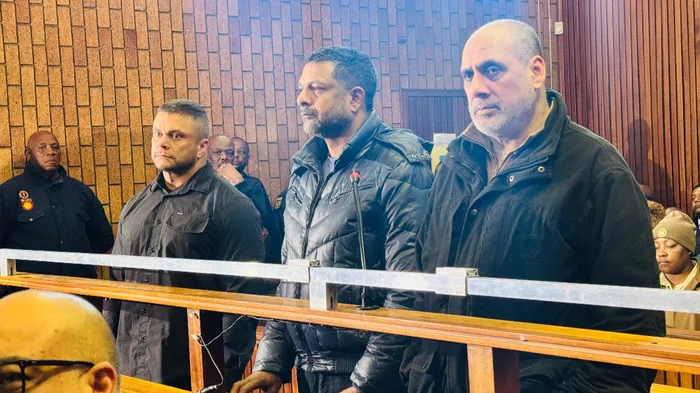
Durban businessman Tariq Downes, Crime Intelligence head Major-General Feroz Khan, and Gauteng Hawks head Major-General Ebrahim Kadwa were each recently granted R20,000 bail in the Kempton Magistrate's Court. The accused are allegedly linked to the illegal dealing and unlawful possession of precious metals, following an intensive investigation by the Gauteng counter-intelligence operations.
Image: NPA
THE South African Police Service (SAPS) has long been a subject of public scrutiny and criticism. For years, South Africans have expressed their concerns about corruption, inefficiency, and the pervasive feeling that the police force has been infiltrated by criminal elements.
What has often been dismissed as mere anecdotal evidence is now emerging in a way that demands attention and action. The recent revelations of moral decay within the SAPS, particularly among high-ranking officials, highlight a significant crisis that goes beyond individual failings – it points to systemic issues that require urgent reform.
At the core of this issue is the betrayal of public trust. The police are meant to serve and protect citizens, uphold the law, and ensure societal safety. However, when individuals in positions of power leverage their authority for personal gain, they not only undermine the institution's integrity but also compromise the safety and security of the entire community. The frustration and anger of South Africans are palpable; they feel that their fears and experiences have been validated by the exposure of misconduct among those they believed were entrusted to uphold the law.
Recent investigations and reports have revealed a disturbing trend in which officers of the law have essentially become agents of their own interests, using their roles to engage in corrupt practices that enrich themselves at the public's expense. Such behaviour poses serious moral and ethical questions. It highlights a significant disconnect between the ideals of public service and its execution within the SAPS. When police officials engage in criminal activities, including collusion with organised crime syndicates, they perpetuate a cycle of violence and insecurity that disproportionately impacts the most vulnerable communities in South Africa.
The implications of this rot within the SAPS cannot be overstated. It breeds a culture of cynicism and despair among citizens, who may feel powerless to seek justice. When those tasked with enforcing the law themselves engage in unlawful activities, it sends a troubling message: that the rule of law is selectively applied, often in favour of those with resources and connections. This not only erodes public confidence in the police, but also diminishes the overall effectiveness of law enforcement. Communities may become reluctant to report crimes or co-operate with investigations, fearing that their cases will not be handled impartially.
Furthermore, the narrative surrounding police corruption reinforces broader societal issues, including systemic inequality and social injustice. The very communities that are most affected by crime are often the same ones where police corruption thrives. When police officers engage in corrupt practices, they exacerbate existing inequalities, leading to increased victimisation and marginalisation of already disadvantaged groups. Thus, addressing corruption within the SAPS is not merely an organisational issue; it is an essential part of ensuring justice, equity, and fair treatment for all citizens.
The ongoing demand for accountability in South Africa underscores a growing public sentiment that corruption must be addressed with urgency and seriousness. As revelations of misconduct emerge, citizens increasingly call for measures that go beyond mere transparency; they seek tangible repercussions for those involved. This shift in public expectation reflects a broader understanding that the integrity of public office is paramount in fostering trust and promoting good governance.
In this context, internal disciplinary hearings are often viewed as inadequate responses to severe misconduct. While they signify an attempt to address wrongdoing within the system, they often lack the teeth to deter potential offenders. The public's frustration with the status quo highlights the necessity for legal prosecutions to be pursued vigorously. Without the threat of significant legal consequences, there is little to prevent individuals in positions of power from abusing their privileges for personal gain.
Furthermore, the insistence on holding individuals accountable serves several important functions. It reinforces the principle that public servants are stewards of the public trust and that their primary responsibility is to serve the community rather than themselves. In doing so, it restores faith in public institutions, which is essential for social cohesion and democratic stability.
Additionally, the pursuit of accountability can catalyse institutional reforms, prompting a re-evaluation of governance practices, and the implementation of more robust checks and balances. This, in turn, can lead to a more transparent and equitable system, making corruption more difficult to perpetrate in the future.
Ultimately, the message must resonate clearly that the misuse of public office not only undermines democratic values, but also invites severe legal repercussions. Upholding this message is crucial to ensuring that South Africa's governance structures remain resilient, and reflect the ethical standards its citizens demand.
The challenges faced by SAPS illustrate a broader governance crisis in South Africa. The exposure of corruption among high-ranking officials underscores the urgent need for comprehensive reform within the police system. Structural changes, increased oversight, and a commitment to ethical leadership are essential in rebuilding public trust.
For South Africans, the exposure of these issues represents not just a moment of reckoning but also an opportunity for change that could restore faith in law enforcement and, ultimately, contribute to a safer and more just society. The road to reform will be difficult, but the call for justice is louder than ever, urging a collective move towards integrity and accountability in the public service.
** The views expressed do not necessarily reflect the views of IOL or Independent Media.