

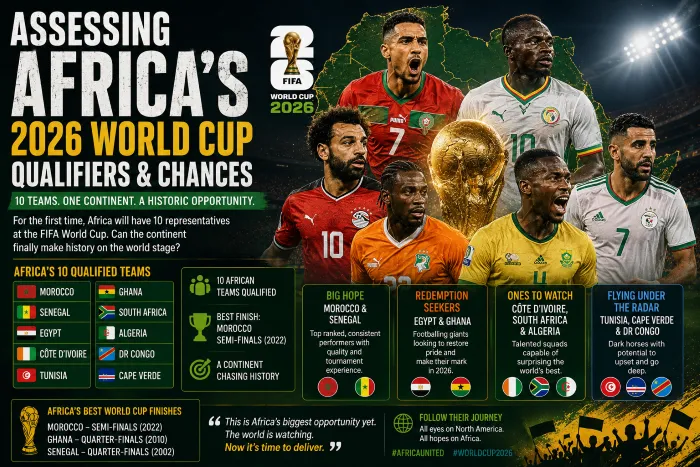
As the 2026 FIFA World Cup approaches, Africa will proudly feature 10 teams for the first time. Can these nations make a significant impact on the global stage?
Image: Supplied
The 2026 FIFA World Cup is almost here and, for the first time, Africa will feature 10 teams at the global showpiece in the United States, Canada and Mexico. Does the continent have a chance of making an impact?
Bets.co.za have rolled the dice and taken a look at home each of the African contingent could perform at the finals.
Africa had a marathon qualifying campaign that saw nine teams secure direct spots at the FIFA World Cup as group winners. Two major players failed to qualify, with Cameroon losing to debutants Cape Verde while Nigeria miss out for the second consecutive tournament.
A number of big teams reasserted their dominance on the continent, with the likes of Egypt, Côte d’Ivoire, Tunisia, and Senegal qualifying with perfect records.
Ghana are also back at the global event, making a surprise return to the tournament in a period when their football appears to be in a crisis after a failure to qualify for the 2026 AFCON.
Also returning to the world stage are DR Congo, who are back at the World Cup for the first time since Germany 1974, when they played as Zaire. Of the overall 48 teams at the tournament means there are a few debutants and Africa have Cape Verde on that list.
The most impressive team during the qualifiers were Morocco, who finished with a perfect record. They also showed great balance between attack and defence, scoring 22 goals in 10 matches and conceding just twice.
Africa is yet to produce a World Cup winner, but their reputation on the global stage continues to improve as time goes by.
Over the years, the likes of Ghana, Cameroon and Senegal have reached the quarter-finals while Morocco progressed all the way to the last four in Qatar 2022.
With 10 teams representing the continent in North America, there is increased hope that Africa may finally fulfil its potential on the world stage
Morocco and Senegal are currently Africa’s top two-ranked teams and have underlined that status by a string of impressive performances in recent times.
They also played in the AFCON final, with the West Africans winning 1-0 after extra-time, although that result has since been overturned by CAF.
The Atlas Lions reached the semi-final in Qatar 2022 and have maintained that defensive solidity, which served them well in that tournament. However, they have now added more clinical finishing in attack, with the likes of Brahim Diaz, Chemsdine Talbi, Ayoub El Kaabi, and many others.
A recent managerial change could add an interesting dynamic to Morocco’s World Cup campaign. It remains to be seen if Mohamed Ouahbi can match predecessor Walid Regragui’s semi-final berth in 2022.
As stated earlier, the Teranga Lions of Senegal won the 2025 AFCON on the pitch before being stripped of the title by CAF. They are widely regarded as the most balanced squad and have somehow built another golden generation after the squad that reached the quarter-finals in Korea/Japan 2002.
Despite suffering a slight dip in form during the mid-qualifiers, Senegal still managed to maintain an unbeaten record. Their experience in high-pressure games puts them as a safe bet to progress beyond the group stage, and it will be interesting to see how far they go after that.
Egypt and Ghana are two of the most successful teams in African football, and both countries have a reputation on the global stage. However, they have failed to live up to that reputation and will be looking to re-establish themselves in the summer.
The Pharaohs of Egypt have a slightly ageing squad and are still dependent on Mohamed Salah, who is facing a final shot at a World Cup legacy. An unbeaten record in the qualifiers and a run to the AFCON semi-finals suggest that there may be some fight in the old giant come the summer.
Ghana remain a conundrum as they are going to the World Cup but failed to qualify for the 2025 AFCON.
Heavy defeats to Germany and Austria during the March international break suggest the Black Stars may not be ready for the world stage, and they have made moves to find a solution, with manager Otto Addo paying the ultimate price and former Portugal boss Carlos Queiroz named as the new man at the helm.
The last few years have seen Côte d’Ivoire and South Africa come back into reckoning in African football. The Ivorians won the AFCON in 2023 while Bafana Bafana qualified for the World Cup at the expense of powerhouses Nigeria.
Côte d’Ivoire have looked solid under manager Emerse Fae, combining a compact midfield with a blistering and breathtaking attack. The Elephants have exciting players like Simon Adingra, Amad Diallo, Yan Diomande, and Sebastien Haller, and will certainly be worth keeping an eye on in the summer.
South Africa are back at the World Cup for the first time since they hosted in 2010. They play a possession-based style under manager Hugo Broos, and with players like Lyle Foster, Oswin Appollis, Teboho Mokoena and goalkeeper Ronwen Williams, they certainly have the quality to pull a few surprises at the global showpiece.
Algeria are considered a powerhouse in Africa, with two AFCON titles and a collection of exciting players like Riyad Mahrez, Houssem Aouar, Ibrahim Maza and Amine Gouiri. They had a solid qualifying campaign, reached the quarter-finals of the AFCON, and will be an intriguing prospect in North America
Tunisia have been at the World Cup six previous times but have failed to make any significant impact. The Eagles of Carthage remain something of a wildcard in major tournaments as they qualified for the Mundial unbeaten but struggled at the AFCON in January.
Cape Verde are one of the beneficiaries of Africa’s expanded 10 slots, and their achievement is even more impressive knowing that powerhouses like Nigeria did not qualify. They finished four points clear at the top of a group that included Cameroon, suffering only one defeat in the process.
DR Congo are the only one of Africa’s representatives not to qualify directly, but making the tournament via an arduous route like the playoffs means they can hold their own.