

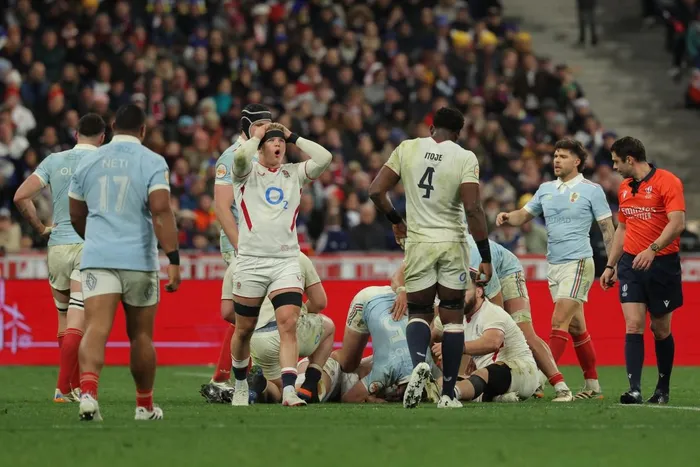
England and their young star Henry Pollock area heading to South Africa to face the Springboks after a horrible Six Nations campaign.
Image: AFP
The 2026 Six Nations was supposed to be the platform for Steve Borthwick’s England to launch towards their battle against the Springboks, but as the dust settles on an underwhelming campaign, the reality is far more sobering.
For England fans looking ahead to the July Test series against the world champions, the optimism is thin. On current evidence, England simply do not possess the firepower, mentally, physically or tactical nous to dismantle the green and gold machine.
The most glaring issue remains England’s toothless attack. Throughout the Six Nations, Borthwick’s side struggled for identity. They seem to be stuck in no-man's-land when it comes to a proper game plan.
They fluctuated between a kick-pressure game and a lateral offensive structure that lacked a clinical edge. In the end, neither worked, as they suffered four stinging defeats that will leave their confidence in the gutter heading to these shores in a few months’ time.
Against a Springbok defence orchestrated by Irishman Jerry Flannery, being lateral on attack is a death sentence. The Boks thrive on closing space, and England’s habit of shifting the ball without gaining the gain line will play right into the hands of one of the most aggressive blitz defences in world rugby.
To beat South Africa, you need players who can win individual duels when the system breaks down. That gain-line battle is where games are won and lost against the Springboks.
During the Six Nations, England’s primary strike runners were often neutralised by organised European defences. If England struggled to find holes in a Scottish or Italian line, how do they expect to breach a Springbok wall featuring the likes of Eben Etzebeth and Pieter-Steph du Toit?
The Boks don't just tackle; they physically dominate the point of contact, and England’s current crop of ball-carriers lacks the physicality to punch holes in the South African line.
Furthermore, their so-called "Pom Squad" doesn’t come close to the real thing — the Springboks’ vaunted “Bomb Squad” bench.
The Six Nations highlighted a recurring England frailty in closing out matches. England surrendered leads and lost tactical discipline in the closing twenty minutes of multiple matches. Against the Springboks, the final quarter isn't a period to endure; it is where the game is won. Rassie Erasmus’s ability to inject fresh players of world-class quality in the second half is a luxury England cannot match.
England’s bench depth — particularly in the tight five — is a significant concern. A tiring English side on the Highveld, where the air is thin and oxygen in limited supply, could get hammered in those crucial last 20 minutes.
Tactically, the Springboks are much more rounded. Under Tony Brown, they are no longer just a kick and defend side. They have integrated a sophisticated passing game that complements their traditional power. Then there is their kicking game, which has been brilliantly adapted to win the ball back in the air after World Rugby’s law changes that prohibit blockers.
Then there is the psychological gulf. The Springboks play with a collective clarity and a battle-hardened arrogance that comes from back-to-back World Cup titles. England, conversely, look like a team searching for permission to be great.
July could be a brutal reality check. England were on a 12-match winning streak before their wheels came off over the last two months. And now they face the Springboks, who are in a different stratosphere than what they faced in the Six Nations.
Erasmus and his team won’t underestimate England in July, but the visitors could be in for a long and painful afternoon at Ellis Park.