

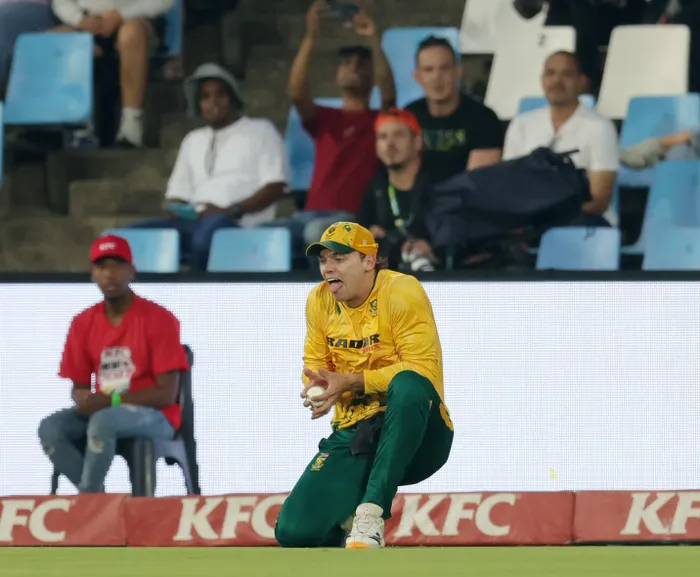
South Africa’s World Test Championship victory doesn’t necessarily translate to confidence in limited overs World Cups, as their historical success in Test cricket doesn’t guarantee similar achievements in T20 formats. Seen here: Tristan Stubbs. Picture: BackpagePix
Image: Backpagepix
A lot has been made of the fact that the Proteas’ World Test Championship (WTC) victory will give them a newfound confidence in limited overs World Cups, and for me that simply doesn’t make sense.
The Proteas have traditionally been a strong Test-playing nation since readmission, always able to compete and beat the best in the world. This was especially true under Graeme Smith, who led the side to series victories in England and Australia.
Most notably, Smith led the team to the number one ranking in 2012 when South Africa was awarded the ICC Test mace.
That’s the equivalent of winning the WTC, which the Proteas did under Temba Bavuma last year, beating Australia in the final at Lord’s.
The victory was widely hailed as South Africa’s first ICC trophy, and while technically true, that’s not actually the case since Smith’s side achieved the same feat.
What all this means is that success in the longest format is something the Proteas are well-accustomed to achieving.
Therefore, trying to conflate their red-ball success into confidence in limited overs is something of a stretch.
You might as well say the Springboks winning the Rugby World Cup will translate to similar achievements on the cricket field. That’s just not how it works. What is far more relevant, is the performances of the Proteas during the recently-completed SA20.
In the meantime, the Proteas will be eagerly awaiting their first match at the T20 World Cup next week. Co-hosts India will be in action on the opening day against minnows USA, while South Africa will take on Canada on Monday.
The Proteas are in a tricky group D, including New Zealand and Afghanistan.
* The views expressed are not necessarily the views of IOL or Independent Media.
** JOIN THE CONVERSATION: Send us an email with your comments, thoughts or responses to [email protected]. Letters should be a maximum of 500 words, and may be edited for length. Anonymous correspondence will not be published. Submissions should include a contact number and physical address (not for publication).