

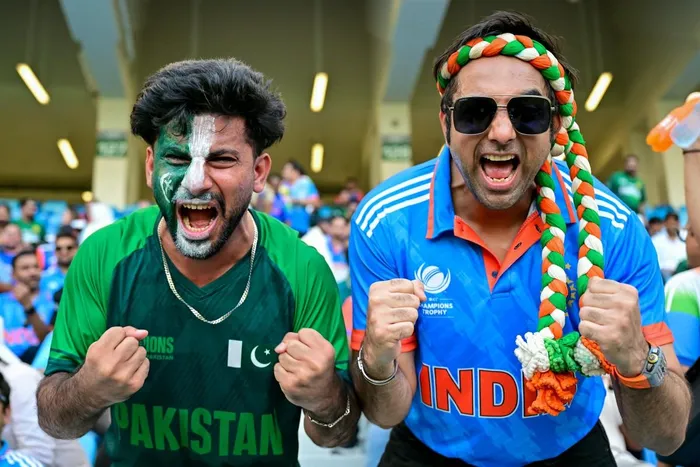
Pakistan and India fans may not get the opportunity to watch their teams face each other at the ICC T20 World Cup. | AFP
Image: AFP
COMMENT
In a utopia, sport and politics would not mix.
For sport is, in its purest form, is an escape from the realities of the every day; an opportunity to passionately immerse yourself into a universe far removed from a hum-drum existence.
The reality, however, is that sport is political. It’s in fact, modern-day diplomacy, with tribal support groups formed to cheer on teams in dedicated, modern-day colosseums. Add the business element — a multi-billion-dollar endeavour — and it becomes even more politically intertwined.
History has shown us the impact sport has had on the political landscape in our very own country.
The South African Council of Sport's Anti-Apartheid slogan, "No normal sport in an abnormal society", is a poignant reminder of how sport can be a powerful catalyst for political change. In the years leading up to the end of apartheid, sport boycotts effectively highlighted the injustices of violent segregation in South Africa, making it clear that the field can serve as a platform for significant socio-political commentary.
No major sporting events can escape its political nature. Events like the Olympics, Fifa World Cups and Cricket World Cups have all been affected, much like the upcoming ICC Men's T20 World Cup in India and Sri Lanka currently is.
In less than 18 months, South Africa will also co-host the next ICC Cricket World Cup with Zimbabwe and Namibia, which invokes memories of the 2003 tournament that was marred by political strife.
England forfeited their match against Zimbabwe in Harare, due to the diplomatic standoff between then president Robert Mugabe's administration and the UK, while New Zealand forfeited their match with Kenya in Nairobi after a suicide bomber killed 16 people in an attack on an Israeli-owned hotel in Mombasa.
Meanwhile, Zimbabwean duo Andy Flower and Henry Olonga wore black armbands to 'mourn the death of democracy' in their country during their opening game against Namibia.
Recently, Pakistan’s government has reportedly directed their cricket team not to play against India on Sunday, February 15, in the T20 world Cup, despite the match being scheduled at the neutral venue in Sri Lanka.
According to Cricinfo, participation in ICC events is governed by a Members Participation Agreement, signed by each participating ICC member. It states unequivocally that members commit to compete unconditionally, not only in all ICC events they qualify for, but also play every match scheduled in those events.
Should this forfeiture materialise, the ICC could claim Pakistan are in breach of this agreement, while Pakistan could exercise force majeure as reason for their withdrawal.
Financially, it'll have far-reaching implications, as the match is the centerpiece in the ICC’s $3 billion (about R65.66bn) rights deal with the media conglomerate JioStar. The reputational damage to cricket might be much higher.
Regardless, tensions are at their flash point.
Whereas in the past players from both sides viewed India v Pakistan matches as an opportunity to build bridges between these two politically charged nations, their geo-political tensions have now spilled over onto the field. Last year, India refused to shake hands with their Pakistan counterparts during the Asia Cup in the UAE.
It is, however, not only Pakistan that's been in conflict with India 'through' the Board of Control for Cricket in India (BCCI).
Bangladesh have already been replaced with Scotland in the World Cup, after the former's cricket board refused to allow their side to travel to India, citing security concerns on the advice of their government. This, in apparent retaliation after the BCCI instructed the IPL's Kolkata Knight Riders to release Bangladesh’s Mustafizur Rahman in early January.
Pakistan Cricket Board (PCB) chair Mohsin Naqvi, who is also a senior minister in the government of Pakistan, stated Bangladesh’s removal was an “injustice” and a show of “double standards” that favoured India.
In instances like these, the onus lies on the mother body, the ICC, to take a firm stand in order to maintain the integrity of the competition. But the ICC is led by Jay Shah – the former BCCI secretary — who is the son of the Indian home affairs minister Amit Shah.
The ICC have approached the association’s deputy chairman, Imran Khwaja, to act as a mediator in attempting to resolve the crisis but it may just be perfunctory.
Earlier this week, the ICC released an official statement where it implores the PCB to “consider the significant and long-term implications for cricket in their country". It also emphasised that “tournaments are built on sporting integrity, competitiveness, consistency and fairness, and selective participation undermines the spirit and sanctity of the competitions.”
These are all wonderful words in theory, but the time has now come for action to be taken to ensure the game is decided again by those playing on the field and not in state-owned government houses halls stalked by selfish law-makers.