

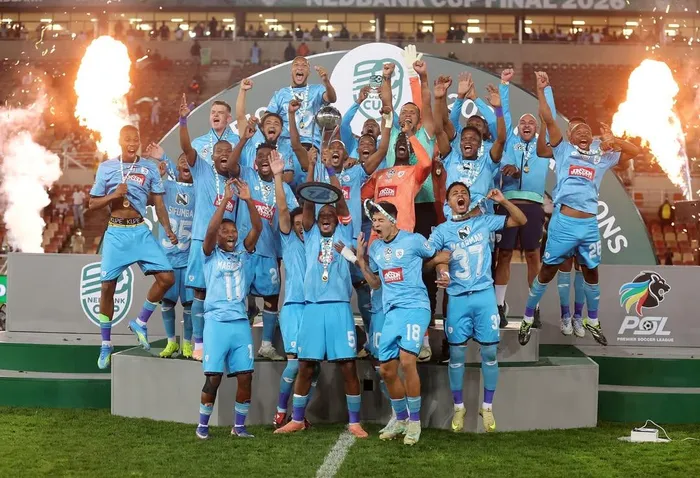
CHAMPIONS A province’s wait is over. Durban City FC make history as the first team from KwaZulu Natal to lift the Nedbank Cup, a moment of pure resilience that turns a bold gamble into a golden homecoming.
Image: Durban City
The Saturday afternoon sun was beginning to dip, casting a shadow across The Wordsmith, my home pub. The air in the room was heavy, thick with the kind of stillness that only a lifetime of shared personal history can produce.
Sitting across from me was the man who started it all. My father, Morgan Naicker, was a former defender who played at a decent level during the dark days of apartheid. At close to seventy, he still has an eye for a pass and reads the game with ease during our backyard matches with my boys.
He sat with a simple glass of Coke. I held something a bit stronger. Together, we were a two man vigil for a moment decades in the making. I do not get to watch many games with my dad these days, but this was the Nedbank Cup Final, featuring KZN’s very own Durban City FC against TS Galaxy.
Let me provide some perspective as to why this game mattered so much.
During my younger days, we spent countless Saturdays and Sundays anchored to the screen, immersed in the exploits of teams like Manning Rangers, Umtata Bush Bucks, and Hellenic. I purposely omitted the Soweto giants, Kaizer Chiefs and Orlando Pirates or even Mamelodi Sundowns, my dad always seemed to fancy the smaller team or the fight of the underdog. Those afternoons were my education; they ignited a desire in me not just to play the game, but to eventually find a way to tell its stories.
It was in those moments, watching with my dad, that my journey into journalism began. Throughout almost two decades in the industry, I have striven for the objectivity the profession demands, but on this night, the lines blurred. I wasn't just a journalist; I was a KZN man watching a local resurrection.
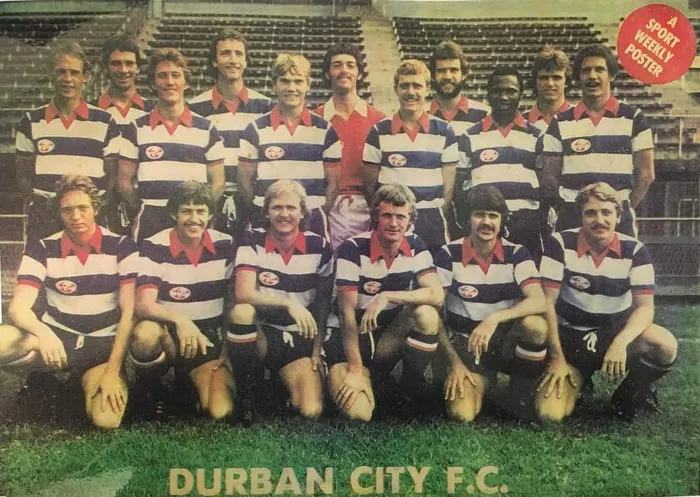
THE ORIGINALS A bridge across time. The 1978 Durban City side, a powerhouse of a different era, whose name has now been resurrected to anchor a new legacy.
Image: Supplied
We caught up as the early knockings of the match unfolded. As both teams found their feet, anxiety pierced through the air. Then, against the run of play, TS Galaxy grabbed the lead. A familiar silence settled; it felt as though the ghost of our province’s long standing heartbreak was tightening its grip once again.
It is important to that it has been 17 years since a KZN side won a major trophy. Back in 2009, Golden Arrows lifted the MTN8 title by thumping Ajax Cape Town 6-0.
As we watched the battle on the pitch unfold, my father began to peel back the layers of the past. He spoke of the original Durban City of blue and white hoops who played in the whites only National Football League, Norman Elliott’s powerhouse that existed in a world of divided grandstands and imported stars.
Every so often, the heavy atmosphere of the pub was punctuated by the arrival of my son, Quade. An Orlando Pirates fan through and through, he kept drifting in to check on the action, his youthful energy a reminder of how the game continues to bridge generations, even when allegiances differ.
For my dad, the true pulse of the game was always found elsewhere. He recalled the Wednesday evening bus from Verulam where he grew up, a pilgrimage not to see Elliott’s men, but to watch his team, Verulam Suburbs, in the Federation Professional League (FPL) at Curries Fountain.
That was the league of the people, a non-racial defiance against a fractured country where the talent was immense but the recognition was scarce. He spoke of the grit required to play in the FPL, a world away from the professional polish on the screen, yet essentially connected to the team we were shouting for now.
In that moment, the resurrection of the "Durban City" name felt like a bridge being built over a historical chasm, merging the community spirit of the FPL with the professional legacy of the old NFL.
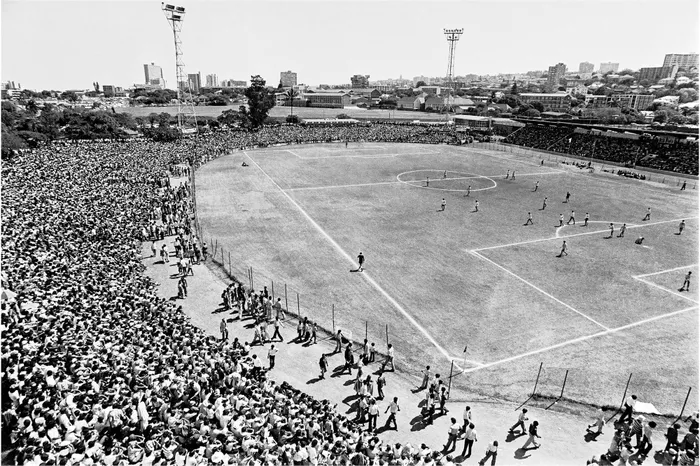
LEGACY The cradle of the non racial game. Curries Fountain, where the heart of the Federation Professional League beat loudest and where dreams were forged in defiance.
Image: File
This rebirth was anchored by another father and son. Farook Kadodia and his son Younus, alongside their ambitious board, had shown immense courage to reach this point.
Two years ago, their 21 year journey in Pietermaritzburg as Maritzburg United reached a painful crossroads. Relegated and feeling abandoned by local commercial interests, they made the gut wrenching decision to move to the coast. It was a gamble that risked alienating their history to save their future, but as the game turned, it was clear they had revived a province’s soul.
The team, mirroring the resilience of the Kadodias themselves, refused to buckle.
They fought back, the equalizer bringing my father to the edge of his seat. When the winner went in, a wild strike by Congolese forward Jean Lumumba that seemed to carry the collective momentum of every KZN side that had come before, it finally broke the dam.
"Just hold on," my father shouted as the clock edged towards full time.
In the colours of Maritzburg United and their legion of fans, the Team of Choice had been to two major finals before.Both of which they lost, the first of which a one nil defeat in the same competition to Free State Stars in Cape Town while the other was a Telkom Knockout to Mamelodi Sundowns in Durban.
The Kadodia family who have sacrificed so much to stay in the big time were on the brink of their magnum opus.
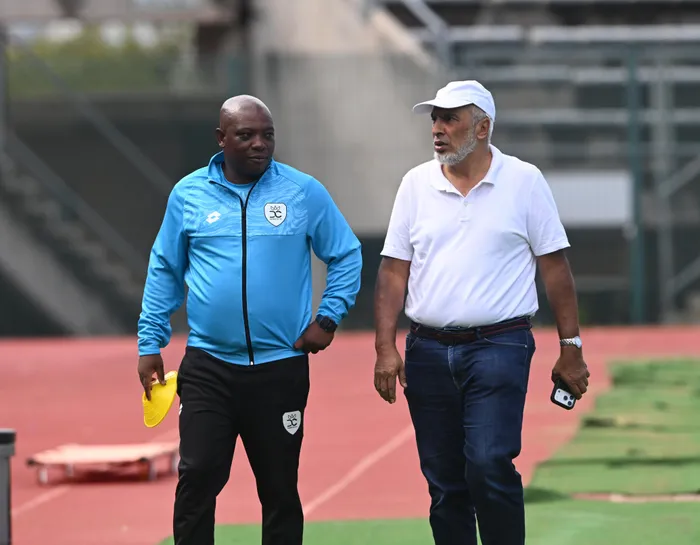
TACTICAL The architect and the tactician. Chairman Farook Kadodia’s unwavering courage provided the foundation, while Pitso Dladla steered the final steps.
Image: BackpagePix
When the final whistle blew, Durban City hadn't just won a trophy; they had completed the longest homecoming in South African football.
For the first time, the Nedbank Cup was coming to KwaZulu Natal. I looked at my father, the man who taught me to love a game that didn't always love us back. He didn't need many words. The clink of the ice in his glass and the quiet, steady nod of his head said it all.
The game has a cruel way of erasing its legends. Throughout my career, I have watched the pillars of our local game crumble; names like Manning Rangers, Umtata Bush Bucks, Hellenic, and Ajax Cape Town have all slipped into the quiet of the history books, now defunct and relegated to memory.
Yet, in the middle of that wreckage, the Kadodias and the spirit of Maritzburg United found a way. They had the courage to shed their skin, to reimagine their identity as Durban City, and to evolve when the world seemed set on their extinction.
It is a reminder that football is a lot like life: we must adapt to survive, and we must grow to succeed. As the trophy was hoisted high, it was clear that every setback, every relocation, and every tear shed along the way was simply the price of a historic rebirth.
In the sanctuary of The Wordsmith, the divide between the old leagues and the new era had finally been bridged.
I’ve spent years searching for the right way to describe KZN’s place in the sun.
As it turns out, I just needed to be sitting in a pub with my dad to finally find it.
* Myron Naicker is an award winning South African journalist. He is a multi-faceted storyteller with extensive work in television, radio and print journalism.
** The views expressed do not necessarily reflect the views of IOL or Independent Media.