
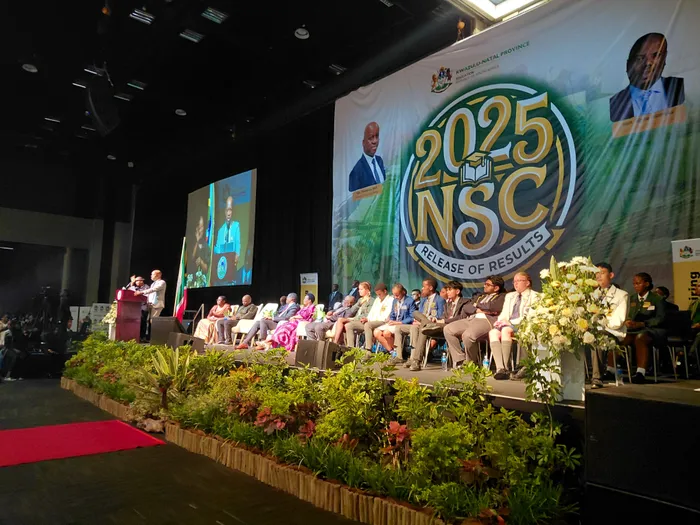
KwaZulu-Natal's top 10 Matric achievers were honoured in an event organised by the KwaZulu-Natal Department of Education at the Inkosi Albert Luthuli Convention Centre in Durban to celerate their academic excellence. The writer argues that the province's 90.6% pass rate results making KZN the best achieving province for 2025, masks a deeper education crisis.
Image: XOLILE MTEMBU

Zwakele Mncwango KwaZulu-Natal Chairperson of ActionSA
Image: File
KwaZulu-Natal has emerged as the top-performing province in the 2025 matric results, and the learners who achieved this outcome deserve sincere congratulations. For many young people, this success was achieved despite poverty, overcrowded classrooms, and limited resources. Their achievement reflects resilience, discipline, and determination.
However, celebration should not be confused with resolution. A high matric pass rate, while encouraging, does not automatically translate into a healthy or equal education system. Behind the headline figures lies a far more troubling reality, especially for learners in no-fee and rural schools.
Across KwaZulu-Natal, many schools continue to operate under severe constraints. Crumbling infrastructure, overcrowded classrooms, and unsafe sanitation—including pit toilets—remain common. These conditions undermine dignity and compromise effective teaching and learning.
For many learners, education is further disrupted by inadequate scholar transport. Long and unsafe journeys to school leave learners exhausted before lessons even begin. Absenteeism and dropout rates are highest in these communities, not because learners lack ability, but because the system consistently fails them.
School nutrition programmes, a lifeline for learners in no-fee schools, remain inconsistent and vulnerable to administrative failures. Hunger and learning cannot coexist. Expecting strong academic outcomes from hungry children is neither realistic nor just.
Equally important is what the pass rate does not reveal. Thousands of learners drop out long before reaching Grade 12. When we celebrate pass rates, we rarely ask how many learners started the journey but never reached matric. In this sense, pass rates mask the true scale of the crisis.
The inequality between rural and no-fee schools and former Model C schools remains stark. Access to libraries, laboratories, digital resources, and experienced teachers is still determined largely by geography and family income. This unequal education system reproduces inequality across generations.
Adding to this crisis is the failure to deliver basic necessities. Many schools in KwaZulu-Natal have not received stationery or norms and standards budgets on time. Teaching and learning continue without essential tools, yet we are expected to applaud outcomes as if conditions are normal. They are not.
ActionSA believes education must be the great equaliser in our society. Every child, regardless of family income or location, deserves access to quality education. Improving outcomes requires targeted investment in infrastructure, reliable scholar transport, protected nutrition programmes, and proper resourcing of schools.
Teachers and learners remain the real heroes of any success achieved under these conditions. It is deeply concerning that politicians often claim credit for pass rates while ignoring the daily struggles faced in classrooms.
KwaZulu-Natal’s top ranking should inspire urgency, not complacency. True success will be measured not by pass rates alone, but by reduced dropout levels, safe and resourced schools, and a narrowing gap between privileged and disadvantaged learners.
(Mncwango is KwaZulu-Natal ActionSA Chairperson. His views are not necessarily those of the Sunday Tribune or IOL)