

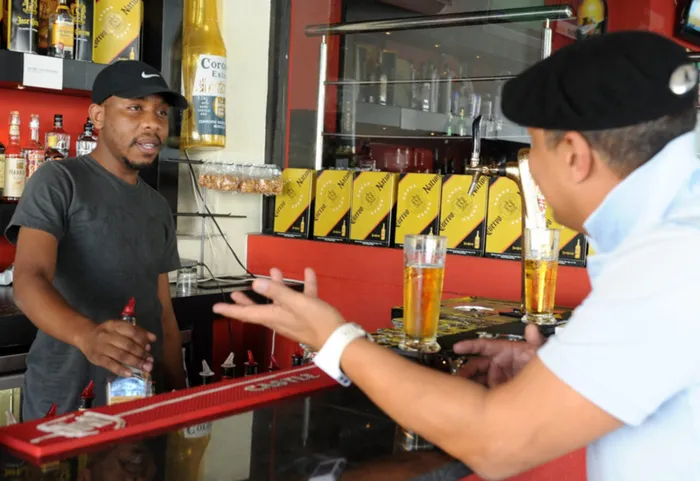
FIXING A DRINK: Barman Paul Musa and customer Michael Abrahams inside Tommy's Sports Bar. Banning alcohol advertising due to alcohol abuse is a knee-jerk reaction, says the writer. Picture: Tracey Adams FIXING A DRINK: Barman Paul Musa and customer Michael Abrahams inside Tommy's Sports Bar. Banning alcohol advertising due to alcohol abuse is a knee-jerk reaction, says the writer. Picture: Tracey Adams
Recent newspaper reports have intermittently carried news that our Minister of Health, Aaron Motsoaledi, is deliberating over a possible ban on all forms of alcohol advertising. Initially I dismissed this as yet another posturing by a government official out to impress with the resolve to create better health for all.
It was unlikely to be ever implemented, so I hoped. Only when I read about this again recently in newspapers, showing our bespectacled minister venting his spleen, I finally put my beer glass down and took notice.
The man seems serious!
While I appreciate the rationale behind this well-intended move, I wondered whether the honourable minister has thoroughly applied his mind on the possible side effects of such a ban.
Has he equally weighed the pros and cons of the likely ban?
Then I wondered about the eerily deafening silence from the liquor and advertising industries. After all they have a vested interest in the matter and should fight for their place under the bright Mzansi sun.
They are revenue earners for the government and have some leverage.
What about trade unions? Should they not be worried about the effect of such a ban on employment?
Is anyone out there really interested?
Here we are standing on the eve of a potential bureaucratic bungle that could result in the shedding of thousands of jobs and the liquor industry and other affected stakeholders are nonchalantly shrugging off their collective shoulders.
My brief research on the reasons for this seemingly suicidal indifference and deafening silence elicited a strange response. The general belief is that there is a sense of déjà vu as this has happened before with cigarette companies some years back. It is thus a cynical foregone conclusion that the liquor industry will follow the same route, “ noma kanjani” (whether we like it or not).
I can almost hear them muttering under their alcohol-laden breath, at corporate cocktail parties that if the government is prepared to sacrifice employment of thousands of its own citizens (read voters), then this is none of their concern.
Well, I am a concerned citizen.
The comparison with the cigarette industry is not just unfortunate and opportunistic but also inaccurate. While the dangers of cigarette smoking have been well documented in medical journals, their negative impact cannot be equated to that of alcohol, which if imbibed moderately poses no health nor social problems to drinkers and society alike. Certain alcoholic drinks such as sorghum (African) beer and red wine even have medicinal properties.
While I do not attempt to deny that abuse of alcohol is becoming endemic in our society, I do not see how a ban on its advertising could help reverse the trend. Abuse of alcohol like most forms of addiction has a complex socio-economic and psychological basis that cannot just be remedied by something as simple as a ban on alcohol advertising.
Advertising in most instances merely serves to reinforce behaviour such as drinking that is already there, rather than persuade drinkers to indulge more or recruit new drinkers. If advertising was all that encouraged intake of substances, then this country would not have the fast-growing addiction to illicit drugs such as tik, cocaine, nyaope and mandrax that are fast proliferating underground on word -of-mouth alone.
To blame advertising for our high consumption alcoholic drinks on advertising is, in my opinion, a red herring and its banishing will hurt, more than help, our economy.
I would also like to see extensive research done to prove a link between advertising and alcohol abuse.
In a country such as SA, which is sports-loving, a ban on advertising will have a disastrous effect on the promotion of our sporting codes especially soccer, rugby and cricket.
Think of all imported sports programs such as the Uefa Championship and you shudder at what is likely to happen.
Should this ban become reality, SA should forget ever hosting big events such as Formula One Motorsport, tennis and golf. This will greatly damage our developmental programme as a sporting nation.
The government can and should try to control alcohol abuse. This can be done in a variety of ways. The government should start by limiting easy accessibility to liquor by reversing some laws. Why do we have laws today that permit outlets such as supermarkets to carry and sell alcoholic beverages at all times even on Sundays and Public Holidays? This law could be done away with tomorrow because it was not like this in the past.
Previously, bottle stores were the only retail outlets for alcoholic drinks and operated under strict conditions such as restricted trading hours. Why has this changed? Now that we are sitting on a time bomb of alcoholic abuse the powers that be chose to focus only on one direction, which is a ban on advertising.
The proliferation of shebeens, taverns and pubs needs to be checked too, ensuring that they are properly licensed, remain compliant to the country’s liquor laws such as not selling alcoholic beverages to under-aged people. Diligent policing to ensure compliance is required. The government should realise that it is the easier access to alcoholic drinks that is the main problem, and not advertising.
While at it, the government should legislate against the production and selling of the so-called Fabs – flavoured alcoholic beverages. This is a wolf in sheep’s clothing – alcohol disguised as fruit juice or cooldrink but with the effect of a wild horse kick.
These Fabs are targeted mainly at the younger entry-level drinker and resonate well with their youthful palates.
The result is that these kids gulp down the Fabs like cooldrink with disastrous effect. This could be one reason SA has such a high motor vehicle crash rate in this age category. It is thanks to the greedy and some socially irresponsible liquor companies. These are practices that need to be checked.
Thus while I support the minister’s call for a reduction in intake, I do not believe advertising has much to do with it. We need a balanced view to tackle the problem of high intake of alcohol in our society. In a country with such high unemployment, the government should act cautiously, not in a manner that could negatively impact on employment growth, unless they are certain of a positive outcome.
As a country we cannot afford to see any more thousands of employed thrown out onto our streets. What we need right now is cooler heads and an integrated approach to try and resolve the problem of alcohol abuse and not a knee-jerk grandstanding gesture from government officials. This might cause more harm than good and act contrary to the government’s resolve to tackle our high levels of unemployment.
n Maisela is a management consultant and author of published novel The Empowered Native