

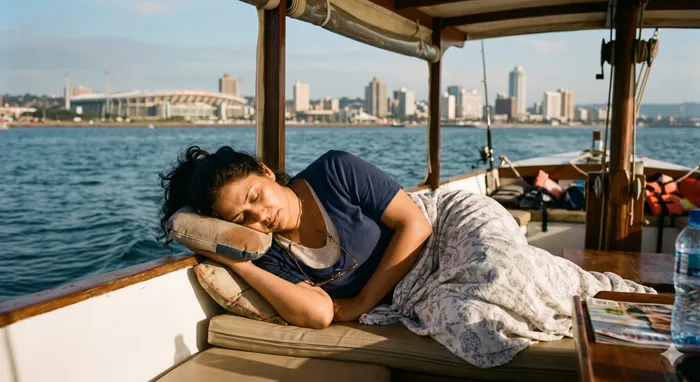
The writer recalls once falling asleep on a boat in Thailand.
Image: Google Gemini
I ONCE fell asleep on a moving boat in Thailand. Not peacefully sunbathing, but proper, head-nodding, can’t-keep-my-eyes-open sleep. I was 39, on holiday, surrounded by everything that should have made me feel alive. Instead, I was exhausted. I blamed it on too much swimming, too much sun, too much fun. Looking back now, that may have been the beginning.
Then came 2020. Lockdown turned us all into chefs. Between banana bread, breyani experiments and no gyms, I gained a few kilograms. I told myself it was normal. Pandemic life. Comfort eating. Less movement. Except the weight didn’t behave normally. I worked hard to lose it and briefly reached my goal weight, but I couldn’t maintain it.
I was constantly tired, demotivated, and slowly becoming a version of myself I didn’t recognise. By December 2021, I knew something was wrong. My doctor diagnosed depression. I was prescribed sleeping tablets, antidepressants and Ashwagandha, because apparently that fixes everything from stress to load shedding. It didn’t fix me.
In fact, I got worse. I struggled to stay awake while driving. My energy dipped at work, and I relied on sugar to get through the day. Quick fixes followed by crashes. A cycle I couldn’t break. I felt disconnected from myself. I hated my body. Some days, I was so overwhelmed I even resented the people I loved most. And the question that kept coming back was: why does everyone else seem fine when I feel like I’m falling apart?
I suspected menopause more than once, but at 42 I was told it wasn’t possible. Instead, I was tested for everything else, and my medication was changed repeatedly. By then, I was spending close to R5,000 a month trying to feel like a functioning human being. Still, nothing changed. In 2023, I cut out sugar. I exercised six days a week. I did everything right. Yet I was still exhausted, still holding on to weight, still waking up drenched in sweat, which I was told were panic attacks. More medication was suggested.
By 2024, after four years of feeling like a stranger in my own body, I’d had enough. I walked into my doctor’s office and insisted on an FSH (follicle-stimulating hormone) test. After doing my own research, I learnt that while perimenopause is diagnosed mainly through symptoms, hormone levels can help confirm it. When the results came back, my doctor was surprised.
“But you look so young,” he said.
And that’s exactly the problem. Perimenopause doesn’t care how young you look. It doesn’t follow a script. Despite affecting every cell in a woman’s body, it remains one of the most under-discussed areas of health. With the right information, I chose to start hormone therapy. My treatment included progesterone and oestrogen gel to manage symptoms, protect bone density, and stabilise my mood. The difference was life changing. I got my energy back. I could focus again. The stubborn belly fat started shifting, and my libido made a very enthusiastic return.
Now, as I approach 46, some symptoms are creeping back in. But this time, I understand what’s happening. Menopause isn’t a moment, it’s a transition. These days, I support my body in multiple ways. Alongside hormone therapy, I take vitamin D, magnesium, iron, and a B-complex supplement. I prioritise movement, especially strength training, because maintaining muscle is essential for bone health. There is no one-size-fits-all solution. Every woman’s journey is different. And then there’s the medical aid reality, covering pregnancy long after your eggs have retired, but not the hormones you need. That’s a conversation many of us are starting to have.
Because if there’s one thing I’ve learnt: we cannot do this in silence. The more we talk about it, the more we realise how many of us are walking the same path, especially women in their forties trying to hold everything together while their bodies are shifting beneath them. That’s why spaces where women can share openly, matter. Whether it’s a conversation with a friend or an online community where you can laugh, vent and learn, it all helps.
I started one such space, Women of the Pause, after realising how many of us were searching for answers alone. It has become a place where women support one another, share advice, and find humour in the chaos. Because sometimes, the only way to survive a 3am hot flash is to laugh about it later. And if there’s one piece of advice I’d leave you with: don’t take life too seriously. None of us are getting out alive anyway. If you want any advice or just to talk, reach out to me on [email protected] or find me on my social media.