

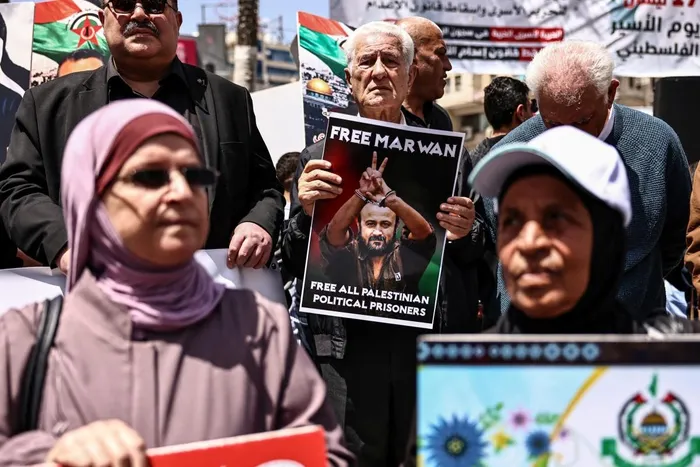
Palestinians hold pictures of prisoners held in Israeli jails, including jailed Palestinian leader Marwan Barghouti, during a rally in Ramallah in the occupied West Bank, to mark Prisoners' Day and to protest against the Israeli parliament's approval of a new death penalty bill for Palestinians convicted of deadly attacks.
Image: AFP
POPPING open a bottle of champagne, chinking glasses, wide grins and the sounds of laughter. A group of men patting one another on the backs and celebrating. The video goes viral on social media. It is March 30, 2026.
You would easily be forgiven for thinking that the group of men, clad in suits, had just closed a major multimillion-dollar business deal. Whatever was going on in this video, the joy was explicit.
Leading this celebration is the unmistakeable face of Ben Gvir – the hardliner far-right extremist Israeli minister of national security. This was no ordinary occasion like the kind many, if not most normal people, would celebrate: birthdays, a new job, a birth of a baby. Gvir was toasting the newly-passed death penalty law in the Israeli Knesset. A law, very precise in its wording, a brutal indictment on paper.
Death by hanging for acts the government deems that "negate the existence of the State of Israel". A sentence reserved exclusively for Palestinians. No appeals, no open and transparent court proceedings. Ninety days in which to carry out the state-sanctioned murder.
Israelis who may commit identical acts that a Palestinian will be hanged for, however, will get a better deal. At most a discretionary life imprisonment. Simply put, in the West Bank where Palestinians face daily horrors of ongoing violent harassment, being forced out of their homes and in many instances killed just for being Palestinian, where Israeli settlers run riot carrying out these reprehensible acts, the Israeli at worst may suffer the inconvenience of life imprisonment, if even that, for their heinous crime.
A Palestinian, however, who chooses to defend themselves, their families or home will be convicted as a terrorist, and be hanged for the audacity of autonomy and self-defence. Whataboutists and supporters of the genocidal apartheid Israeli state could argue in mitigation of this modern-day state-sanctioned crime: "well what about other countries that also impose the death sentence?"
Good question. Valid. Of the 54 countries, which according to Amnesty International that retain capital punishment, there are none that apply it based on race or religion. Even if we took the worst-case scenario like Saudi Arabia, for example, where executions are not always carried out with due legal process, which is another and separate human rights argument on its own, the punishment is not exclusive to persons only from specific ethnic backgrounds.
Sounds crazy, but as much as these countries can be accused of human rights violations, they don’t discriminate when it comes to carrying out the death penalty. Not in Israel though, the lives of Jews are sanctified and protected.
In the USA, the death penalty for specific federal terrorism/murder cases is fully discretionary, and those sentenced to death have the right to appeal. A right that is also applicable to foreign nationals. This appeal process could take anything up 20 years to reach a final verdict to uphold the death sentence or not. Not in Israel, though. Ninety days to hanging. And no room for appeal.
India and Pakistan, where the death sentence is sometimes mandatory in some cases, it is a uniform application and often a lengthy process. Not in Israel though, the so-called "only democracy in the Middle East".
An oxymoron (if you wish to be diplomatic or speak in muted and measured tone) or you can be real and acknowledge it for what it is, unadulterated Western-sponsored Nazism exported as Jewish safety, exploiting one holocaust to defend another happening in real time – the undisputed fact remains, Israel is now the "only democracy" in the world to reintroduce and expand capital punishment in the 21st century, putting on paper a legally-binding system, designed to treat Israelis explicitly lightly, while Palestinians will pay with their lives for simply being Palestinian.
There is no cladding this differently. A textbook definition of discrimination based on ethnic and national identity. Something South Africans are all too familiar with. It was called apartheid. Enshrined in law and baptised by religion. And the world’s self-appointed "most moral army" and "only democracy" in the Middle East reeks of the stench of it. Israel is operating straight out of the apartheid handbook – a manual that should have been relegated to the fires of hell never to be repeated.
Human Rights Watch calls it "cruel" and "a bill that aims to kill Palestinians faster and with less scrutiny". The UN amplifies this, "a law that effectively singles out Palestinians for execution, conveys that Palestinian lives are less worthy of legal protection".
Amnesty International is clear, "the law further empowers Israel’s system of apartheid". But don’t just take their word for it. Rabbis for Human Rights and several other respected and recognised Israeli human rights groups have spoken out, describing the Palestinian death penalty law as the "beginning of a troubling new phase of Israel’s oppression".
B’Tselem, a leading Israeli organisation, summed it up best: "Israel is reaching a new low in the dehumanisation of Palestinians enshrining their cruel treatment in state law."
But here we are. In 2026, debating and discussing the value of Palestinian lives, the Palestinian right to exist, the Palestinians' right to freedom, the Palestinians desire for statehood and the Palestinians' right to defend themselves when confronted with Israeli extremists/settlers, even when the reality of rape and violent death hangs over them, the Palestinian must resolve to remain subservient. Die if they do. Die if they don’t.
** The views expressed do not necessarily reflect the views of IOL or Independent Media.